
Somewhere between refreshing your visa portal for the fifth time this week and rereading your SOP for typos, the gravity of the situation sinks in. That getting into the university of your dreams was the easy part. Because the real test, the one that will determine if you’re relocating in six months or still studying at home, is the visa interview. Global student mobility reached 6.9 million in 2024 and is poised to cross 10 million by 2030, according to UNESCO, but a growing number of international students are looking elsewhere now that Canada, the UK, Australia, and New Zealand have cracked down on their immigration policies. This blog on the best countries for international students provides insight into six Study Abroad-friendly nations. We’ve covered everything from visa approval rates to tuition fees and post-graduation opportunities, arming you with hard figures to help you finalise your shortlist of study abroad destinations. Think of this article as your comprehensive guide to study abroad requirements and a curated list of options for you to consider. By the end, you’ll know exactly which of these count as the easiest countries to study abroad for your specific budget and course.
“The future of higher education is global, digital and mobile.” ~ Stefania Giannini, UNESCO Assistant Director-General for Education
Countries That Accept International Students Easily at a Glance
Before diving into each one, here’s a quick list of countries that accept International students easily, and also happen to be six of the most student-friendly countries in the world for universities accepting international students without the years-long application and paperwork process, and six of the most commonly cited countries in any comparison of countries with high visa success rates.
| Country | Visa Success Rate | Top Universities | Average Tuition Fees (per year) |
| Germany | High – mostly document-based, no interview for most applicants | TU Munich, LMU Munich, Heidelberg, RWTH Aachen | €0–400/semester (semester contribution) at most public universities; €1,500/semester (€3,000/year) in Baden-Württemberg |
| Ireland | High for compliant applications; paper-based review (INIS) | Trinity College Dublin, UCD, UCC | 15,000 – 23,000 EUR (up to 30,000 EUR for STEM) |
| Singapore | Efficient Student’s Pass process; university admission itself is competitive | NUS, NTU, SMU | 17,650 – 32,550 SGD (£10,300 – £19,000) |
| Malaysia | ~90% approval through EMGS, the government’s own gateway | University of Malaya, USM, UTM | 2,000 – 17,000 USD (excluding medicine) |
| France | 90-95% for complete applications, says Campus France, partner agents | Sorbonne, PSL, Sciences Po | 178 – 3,941 EUR for public universities depending on nationality and level |
| UAE (Dubai) | High – GDRFA-run, university-sponsored, no visa interview | Khalifa University, AUS, UAEU, NYU Abu Dhabi | 30,000 – 120,000 AED (£6,500 – £26,000) |
In short, this shortlist features six of the most reliable countries that accept international students easily and provides some context as to why. From Germany’s relaxed bureaucratic approach to international students to Malaysia’s EMGS system, this shortlist is sure to rival any list of easiest student visa countries you can find elsewhere. It is also important to note that being one of the cheapest countries for international students and one of the countries with a high visa success rate for students are not necessarily mutually exclusive, which Germany can also boast of, and hence why it tops this list.
What Makes a Country Easy for International Students
An “easy” study abroad destination does not mean an easy one; it means the study abroad requirements are clear enough that a well-prepared applicant will know what to expect, rather than being at the whim of a visa officer. Six factors determine the list of easiest countries to study abroad in, and the same six determine the difference between genuine and fake easy study abroad countries.
The student visa process
It is another critical factor, with fewer discretionary steps (interviews, personal appearance, etc.) resulting in higher predictability of outcome and therefore easier application. Germany and the UAE are both heavily document-based, which is why they score particularly high on this criterion and appear as some of the easiest student visa countries to enter. Malaysia only allows the visa to be applied through one official government portal, EMGS, as opposed to embassies, making it one of the more genuine countries with easy student visa systems in Asia. Ireland and France both have primarily paper-based systems, but allow for a clarifying interview if one’s documents seem to be incomplete in any way, thus landing them significantly higher than most easiest student visa countries lists that only look good on the surface.
Admission Requirements
Countries with a wide range of public, private, and branch-campus universities (Malaysia and the UAE especially) tend to have entry points at multiple levels, so that a lower than average school-leaving score is not a total barrier to international student admissions; and Germany’s mixture of technical universities (Fachhochschulen) and research universities also serves to broaden participation, beyond the small number of elite institutions.
English Language Requirements
France and Germany require a certain proficiency level in their respective languages for any course of degree instruction taken there in French or German, but programs taught in English are on the rise in both countries, and are also widespread in Malaysia and Singapore, both of which are effectively English-speaking countries, so studying abroad without IELTS is available if you were educated in English. Study abroad without IELTS is also an option in Ireland and the UAE, where other English language tests or a previous education using the English language can sometimes be substituted for an IELTS exam, which represents another pathway that makes studying abroad without IELTS possible for more students than many realise.
Acceptance rates
This factor varies significantly from country to country, as well as among universities within the same country. At the same time, the proportion of foreign students accepted at Singapore’s National University is about 5-10%, which is comparable to Ivy League schools; a significant number of students from both local and foreign universities have an opportunity to be accepted, in particular, this is the case for Malaysia’s public universities and smaller technical colleges in Germany, making these countries the best countries for international students on cost-adjusted terms.
Availability of Scholarship
Germany’s DAAD, France’s Bourse Eiffel, and Ireland’s Government of Ireland International Education Scholarships all provide a direct subsidy for non-EU students, which is even more important than it may seem, differentiating the countries offering scholarships from countries that just advertise them. Apart from the GEMS nations, Malaysia and the UAE offer similar scholarship programs at the university level, so it is advisable to check the countries offering scholarships page directly once.
Post Study Work Opportunities
An easy visa is less valuable if you are thrown out within days of graduation. Germany’s 18-month job-seeker visa and Ireland’s 1-24-month Stamp 1G are two of the longest among all countries with post-study work visa options anywhere in the world. France’s APS/RECE and the UAE’s Green Visa make a list of four that can be considered as countries with post-study work visa policies, as opposed to requiring students to secure their own sponsorship upon arrival.
Taken together, these six signals are an attempt to distinguish between genuine countries that are welcoming to international students, and those that are only welcoming on paper, at least from the perspective of a marketing brochure. A potential host country may excel on one or two characteristics, but fail on others, which is why it’s so important to look at all six factors before choosing a destination based on its supposed ease of entry for foreign students.
Top Countries that Accept International Students Easily
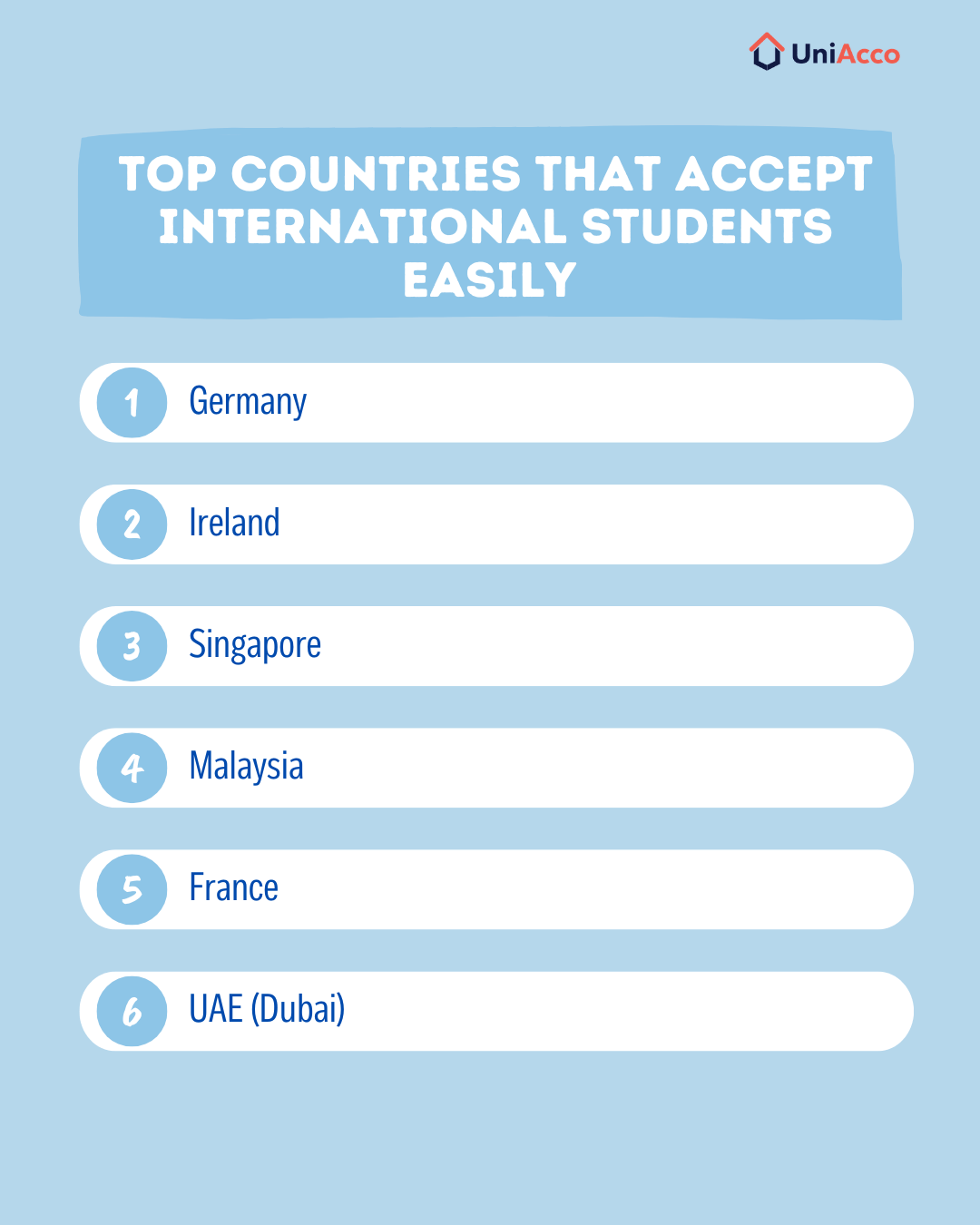
Here are the details on each of the six countries that accept international students easily, in the order that most students would consider them.
Germany
Germany is practically begging international students to come and study in the country: the only price to pay for getting a degree from a world-class university is a tiresome paperwork process called blocked account. The state of Baden-Württemberg is an exception, charging 1,500 euros per semester from non-EU students, compared to about 150-400 euros in other states, usually with a public transport pass included, reports the German Academic Exchange Service (DAAD) and the Alliance of German Rectors. For everyone else, the application process is refreshingly straightforward: present a confirmation of studies, enough cash on a blocked account (11,904 euros as of 2023), and health insurance, and you’re almost past the visa interview. More than 400,000 international students have already signed up for the winter semester 2024/25. Germany is the third-most popular study destination worldwide and, overall, consistently one of the countries with affordable tuition that students actually choose to study in Germany for. It is one of the few countries where students are willing to study in Germany for the duration of their qualification, be it a technical degree or a PhD. which is rare among universities accepting international students at this level of global ranking.
| Feature | Details |
| Top Universities | LMU Munich, TU Munich, RWTH Aachen, Heidelberg University, Humboldt Berlin |
| Popular Courses | Mechanical & electrical engineering, computer science, business administration, renewable energy |
| Average Tuition Fees | €0-€400/semester in most public universities, €1,500/semester in BW, up to €6,000/semester in some TUM programs |
| Intakes | Winter (October) and Summer (April) |
| Post-Study Work Opportunities | 18-month Job Seeker Residence Permit, no need for employer sponsorship during job search |
International students are drawn to Germany because the math simply can’t be beat: a world-class top-50 engineering degree with no tuition, in a country where you will be given one and a half years to find a job before needing one. Those two factors combined are what make Germany so often topping the list of countries that accept international students easily.
Still not sure? Read this Reddit thread and find out why international students choose Germany, answered by students themselves.
Why is Germany so popular for studying abroad? – r/Indians_StudyAbroad
Ireland
Ireland is a popular choice for international students because it is the only English-speaking country in the EU. The visa process is also fairly simple, with less paperwork and no interview in most cases. Ireland also offers one of the longest post-study work periods in Europe. From June 2025, students need to show that they have paid at least €6,000 towards their tuition fees and have access to €10,000 per year for living costs. Most long-stay study visa applications are processed by Immigration Service Delivery, with an interview required only in some cases. More than 35,000 international students study in Ireland every year. Trinity College Dublin, ranked 75th in the QS World University Rankings 2026, and University College Dublin, ranked 118th, are popular choices among international students.
| Feature | Details |
| Top universities | University College Dublin, Trinity College Dublin, University of Galway, University College Cork |
| Popular courses | Computer science & data analytics, business (Smurfit), pharmaceutical sciences, nursing |
| Average tuition fees | €15000-23000/year undergraduate, 25000-30000/year STEM |
| Intakes | September (main), January (limited programs) |
| Post-study work opportunities | Stamp 1G: 12 months for bachelor’s graduates, 24 months for master’s and above |
Students choose Ireland because they want to study in English and be able to obtain a graduate visa valid for a sufficient period to find a real job rather than just some months’ worth of opportunities. Additionally, it has become one of the most popular destinations to study abroad for Indian students in Europe. Apart from the IELTS exam, there is no need to take any other language tests. Apart from being paper-based, which plays a significant role in making Ireland attractive to immigrants, the country is among the most student-friendly nations in Europe for both bachelor’s (four-year) and master’s studies.
Singapore
Unlike the rest of these countries on the list, Singapore is slightly more complicated in its approach; the Student’s Pass issued from the ICA’s SOLAR system truly is one of the fastest and most efficient immigration procedures known to modern man, but getting into NUS or NTU in the first place is highly competitive, with international student acceptance rates of roughly 5-10% in the former. However, the advantage of studying in Singapore lies in the visa’s high chances of approval and the option of receiving the MOE Tuition Grant, cutting fees by 40-60% with an obligation to work for a Singapore-registered company for three years after graduation; both NUS and NTU are ranked 8th and 12th in the QS World Rankings 2026, greatly surpassing other Ivy Leagues.
| Feature | Details |
| Top universities | Nanyang Technological University, Singapore Management University, National University of Singapore |
| Popular courses | Computer science & AI, finance, engineering, business analytics |
| Average tuition fees | SGD 17650-32550/year (undergraduate, unsubsidised international student fee) |
| Intakes | August (main intake, most programs) |
| Post-study work opportunities | There is no specific work visa after studies; you apply for an Employment Pass or S Pass directly upon graduation. |
International students searching for the best place to get a degree choose Singapore for a good reason. A developed educational system and great job opportunities attract thousands of students every year. Moreover, more than 90% of NUS graduates are employed within six months after graduation. Additionally, the financial sector and technology companies offering competitive salaries for graduates are widespread in Singapore. The country is known for providing one of the best education systems in Asia. Since all courses are taught in English, it is possible to study abroad without IELTS. At the same time, Singapore is perceived as one of the most accessible countries that accept international students easily from the point of view of visas. In other words, there are excellent opportunities for finding a job after graduation from university and the best education systems in Asia.
Malaysia
If you are looking for a country with a high approval rate of visa applications, then Malaysia is probably the best choice, as the official Education Malaysia Global Services (EMGS) website approves almost all cases and deals with the matter alone, unlike other countries that have to turn to their respective embassies. More than 170,000 students from over 160 countries now choose to study in Malaysia, up sharply from around 130,000 just a couple of years ago, as the country pushes toward its official target of 250,000 international students, making it one of the top spots when looking at education options abroad. The main reason behind its popularity lies in its affordability – costs are much cheaper compared to most Western countries, where tuition fees range anywhere between $2,000 and $17,000 yearly (depending on the course) for non-medical subjects. Also, most of these English-taught programmes offer admissions starting with IELTS scores of 5.5 so that those with prior experience attending classes in an English-speaking country (like the IGCSE/A-levels system) won’t need to take extra tests. At the same time, official visa processing through the EMGS takes about four to six weeks, and students are allowed to work up to twenty hours a week outside the academic season.
| Feature | Details |
| Top universities | University of Malaya (QS #60, 2026), Universiti Sains Malaysia, Universiti Teknologi Malaysia |
| Most popular courses | Medicine (MBBS), engineering, business, Islamic finance |
| Tuition fees (approx.) | $2,000-$17,000/year at public universities (does not include Medicine) |
| Intakes | Feb, July, September (may vary per university) |
| Post-study Work Opportunities | Employment Pass Category III valid for up to 12 months with a confirmed job offer |
Students prefer studying in Malaysia because it offers value for money and prestige in the country. When it comes to postgraduate studies, English-taught and internationally recognised programs take precedence over everything else. This nation is frequently dubbed the cheapest country for international students due to its overall affordability for an extended period. It’s long been a reliable study abroad destination for Indian students precisely because so many courses do not require IELTS, provided that the applicant’s previous education was taught in English. Malaysia’s EMGS approval rating makes it one of the most welcoming countries for international students. Therefore, when comparing the cheapest countries for international students, Malaysia emerges as a serious competitor due to the combination of low tuition fees and relatively affordable rent and other costs to consider. That is why it frequently appears at the top of the list of desired countries to study for South and Southeast Asian students.
France
France as a land of bureaucracy is a thing of the past for students, as studying there now has an almost fully digital procedure through Campus France, and agencies representing Campus France report visa approval rates of 90-95 per cent for those with completed documents. Education there is also affordable, as the fees are set by the state and not the universities, so a Licence (roughly equivalent to a bachelor’s degree) for non-EU students costs 2,895 euros per year, while a Master’s degree costs 3,941 euros per year, according to the Ministry of Higher Education’s 2025/26 budget. These figures apply for the 2025/26 intake. A May 2026 government decree tightens the exemptions many universities had used to waive these fees for individual non-EU students; from 2026/27 onward, most new non-EU enrollees will be required to pay the full differentiated rate, so applicants targeting that intake or later should budget for it rather than count on an exemption. This makes France the most popular non-Anglophone study destination in the world, with 443,500 international students for the 2024/25 academic year, as well as giving graduates a year-long job search period (APS/RECE permit, renewable once). Students who come to France to study do so for the value, not the climate.
| Feature | Details |
| Top Universities | Sorbonne University, Université PSL, Sciences Po, École Polytechnique |
| Courses | Business & management, engineering, fashion and luxury management, culinary arts |
| Tuition Fees | The average tuition fee for a Licence at public universities is 2,895 EUR/year and 3,941 EUR/year for a Master’s programme, for non-EU students. |
| Intakes | September |
| Post Study Work Opportunities | APS/RECE permit: 12 months, renewable once, for master’s graduates (up to 24 months) |
International students are attracted to France because it offers the combination abroad of Sorbonne- or Sciences Po-level credibility at public-university prices, with a job search to match upon graduation. The French higher education system is considered one of the best education systems in Europe for this reason, as it provides a flat fee for tuition, which is the same country-wide for similar studies, regardless of whether the students study in a small regional University or in the capital city of Paris. Thus, it is one of the most competitive countries in Europe regarding international students and counts among the countries that accept international students easily in Europe.
UAE (Dubai)
The United Arab Emirates (UAE) has witnessed an enormous expansion in its higher education system, boasting over 70+ accredited universities with more than 100,000+ international students. Here, the process for getting your student visa is primarily sponsor-based, which means that your university will apply for your student visa on your behalf through either the GDRFA or ICP; then they’ll test you at the hospital, after which you should be granted your visa in 2-6 weeks without having to face a personal interview. Also, there’s no income tax, with tax-free income given to those who have landed approved part-time jobs. And the recent addition of the Golden Visa for high achievers adds to the list of reasons why these emirates are becoming an increasingly popular option compared to traditional choices such as the UK, Australia, etc. Khalifa University stands ranked 177th in this year’s QS World Rankings 2026. While the UAE holds 9 of the top 25 positions in the QS Arab Region Rankings 2026 amongst its higher education institutions.
| Feature | Details |
| Top Universities | Khalifa University, American University of Sharjah (AUS), UAE University, NYU Abu Dhabi |
| Popular Courses | Business & finance, engineering, artificial intelligence, hospitality management |
| Average Tuition Fees | AED 30,000-120,000/year depending on the university and level of study |
| Intakes | September (main) and January (secondary intake) |
| Post-Study Work Opportunities | Green Visa and Golden Visa for eligible graduates; no specific job-seeker visa category |
Students are choosing the United Arab Emirates for the reason of the tax-free income from their part-time job. It also has an international setting and a quick visa process instead of a challenging one. It’s also become a fast-growing study abroad hub for Indian students, due to their short travel time back to India and substantial Indian community in places like Dubai and Abu Dhabi. The sponsorship-based, interview-free visa procedure is also a prime example of how countries that accept international students easily actually operate.
Line all six of these places up together, and you will notice that none of them made this list based on name recognition. Each was found on the easiest countries to study abroad rankings for specific reasons that should be taken into consideration before choosing where to study overseas. The combination of a document-based visa, attainable tuition, or stay-back window gives each of these countries enough credibility to be considered as one of the leading study abroad destinations rather than only a last resort for study in the UK or study in Australia. If the reader wants to create a list of study abroad requirements for countries, these six consistently show up on comparative lists of countries with easy student visa processing precisely because their governments have simplified the paperwork rather than just marketing around it.
Whatever position you take on this list, having your accommodation booked before arrival can eliminate one major source of stress. With UniAcco, you can explore verified and affordable student accommodation in Germany, compare your options, and find fully furnished rooms with all-inclusive utility bills to make settling into student life easier.
Explore Student Accommodation in GermanyList of Factors to Consider Before Choosing a Study Destination
An easy visa is the most basic requirement, and once you have that, these nine factors will determine your success in the years that follow, be it in the comparison between the options on this list or with the more established programs like study in the UK, study in Australia, or study in Canada.
- Course availability – check whether your desired specialisation is taught in English at the universities you are interested in, not just the country in general, as a country may have a strong reputation in one field over another, e.g. engineering vs. social sciences.
- University rankings – QS and THE rankings are important for the third country student visa requirement in some destination countries after graduation, so strive to graduate from a higher-ranked institution if possible, as even 50-100 points can make a difference in some cases.
- Tuition fees – compare the total cost of a degree, not the yearly cost, as studying in Germany or another country with subsidised rates for three years can be cheaper than a year in a discount country, and consider comparing to other affordable countries to study abroad rather than just comparing the listed budget to your home country. Germany and Malaysia are the most obvious countries with affordable tuition on this list, but France also has a low, flat rate applicable to all public universities.
- Cost of living – Singapore and Dubai have the highest cost of living on this list, with Malaysia and Germany (apart from Munich and Berlin) being the most budget-friendly countries to live in outside of one’s home country, so compare this to the tuition fees when considering the overall cost of a foreign degree. A country may have a low tuition fee budget, but have a high cost of living that makes everyday expenses too expensive.
- Student visa requirements – check if the country’s student visa is interview- or document-based, as this is a much better indication of how straightforward the visa process will be than the general ease of obtaining a student visa for the country itself.
- Scholarships – DAAD, Bourse Eiffel, and Ireland’s GOI-IES scholarships can bridge the gap between the countries offering scholarships on paper and the actual value of money you would get after funding.
- Part-time work opportunities – most of the six countries allow part-time work opportunities for 20 hours a week, but the minimum wage and cost of living in the country decide whether the money earned will cover the rent or not.
- Graduate employability – Singapore’s 90+ per cent six-month employment rate for NUS graduates and the job market for engineers in Germany are the best among the rest, but only in the specific sphere that the country needs. It is essential to compare the employment rates for study in the UK and study in New Zealand and not automatically assume that the country with the more attractive name will offer better opportunities. Moreover, compare those to the graduate employment rates for study in Australia and study in Canada options, as they are also attractive, despite recent visa policy changes, and might have better chances for employment after studies.
- Permanent residency pathways – Germany, Ireland, and Singapore offer a realistic, but slow, pathway to residency for international students, while the UAE Golden Visa is a more recent program that only allows highly skilled individuals to stay in the country. It is also essential to consider the study in Canada and study in Australia PR options, as they used to be more straightforward and faster but have become competitive recently.
Keep in mind these nine factors even after you have shortlisted 2 or 3 countries that are easy on international students because ease of entry is only part of the challenge, and it’s good to remember that of the six countries listed above, four (Germany, Ireland, France, and increasingly the UAE) are now opening their doors to graduates and offering post-graduation work visas, which is more than can be said for many countries on your shortlist.
Comparing tuition fees is only half the story. Accommodation can make up a significant part of your student budget too. With UniAcco, compare verified properties and prices to find affordable student accommodation in Ireland that suits your budget, with fully furnished rooms and utility bills included.
Explore Student Accommodation in IrelandWhich Country Is Right for You?
If you can fit yourself into one of these five categories, the choice between countries that accept international students easily often becomes apparent.
- Budget-conscious students should strongly consider Germany (virtually no tuition) or Malaysia (low tuition and cost of living), two of the most popular destinations on this list for students on a budget, and arguably the two best value destinations for international students, on a purely financial level.
- Students seeking the most prestigious universities may be tempted by Singapore’s NUS/NTU or France’s Sorbonne and Sciences Po, which offer the most globally recognised degrees for a relative steal compared to studying in the US or UK.
- Students who want the easiest visa processes should look into Malaysia’s EMGS-backed process or Germany’s document-based visa, two of the most stress-free options on this list that require no interviews.
- Students who wish to stay in a country after graduation should consider Germany’s 18-month job-seeking visa or Ireland’s more generous 24-month Stamp 1G visa, while Singapore requires completing the three-year Tuition Grant bond before any work permit can be issued.
- Students who want to transition into permanent residency should strongly consider studying in either Germany or Ireland, which have well-established, if slow, student-to-PR pathways.
Found the country that’s right for you? Now find a student home that fits your budget too. Explore verified and affordable student accommodation in France with UniAcco, featuring fully furnished rooms, modern amenities, flexible options, and all-inclusive utility bills to make your student life easier.
Explore Student Accommodation in FranceWhatever profile you pick, all of the five options lead to the same shortlist of countries that accept international students easily, as covered extensively in this guide, with the only difference being which of the six options better suits your personal preferences. And if you have found none of the six profiles to your liking, apply the same criteria to any country with a post-study work visa, whether it appears on the aforementioned shortlist or not.
Conclusion
There is no favourite among the six, just an exact fit for your preferred annual budget, aspirations in terms of the prestige of the university you will attend, and the likelihood that you will want to stay there after graduation. If the budget has to come first, Germany and Malaysia are the countries that accept international students easily without demanding a premium for it, arguably the two easiest countries to study abroad on a tight budget, and two of the more affordable countries to study abroad you’ll find anywhere. When choosing between countries based on prestige, Singapore and France emerge as the most desirable destinations, as both offer excellent value for money and enjoy the best education system reputation in their domestic markets. Finally, when looking for the best student destination with post-graduation visa options, Ireland and Germany emerge as the most viable options with the most promising opportunities for staying after the studies are completed, and with post-study work visa access that actually works in practice. Any of these six countries should be considered when narrowing the list of potential student destination countries for study in Germany, study in Ireland, study in France, and elsewhere in the world for 2026 and beyond. When a country is selected, finding the best student accommodation becomes the next critical task, and UniAcco offers a solution by helping international students find a variety of student housing options at affordable prices and close proximity to universities across Germany, Ireland, France, and other international student destinations.


 LinkedIn





0 Comments