
Imagine someday your professor casually mentions a scientific theory that won him the Nobel Prize. Sounds like a movie scene, right? But for students at top universities, this is just part of their routine. Out of the roughly 1,000 individuals who have ever won a Nobel Prize since 1901, a massive percentage conducted their research at just a handful of elite American and British campuses. So, deciding where to study is a massive choice. Checking which universities have the most Nobel Prize winners is a smart way to find a place with strong research and funding.
This blog looks at the schools with the most Nobel Prize winners, breaking down their rankings, top subjects, and how studying at one of these universities can affect your daily student life.
Nobel Powerhouses: An Overview
Most universities with the highest number of Nobel Prize winners are in the United States and the United Kingdom. Here is a quick look at the top schools, based on historical Nobel data and the latest QS World University Rankings for 2027.
| University | Nobel Laureates | Country | QS World Ranking 2027 |
| Harvard University | 150 | USA | 5 |
| University of Cambridge | 126 | UK | 6 |
| Massachusetts Institute of Technology (MIT) | 101 | USA | 1 |
| University of Chicago | 101 | USA | 24 |
| Columbia University | 88 | USA | 43 |
| University of California (Berkeley System) | 75 | USA | 20 |
| Yale University | 72 | USA | 16 |
| University of Oxford | 58 | UK | 4 |
| Stanford University | 36 | USA | 2 |
| Université PSL | 28 | France | 34 |
Which University has the Most Nobel Prize Winners?
If you want to know which university has the most Nobel Prize winners, the answer is Harvard University. With 150 affiliations, it is far ahead of any other school worldwide. However, counting Nobel Prizes is not always simple. When you check different rankings, the numbers can vary from one source to another.
These differences happen because universities count affiliations in different ways. Some only include alumni who finished a full degree, while others count faculty, researchers, and even visiting professors who spent just one semester on campus before winning the prize. The numbers in this guide show total historical affiliations, so you can see which campuses regularly attract and produce top talent. Knowing which university has the most Nobel Prize winners also helps international students find where the most research funding goes.
Top Universities with the Most Nobel Laureates
Here is a closer look at the universities with the most Nobel Prize winners. We will go beyond the numbers to see what historical events and teaching styles make these schools leaders in research.
Harvard University
When John F. Kennedy lived in Harvard’s dorms in the 1930s, he studied alongside classmates who went on to change global politics and science. Harvard does not rely on its name alone. The university supports its students and staff with a massive $56.9 billion endowment. This money goes straight into advanced facilities like the Rowland Institute, allowing young researchers to skip years of waiting and run their own fully funded labs immediately.
- Nobel count: 150
- QS ranking: 5
- Notable disciplines: Medicine, Economics, and Life Sciences
- Research strengths: Biomedical engineering, macroeconomic policy, and gene-editing technologies
- Why students choose it: 100% need-blind financial aid for international students, direct access to the $56.9 billion endowment for undergraduate research grants, and unmatched global networking.
Also Read: List Of Top 20 Harvard University Notable Alumni
The University of Cambridge
If you walk down Free School Lane and look into the old Cavendish Laboratory, you will see the room where James Watson and Francis Crick discovered the double helix structure of DNA in 1953. Cambridge does more than teach scientific history; it helped create it. Its research success comes from its 800-year-old collegiate system. Students and top professors from different fields eat together every evening, often leading to new ideas in physics and biology.
- Nobel count: 126
- QS ranking: 6
- Notable disciplines: Physics, Molecular Biology, and Mathematics
- Research strengths: Theoretical physics, genomics, and quantum computing
- Why students choose it: The unique “supervision” teaching model where students meet in groups of one or two with top scholars every week to defend their coursework.
Massachusetts Institute of Technology (MIT)
Every year during finals, MIT students are known for creative pranks, like putting a full-sized police car on top of the Great Dome. This playful, innovative spirit also drives their labs. MIT’s motto, “Mens et Manus” (Mind and Hand), means students are expected to turn complex math into real projects. Instead of just reading about theories, 93% of graduates take part in the Undergraduate Research Opportunities Program (UROP), where even first-year students can get paid to build robots or write AI code with leading professors. This hands-on style helps keep MIT among the top universities with the most Nobel Prize winners.
- Nobel count: 101
- QS ranking: 1
- Notable disciplines: Engineering, Physics, and Economics
- Research strengths: Artificial intelligence, quantum mechanics, and robotics
- Why students choose it: Hands-on lab access from the first year and a strong focus on launching tech startups.
University of Chicago
On a cold December day in 1942, under the old racquets court at Stagg Field, Enrico Fermi and his team achieved the world’s first self-sustaining nuclear chain reaction. This bold approach to research is a key part of Chicago’s academic culture. The university is known for the “Chicago School of Economics,” a free-market theory that changed central banking worldwide. Instead of just listening to lectures, students are encouraged to debate and challenge their professors’ ideas using real data, which helps explain why Chicago is among the universities with the most Nobel Prize winners.
- Nobel count: 101
- QS ranking: 24
- Notable disciplines: Economics, Physics, and Sociology
- Research strengths: Quantitative economics, astrophysics, and urban sociology
- Why students choose it: Intense academic rigour, debate-based classes, and a reputation for strong data analysis.
Columbia University
In 1939, in the basement of Pupin Hall, scientists Enrico Fermi and Leo Szilard split the uranium atom for the first time in the United States, starting the atomic age. That spirit of high-level research still shapes Columbia’s Morningside Heights campus. Because Columbia is in Manhattan, its work is closely connected to the real world. Professors often split their time between running campus labs and advising organisations like Wall Street firms or the United Nations.
- Nobel count: 88
- QS ranking: 43
- Notable disciplines: Economics, Literature, and Physics
- Research strengths: Nuclear physics, modern literary theory, and applied finance
- Why students choose it: Direct internship pipelines to Wall Street and the United Nations, combined with the intellectual rigour of the 100-year-old Core Curriculum.
University of California (Berkeley System)
Did you know that at UC Berkeley, Nobel Prize winners receive a special blue parking spot on campus marked “Reserved for NL?” As a large public university, Berkeley produces a lot of important research. Scientists there have discovered 16 chemical elements, including Berkelium and Californium. Students can also use the Lawrence Berkeley National Laboratory, which has powerful government-funded supercomputers. The UC system’s strong funding is a big reason why it is one of the universities with the most Nobel Prize winners.
- Nobel count: 75
- QS ranking: 20
- Notable disciplines: Chemistry, Physics, and Molecular Biology
- Research strengths: CRISPR gene editing, particle physics, and renewable energy technology
- Why students choose it: Top-tier public education, world-class labs, and a long history of driving social change.
Yale University
In the years leading up to the 2008 financial crisis, Yale economics professor Robert Shiller repeatedly warned the world about the housing bubble. His groundbreaking empirical analysis of asset prices earned him the 2013 Nobel Prize in Economics, cementing Yale’s reputation as a place where academic theory meets real-world global policy. What truly sets Yale’s academic culture apart, however, is its commitment to undergraduate education. Unlike some massive research hubs that hide their top researchers in graduate-only labs, Yale expects its most accomplished faculty to teach introductory classes. Shiller himself has famously taught his massive “Financial Markets” course directly to first-year Yale students.
- Nobel count: 72
- QS ranking: 16
- Notable disciplines: Economics, Chemistry, and Law
- Research strengths: Behavioural economics, chemical biology, and constitutional law
- Why students choose it: 100% need-based financial aid with zero loans required, the highly supportive residential college system, and direct access to senior faculty.
University of Oxford
Before Howard Florey and his team at Oxford produced penicillin during World War II, even a simple infection could be deadly. That tradition of practical, life-saving research continues at Oxford today. Oxford, one of the world’s oldest universities (dating to around 1096), uses a distinctive tutorial system. Each week, you meet with one or two classmates and an expert in your field to discuss and defend a paper you wrote. This challenging style helps students develop strong analytical skills.
- Nobel count: 58
- QS ranking: 4
- Notable disciplines: Medicine, Literature, and Philosophy
- Research strengths: Immunology, political philosophy, and structural biology
- Why students choose it: Personalised one-on-one tutorial learning, historic college housing, and unmatched global prestige.
Also Read: Oxford Vs Harvard: Which Is The Better Choice For You?
Got your offer for Oxford? Compare and book verified student accommodation in Oxford with UniAcco. Choose from fully furnished rooms with flexible lease options, all-inclusive bills, and modern amenities, all conveniently located close to college campuses and the city’s student hubs.
🔍 Explore Student Accommodation in OxfordStanford University
In the 1930s, Frederick Terman, Dean of Engineering, encouraged students William Hewlett and David Packard to start a company in a garage near campus. This decision helped start what became Silicon Valley. Stanford is known for quickly turning academic ideas into real-world technology. With its location near Sand Hill Road’s venture capital firms, Stanford helps students and faculty patent their discoveries, turning Nobel-winning research in fields like laser physics and biotechnology into successful companies.
- Nobel count: 36
- QS ranking: 2
- Notable disciplines: Computer Science, Physics, and Biotechnology
- Research strengths: Quantum optics, gene therapy, and venture-backed tech innovation
- Why students choose it: Direct venture capital ties to Silicon Valley, massive funding for public service projects through the Cardinal Quarter programme, and a culture that prioritises building real businesses.
Université PSL
Marie Curie carried radioactive isotopes in her coat pockets while working in a small shed that is now part of the PSL network. While the historic University of Paris no longer exists as a single institution—having split into multiple independent universities in 1970—its world-changing legacy is carried forward by prominent modern successors like Université PSL. Today, PSL brings together 11 of France’s most prestigious specialised schools into a single research powerhouse. Focused heavily on elite theoretical research, its math and physics departments continue to shape European science, proudly claiming 28 Nobel laureates among its direct alumni and faculty.
- Nobel count: 28
- QS ranking: 34
- Notable disciplines: Physics, Mathematics, and Literature
- Research strengths: Quantum physics, pure mathematics, and continental philosophy
- Why students choose it: Exceptionally affordable tuition compared to the US and UK (often under €4,000 a year for international students), and direct access to major European research networks.
Curious what students think? Read this popular Reddit discussion that ranks UK universities by Nobel Prize winners and explores whether Nobel counts are truly a meaningful measure of a university’s quality and reputation.
Top 10 UK Universities 2026 with the Most Nobel Prize Winners – r/UniUK
Nobel Laureates by Prize Category
When you look at universities with the most Nobel Prize winners, you will see that some schools lead in certain fields because of their history of funding and lab resources. Here is a look at which universities have the most Nobel Prize winners in each category.
| Category | Leading Universities |
| Physics | MIT, Cambridge, UC Berkeley |
| Chemistry | UC Berkeley, Cambridge, Harvard |
| Medicine | Harvard, Oxford, Stanford |
| Economics | Chicago, MIT, Columbia |
| Literature | Columbia, Oxford, Paris |
| Peace | Harvard, Oxford |
Universities such as Cambridge lead in physics because they invested in advanced labs early in the 20th century. The University of Chicago leads in economics because it built a focused department that attracted experts in the field. This kind of specialisation is important when looking at which universities have the most Nobel Prizes.
Most Influential Nobel-Winning Alumni
While campus buildings and reputation matter, a university’s real value is in the people it produces. To see the impact of universities with the most Nobel Prize winners, just look at the alumni who studied there before making major changes in the world.
| Nobel Laureate | University | Nobel Category | Contribution |
| Julian Schwinger | Columbia University | Physics | Foundational work in quantum electrodynamics, reshaping our understanding of light and matter. |
| Milton Friedman | University of Chicago | Economics | Groundbreaking research on consumption analysis and monetary history. |
| T.S. Eliot | Harvard University | Literature | Monumental impact on modern poetry. |
| Daniel Kahneman | Princeton University | Economics | Integrated psychological insights into economic science. |
Universities with the Most Active Nobel Faculty Members
Having alumni who won a Nobel Prize decades ago is a great source of university pride, but being taught by a current, active laureate is a massive academic advantage. When looking at university statistics, it is crucial to understand the “Retirement” Factor. Many institutions claim 70 to 100+ laureates, but the vast majority of those represent historical figures, retired professors, or alumni who won the award while working elsewhere.
If you want to work in a lab run by someone actively shaping modern science and economics, take a look at the universities below with the most impressive rosters of currently teaching faculty:
Stanford University
Stanford consistently maintains one of the largest concentrations of living, active Nobel laureates on a single campus, making it a powerhouse for students seeking elite mentorship.
Active Faculty: Stanford’s labs are currently led by groundbreaking minds like Carolyn Bertozzi (Chemistry, 2022), Guido Imbens (Economics, 2021), Paul Milgrom (Economics, 2020), and Brian Kobilka (Chemistry, 2012).
Massachusetts Institute of Technology (MIT)
The active figures at MIT are largely driven by its famous Department of Economics and its practical approach to applied sciences.
Active Faculty: The Department of Economics at MIT is legendary, consisting of recently awarded Daron Acemoglu and Simon Johnson (Economics, 2024), and former winners Abhijit Banerjee and Esther Duflo (Economics, 2019).
Harvard University
While Harvard leads in the overall historical counts, its current faculty is equally distinguished. Students will often encounter professors who are making new advances in international health and economics.
Active Faculty: Active, teaching professors include Claudia Goldin (Economics, 2023), Oliver Hart (Economics, 2016), and recent laureates like Gary Ruvkun (Medicine, 2024).
University of California, Berkeley
Berkeley actively employs a high concentration of living Nobel Prize winners, allowing undergraduates to learn directly from experts who are actively shaping modern science and economics.
Active Faculty: UC Berkeley’s roster of current faculty includes pioneers responsible for recent landmark discoveries, such as John Clarke (Physics, 2025), David Card (Economics, 2021), Jennifer Doudna (Chemistry, 2020, co-developer of CRISPR), and Reinhard Genzel (Physics, 2020).
University of Chicago
Chicago keeps its intensely rigorous, debate-driven academic traditions alive by employing the modern pioneers of quantitative data and behavioural economics.
Active Faculty: The campus remains the global epicentre for economic theory, boasting active staff like Douglas Diamond (Economics, 2022) and Richard Thaler (Economics, 2017).
When a university has active Nobel laureates on campus, it attracts massive federal and private research grants. For undergraduates, this means you can apply for research assistant jobs in heavily funded, cutting-edge labs—giving you a monumental advantage when applying to graduate school or entering the corporate world.
Secure your ideal student room before the next intake begins. Whether you’re looking for a private studio or a shared apartment, UniAcco offers verified, affordable, and secure student accommodation in Cambridge. Enjoy fully furnished rooms, all-inclusive bills, and convenient locations close to top universities.
🔍 Explore Student Accommodation in CambridgeIvy League vs Oxbridge vs Other Global Universities
If you are choosing between major academic groups, it is important to compare their strengths. When you look at Nobel University rankings and research funding, here is how the Ivy League, Oxbridge, and other top schools compare.
| Category | Ivy League | Oxford & Cambridge | Other Global Leaders (MIT, Stanford, UC Berkeley) |
| Nobel Laureates | Extremely high (Harvard leads globally). | High concentration in natural sciences. | Very high in tech and applied sciences. |
| QS Rankings 2027 | Consistently top 25. | Consistently top 10. | MIT holds the #1 spot globally. |
| Research Funding | Massive private endowments (Harvard: $56.9 billion). | Strong government and historic trust funding. | Heavy corporate and venture capital backing. |
| Global Reputation | Elite, corporate, and political feeder schools. | Historic, rigorous, and highly traditional. | Innovative, disruptive, and tech-focused. |
Looking at Nobel university rankings is useful, but you should also make sure the university’s culture matches your career goals. This helps you see if universities with the most Nobel Prize winners are truly a good fit for your field of study.
Benefits of Studying at Nobel-Winning Universities
- Access to World-Class Research Facilities: When you go to a university with many Nobel laureates, you can use the same advanced labs, supercomputers, and large libraries as the prize winners. The funding from these prizes helps keep the university’s facilities far ahead of most other colleges.
- Mentorship from Distinguished Faculty: Your lecturers are not just teaching from textbooks—they are often the ones writing them and shaping their fields. If a Nobel laureate reviews your thesis or writes you a recommendation, it can open doors in both academia and business that are closed to most graduates.
- Stronger Industry Collaborations: Top tech companies, international banks, and global NGOs often recruit directly from these campuses. They want to hire students trained by leading experts. This results in exclusive career fairs and direct job opportunities for students.
- Global Alumni Networks: Graduating from one of these universities connects you to a global network of alumni in top positions. Whether you need funding for a startup or a referral at a consulting firm, this network gives you a clear advantage.
- Better Funding Opportunities: These schools have large private endowments and government grants. As a result, they can offer more merit-based scholarships, need-based financial aid, and research funding for international students than smaller universities.
- Unmatched Graduate Employability: A degree from a university with many Nobel Prize winners helps your resume stand out to employers. Companies around the world know how challenging it is to graduate from these schools, which quickly proves your skills.
Should You Choose a University Based on Nobel Prize Winners?
A high Nobel count is an undeniable badge of prestige, but it should never be the only reason you choose a university. While attending a campus packed with laureates guarantees access to world-class research infrastructure, your day-to-day student life depends on much broader factors.
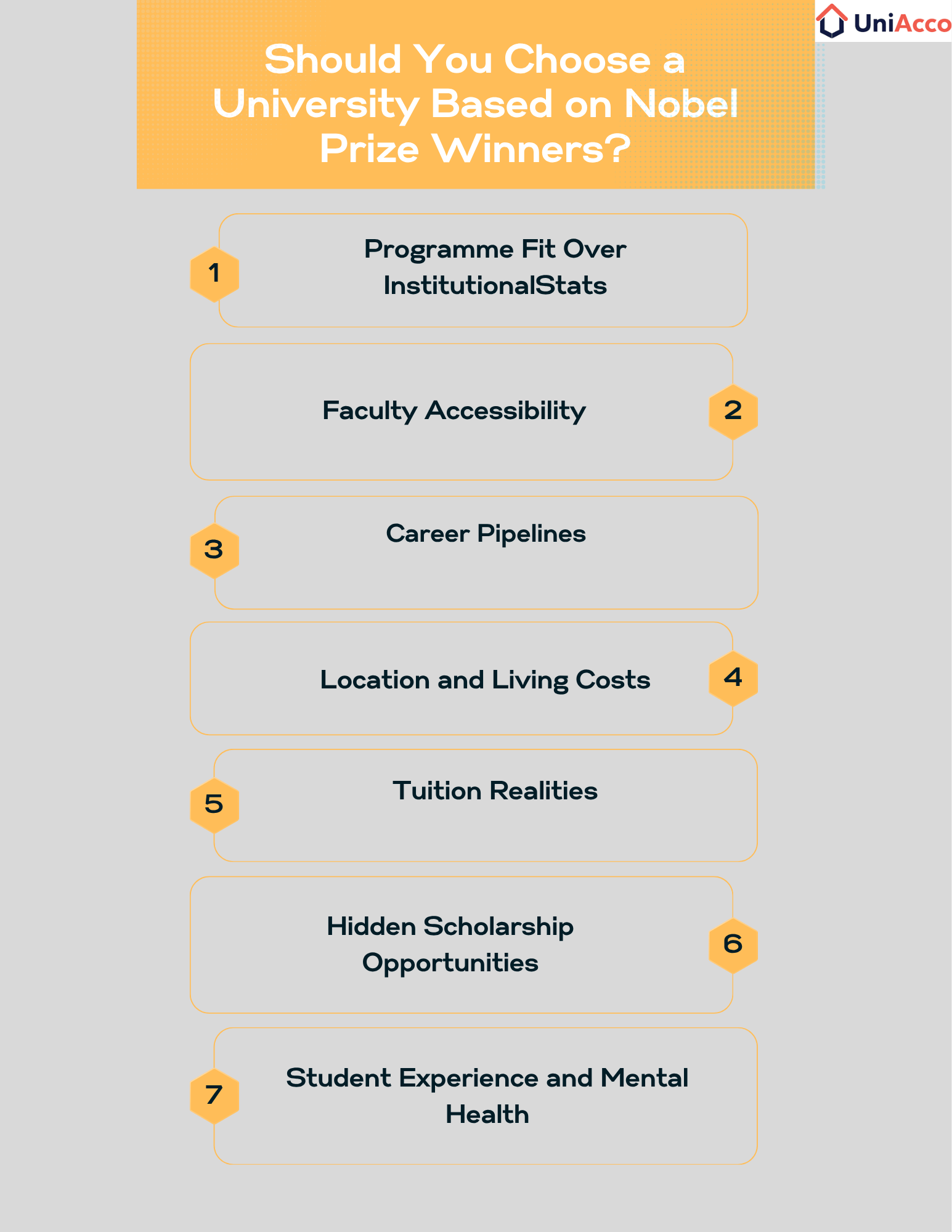
Here is how to balance Nobel prestige with real-world practicality before submitting your application:
Programme Fit Over Institutional Stats
A school might have 70 Nobel Prizes in Physics, but that means nothing if you are applying for English Literature. For example, UC Berkeley is a global powerhouse for STEM, but if you are studying constitutional law, Yale’s specialised legal clinics will serve you far better, despite Yale having a slightly lower overall Nobel count.
Faculty Accessibility
A Nobel laureate on the payroll does not guarantee they will be your professor. At some massive research hubs, decorated faculty focus entirely on running graduate labs and supervising PhDs. Contrast this with the University of Oxford, where the historical “tutorial” system ensures undergraduates meet in groups of one or two directly with leading academics every single week.
Career Pipelines
If your goal is tech startups or corporate finance, geographic recruitment pipelines often beat raw Nobel stats. Stanford holds fewer historical Nobels than Harvard, but its location on the edge of Silicon Valley means undergrads actively patent discoveries and pitch to venture capitalists before they even graduate.
Location and Living Costs
You are choosing a home for the next three to four years, not just a lab. Studying in Manhattan at Columbia University means dealing with high city rent, but you get direct internship pipelines to Wall Street. Meanwhile, studying at Cambridge offers a historic, slower-paced college town environment that is completely different from a major metropolitan hub.
Tuition Realities
Elite research institutions carry massive price tags, often exceeding $80,000 a year in billed costs. You have to weigh this against the debt you will take on. A prestigious name on your degree loses its value quickly if you are spending the next two decades paying off crippling student loans.
Hidden Scholarship Opportunities
Universities with the highest number of Nobel laureates enjoy substantial endowments that help them provide tremendous financial assistance. For example, in the academic year beginning in 2025, Harvard College provides 100% tuition fee, food, and lodging assistance for families earning less than $100,000. Tuition costs at Harvard are now also free for families earning up to $200,000, covering roughly 86% of U.S. families. Likewise, the Reach Oxford Scholarship provides assistance for full tuition fees, a living allowance, and yearly return airfare for undergraduate international students from developing countries.
Student Experience and Mental Health
The high-intensity research institutions foster high-stress, pressure-cooker cultures. MIT is one institution known to be highly stressful, with a lot of emphasis on tough engineering work done in real time. Be certain that the university you pick will have great systems for mental well-being, social organisations, and housing where you can have fun in college.
Conclusion
Universities with the most Nobel Prize winners are at the top of global education. Schools like Harvard, Cambridge, and MIT have spent centuries creating places where talented people get the support they need to make big changes in the world. Looking at which universities have the most Nobel Prizes can help you find where the best research is happening now.
Whether you want a career in quantum mechanics, global economics, or literature, studying at a university with many Nobel Prize winners gives you a strong foundation to support your goals throughout your life.
Every great achievement starts somewhere, and yours could begin with the right place to live. Find your perfect distraction-free study space with UniAcco. Explore verified, flexible, and fully furnished student accommodation designed to help you stay comfortable, focused, and ready to achieve your academic goals.
🔍 Find Your Student Accommodation

 LinkedIn









0 Comments