
Introduction
Let us guess. You’re sitting by your study desk with a mountain full of university brochures, figuring out the much-dreaded student loan rates in the UK. This whole loan interest rates business feels like decoding the time-travel rules in the film Inception. We get what you’re going through. Just sit back and let us simplify it for you. The maximum tuition fees for the 2026-2027 admission process have risen to £9,790 per year in England. But there’s nothing to panic about. Let’s sit down like two friends and talk through it.
The official data from the House of Commons Library states that the total student loan debt in England has reached almost £295 billion, while the average graduate student leaves the campus owing around £47,730. The key to understanding student loan interest rates in the UK is understanding how the interest builds up and how the safety nets protect your wallet.
In this blog, we’ll find out how student loan interest works, we’ll explore the different plans that the UK offers, and then move to see how your take-home salary looks when you start your job.
Understanding the UK Student Loan System
Let’s start with the basics. What are student loans? Think of it as a huge, friendly bank that the government opens up to help you pay for your studies and living costs while you’re studying at the university.
How do these student loans differ from traditional loans, like a standard bank loan or a car loan? Let’s say you buy a new Mercedes using a normal car loan; the bank expects you to pay back a fixed amount every month, at any cost. If you lose your job, the bank doesn’t care; it still wants its monthly payment. If you can’t pay, your credit score drops.
A student loan behaves differently. Your monthly payments depend on your monthly income, and not how much you borrowed. If you don’t earn enough, you have to pay nothing. What if you lose your job? Your payments are automatically paused until you get a new job, without affecting your credit rating. Not just that, after a certain number of years, your leftover debt is completely erased by the government. WHAT! How is this possible, you may ask.
The answer lies in the interest rate on student loans and which plan you belong to. The government splits everyone into 5 different types of repayment plans depending on when and where you started your studies. Let’s understand these plans.
- Plan 1:This plan is for English and Northern Irish students who started their UG programs between 1998 and 2012.
- Plan 2: This plan is for English students who started their UG between September 2012 and July 2023, and for Welsh students who started from 2012.
- Plan 4: This is a special plan for all Scottish students who started their UG university program any time from 1998 up to today.
- Plan 5: This plan applies to all new UG students from England starting their university courses from August 2023 onwards. If you’re applying for the 2026-2027 admission procedure, this is your plan.
- Postgraduate Loan (Plan 3): This is meant for students who are specifically from England and Wales studying a Master’s or Doctoral degree.
(If you’re an international student, you generally do not qualify for government-funded UK student loans)
What Are Student Loan Interest Rates?
Now, let’s understand what these student loan interest rates on loans are in a simple way. Interest is an extra percentage that is added over your total loan balance. Look at it like a tiny fee that the government applies for borrowing the government money. It starts counting from the first day that the Student Loans Company pays your tuition fees.
One may wonder why the government charges an interest rate? Because of inflation. This is done to stop the money from losing its real value over time. This is the government’s way of ensuring the loan balance keeps pace with the world economy by linking the interest to the Retail Price Index (RPI), which tracks the daily price movement.
Now, here’s the next question you may have – how does the student loan interest work over the years? The one-word answer is compounding. Let’s say you borrow £10,000 and it gets a 3% interest charge in your first year. Now, your new balance becomes £10,300. The next year, another 3% is calculated on £10,300, not the original £10,000, mind you. This small percentage won’t dig a big hole in your pockets if you’re earning a salary on the lower end after university. But if you become a high-earner, you need to keep an eye on the interest rate because it decides the total amount of cash you will ultimately hand back.
How Are Student Loan Interest Rates Calculated in the UK?
This is where you may need a piece of paper to figure out how the government calculates interest rates. Each plan has a unique formula; it all depends on the year you joined the university.
Plan 1 Loans
Under this plan, the government looks at these 2 numbers: the March RPI inflation rate from the previous year, or the Bank of England base rate plus 1%. Out of these 2 numbers, they automatically choose whichever number is lower to maintain stability and fairness for older borrowers.
Plan 2 Loans
This plan has a sliding scale which is directly linked to your post-university salary. You are charged full March RPI plus an extra 3%, while you are studying up until the April after you leave university. Once you begin your work, in case you have a lower salary, you will only be charged flat RPI. As your income gets higher, your interest rate bracket scales up until it hits plus 3%. For the 2026-2027 cycle, special safety caps are applied to protect high earners from extreme spikes.
Plan 3 Loans
The calculations behind the Postgraduate plans are pretty straightforward; however, it can be a bit more expensive. You are charged a flat rate depending on whatever the March RPI inflation number is, plus an absolute 3%, from the very first day of the beginning of your course till the day you clear the debt.
Plan 4 Loans
This is the Scottish plan, which acts similarly to Plan 1. The government compares the March RPI inflation rate against the Bank of England base rate plus 1%, and the lower number is automatically locked in order to safeguard Scottish borrowers from a sudden financial surprise.
Plan 5 Loans
The calculations behind the Postgraduate plans are pretty straightforward; however, it can be a bit more expensive. You are charged a flat rate depending on whatever the March RPI inflation number is, plus an absolute 3%, from the very first day of the beginning of your course till the day you clear the debt.
Let’s make it simpler by putting it in a table.
| Loan Plan | Who It Applies To | Interest Rate | Repayment Threshold | Repayment Rate |
| Plan 1 | England/NI students starting 1998-2012 | March RPI or Bank Base Rate + 1% | £26,900 | 9% |
| Plan 2 | England/Wales students starting 2012-2023 | Variable scale between RPI and RPI + 3% | £29,385 | 9% |
| Plan 4 | Scottish students starting 1998 onwards | Lower of March RPI or Bank Base Rate + 1% | £33,795 | 9% |
| Plan 5 | English students starting from August 2023 | Matched exactly to the flat RPI inflation | £25,000 | 9% |
| Plan 3 (Postgraduate Plan) | Master’s/Doctoral students from England and Wales | Flat RPI + 3% | £21,000 | 6% |
Wondering how student loan interest rates differ across England, Scotland, Wales, and Northern Ireland? This Quora discussion explains the key differences and answers common questions from students, making it easier to understand how repayments and interest work across the UK.

Current UK Student Loan Interest Rates
Time to look at the actual numbers for the current year 2026-2027. Currently, the baseline RPI inflation rate used for student loans is at 3.2%. But, you know how the economy has been bumpy lately… So the government has stepped in with a safety cap (which is brilliant news!) to make sure the older plans don’t go out of control.
So, what is the interest rate on student loans right now? This table shows exactly that for the year 2026-2027 across all 5 plans.
Note that for Plan 2 and Plan 3, interest rates cannot go higher than 6% for this academic cycle, thanks to government intervention.
| Loan Type | Current Interest Rate |
| Plan 1 | 3.2% |
| Plan 2 | 3.2% to 6.0% |
| Plan 4 | 3.2% |
| Plan 5 | 3.2% |
| Plan 3 (Postgraduate Loan) | 6.2% |
Student Loan Repayment Thresholds Explained
This is an integral part of the system. Let’s look at the repayment threshold as a shield that protects your bank account. It sets a limit to the exact amount of money you need to earn in a year so that the government is allowed to recover its loan. This is what makes your student loan journey walkable without having to spend sleepless nights. In a case where you get a low-paying job, or you face unemployment, your mandatory monthly repayment drops to zero.
So what triggers these payments? The UK government has automated the repayments through a system called PAYE – Pay As You Earn. When you start with your job, your employer’s payroll software examines your earnings. If your paycheck goes over the threshold for the month, the student loan is withdrawn before the money reaches your bank account, along with your income tax deduction at source. This system is actually great because you don’t have to worry about manual transfers or remembering due dates.
This table shows the official threshold limits for the 2026-2027 taxable year.
| Loan Plan | Annual Income Threshold | Monthly Threshold | Percentage Repaid |
| Plan 1 | £26,900 | £2,241.66 | 9% |
| Plan 2 | £29,385 | £2,448.75 | 9% |
| Plan 4 | £33,795 | £2,816.25 | 9% |
| Plan 5 | £25,000 | £2,083.33 | 9% |
| Plan 3 (Postgraduate Loan) | £21,000 | £1,750.00 | 6% |
Looking for a place to call home in Manchester? Explore verified and affordable student accommodation in Manchester with UniAcco. Compare fully furnished studios, en-suite rooms, and shared apartments with all-inclusive bills, modern amenities, flexible booking options, and dedicated support to help you secure your ideal student home with confidence.
🔍 Explore Student Housing in ManchesterHow Much Will You Actually Repay?
Let’s understand with an example for a graduate earning £30,000
- Plan 2: This salary is only £615 above their £29,385 threshold. 9% of this slice is £55 a year, which means only £4.58 is taken from your monthly pay, which is nothing!
- Plan 5: If this is you, earning £30,000 puts you exactly £5,000 over your £25,000 threshold. 9% of that excess is £450 a year, which is again a manageable figure of £37.50 per month.
Take a look at this table, which compares examples of salaries that you might be withdrawing.
| Annual Salary | Plan 1 Repayment | Plan 2 Repayment | Plan 4 Repayment | Plan 5 Repayment | Plan 3 (Postgraduate Plan) |
| £30,000 | £279.00 | £55.00 | £0.00 | £450.00 | £540.00 |
| £40,000 | £1179.00 | £955.00 | £558.00 | £1350.00 | £1140.00 |
| £60,000 | £2,979.00 | £2,755.00 | £2340.00 | £3,150.00 | £2340.00 |
Factors That Affect Student Loan Interest Rates
Inflation (RPI)
Inflation is the measure of how fast the prices of everyday goods and services are rising in the country. As we have seen, RPI is the baseline foundation for every single plan; any minor or major shift in the UK economy automatically brings a shift in how fast your debt may grow. Hence, this is a major factor to be considered that affects student loan interest rates in the UK.
Income level
Lower earners usually are at flat RPI, while higher earners get hit with a variable interest surcharge up to an extra 3%.
Loan plan type
As we saw, the plans are chalked out based on the year you join the university course. So the university date locks you into a specific formula based on the plan. For example, Plan 5 protects new students from any interest above RPI, while Plans 1 and 4 are protected by central bank choices.
Government policy changes
This is a topic that is always discussed in the UK parliament – the policy changes! Ministers have the right to bring changes to the thresholds or modify interest equations for past and future cohorts as and when they choose. Just the way, for this year, the government has stepped in with a safety cap to make sure the older plans don’t go out of control.
Temporary interest rate caps
Again, similar to how the government stepped in for this year, when global inflation spikes suddenly, the government may step in with emergency laws to cap loan rates of UK students to maintain everyone’s sanity.
Living in the UK can be expensive, but your accommodation doesn’t have to be. UniAcco helps students find verified and affordable student accommodation across the UK, including fully furnished studios, en-suite rooms, and shared apartments with all-inclusive bills, modern amenities, and flexible booking options. Save more while enjoying a comfortable student lifestyle.
🔍 Explore Student Accommodation in the UKRecent Changes to UK Student Loan Interest Rates
Government announcements on interest rates
To keep the ball rolling, the government keeps making changes to student finances. Like the most recent one, when the Department for Education in the UK made emergency announcements to stop student loan interest rates in the UK from going berserk. The reasons for this change are the global economic rollercoaster and inflation numbers, which were threatening to push interest rates up to nerdier heights.
Recent repayment threshold updates
The government recently brought changes to the Plan 2 repayment threshold up to £29,385 for graduates, but here’s a catch: they also announced a 3-year freeze on this Plan 2 safety line starting from April 2027. What does this mean? As wages naturally go up, graduates will cross that admission line faster. On the other hand, if you come under the Plan 5 (2026-2027) admission process, your threshold is locked at £25,000. This changes how your monthly payslip deductions are calculated.
Interest rate caps and their impact on borrowers
As we have seen, the ministers officially locked in a 6.0% maximum cap on interest for all Plan 2 and Plan 3 borrowers. The impact of this decision is significant. Imagine high-earning graduates and current Master’s students would have their interest rates peak to 6.2% or higher because of inflation pressures.
What current students and graduates should know
The ultimate takeaway? If you fall under Plan 5, you are safe from the interest growth because your rate just tracks the flat inflation, which is 3.2%. But what you must know is that Plan 5 stays around for 40 years compared to the 30 years for older plans. Keeping an eye on the loan rates is important so that your monthly salary won’t catch you by surprise.
Common Myths About Student Loan Interest Rates
Student loans work like bank loans
No. A student loan behaves differently. Your monthly payments depend on your monthly income, and not how much you borrowed. If you don’t earn enough, you have to pay nothing. What if you lose your job? Your payments are automatically paused until you get a new job, without affecting your credit rating. Not just that, after a certain number of years, your leftover debt is completely erased by the government.
Higher debt means higher monthly repayments
A big NO. If one student owes £20,000 and the other owes £80,000, and both of them are on Plan 5, and both earn the same salary, say, £40,000; they will pay the same amount every month. The total debt is based on how many years they’ll make payments and not how much is taken out of their monthly salary.
You should always pay off your student loan early
It is considered a bad financial move if you pay off the balance early. Why? Since the remaining debt is erased after 30 or 40 years, many graduates will never pay it back in full anyway. You could have easily used that money to clear a mortgage deposit.
Interest rates are fixed forever
Nope. The interest rates are adjusted every year on September 1st based on the economic inflation numbers collected during the last March, plus the government has the power to apply emergency caps whenever the market gets over-volatile.
Still don’t understand student loan interest rates in the UK? Read this Reddit thread and get the direct answers from students and professionals.
Still confused about how student loan interest rates work in the UK? This Reddit discussion features questions and answers from students and professionals, helping you understand how interest is calculated, repayments work, and what to expect after graduation.

Tips for Managing Student Loan Repayments
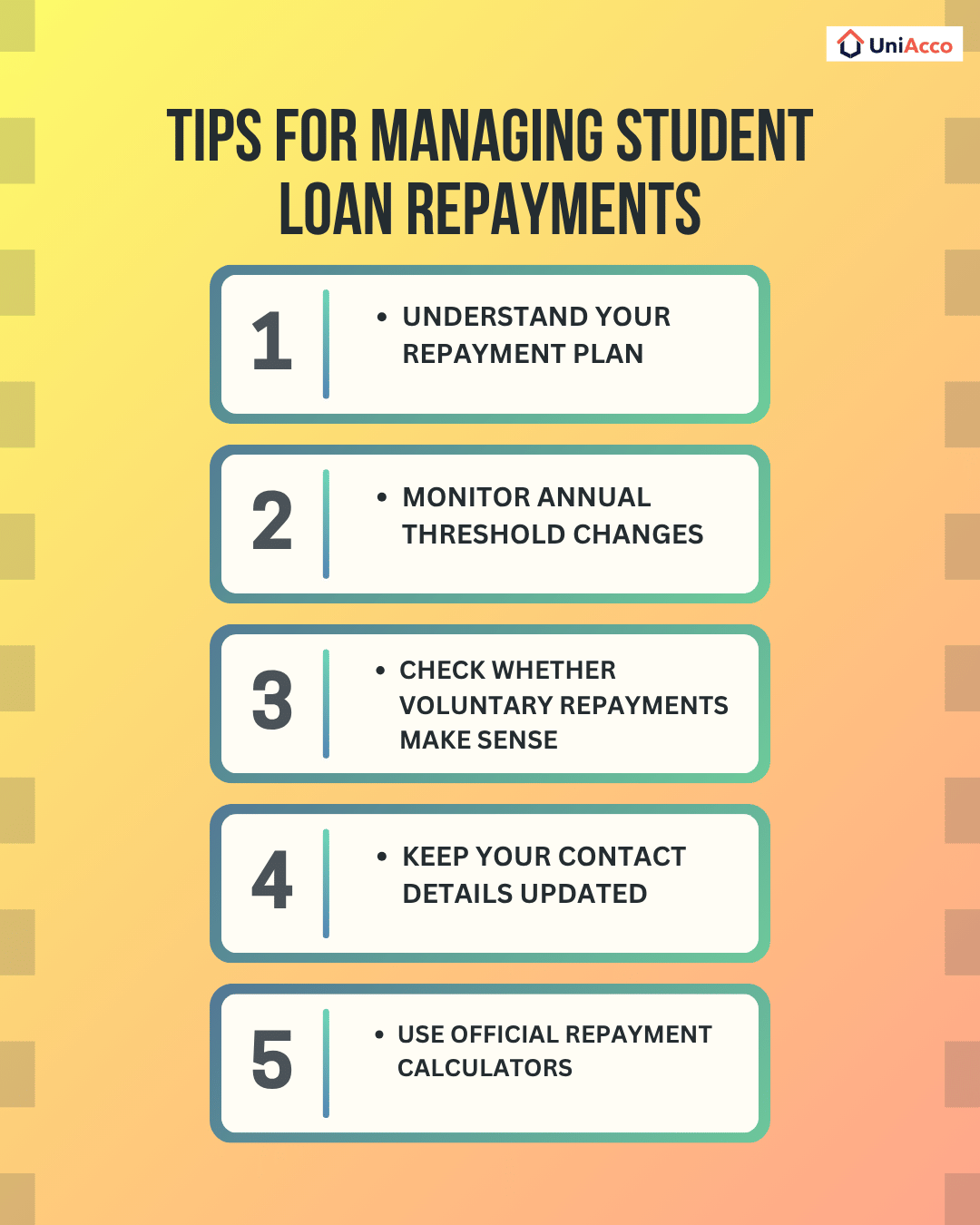
Understand your repayment plan
When you start with your new job, make sure that your employer marks the correct plan on your onboarding papers.
Monitor annual threshold changes
These thresholds are monitored every April. Being on track with these changes ensures that you know exactly how much your take-home income would be every month.
Check whether voluntary repayments make sense
It is considered a bad financial move if you are on the low-earning side. Why? Since the remaining debt is erased after 30 or 40 years, you could easily use that money to clear a mortgage deposit or another loan if you have one. But if you are on the exceptionally high-earning side, paying extra can save you money by cutting down on the interest growth.
Keep your contact details updated
Don’t try this at all! If you forget to maintain your contact details, the Student Loans Company will apply financial penalty rates.
Use official repayment calculators
The official GOV.UK calculators run simulations based on prospective careers. Take advantage of these tools to map out long-term budgets.
Whether you’ve recently moved to London or are looking for a better place to stay, UniAcco makes finding your next home simple. Explore verified and affordable student accommodation in London, including fully furnished studios, en-suite rooms, and shared apartments with all-inclusive bills, modern amenities, and flexible booking options near top universities.
🔍 Explore Student Housing in LondonConclusion
Looking for a tl;dr? Here you go. For the 2026–2027 academic intake, if you are a new UG student, you will be on Plan 5. Your interest rate matches the flat RPI inflation rate that currently sits at 3.2%, which means your debt won’t grow in real economic terms. You won’t owe a single pound until you earn over £25,000 per year. Your repayments are kept at an affordable 9% of whatever you earn above that line. Older plans are currently protected by a solid 6.0% emergency interest cap to balance out inflation.
The student loan interest rate system in the UK is built to scale smoothly with your career, giving you an absolute safety net to ensure that higher education remains a possibility.


 LinkedIn









0 Comments