
There are two kinds of students. The Freedom Fighters – the ones who can’t wait to leave home. The House Plants – the ones who find it difficult to leave home. Either way, we’ve all faced the feeling of missing home in our college lives. In fact, statistically speaking, according to the National Library of Medicine, 94% of first-year students experienced homesickness during the first term of college. What does this mean? You are not alone.
You know the feeling — you’re lying in bed. You’ve snoozed the alarm enough, yet you don’t feel like getting out. You’re staring at the ceiling, thinking about your life back home, the breakfast your mom served. Suddenly, your eyes are leaking water faster than the Titanic. If this sounds familiar, take a deep breath. This feeling of hollowness is exactly how homesickness feels. And it’s completely normal, although painful. Look at it as an emotional tax that you pay for growing up. It’s not because of a flaw in your personality; it’s biological. Know that this is not a permanent state of being, but rather a passing cloud.
In this blog, we’ll help you understand how to cope with homesickness and how to come out the other side feeling like yourself.
What is Homesickness?
I once knew a student who was studying in London and had a full breakdown amidst the silence of a library. You know why? Because of the silence of the library. Being an Indian, she was used to the hustle and bustle at her home and her neighbourhood. She missed her mom shouting at her for not doing the dishes. That’s the thing about homesickness — it’s not always about the big things. It’s often the grief of familiarity.
Homesickness is not just about missing your parents. It’s much deeper. It’s a form of reaction to stress caused by separating from people, places and previous lifestyles. It usually hits after the ‘new city, new me’ idea wears off. For how long does it stay? It depends on each individual’s coping mechanism. But know that the feeling of homesickness eventually fades out, once you start building your definition of ‘home’.
Start building your home away from home with student accommodation that’s comfortable, fully furnished, and designed for real student life — not just a temporary stay.
🏡 Find Your UK Student HomeWhat are the Symptoms of Homesickness?
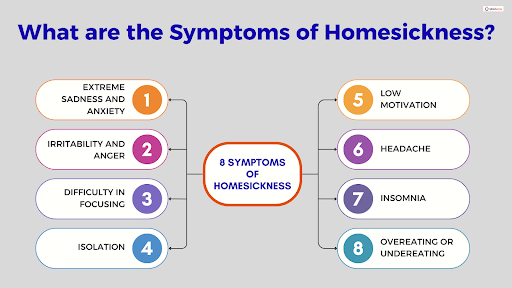
When you’re low, you’ll often find people advising you to go for a walk or watch a movie, or simply not think about being low. Well, it’s not so simple. Understanding that your physical and emotional struggles are symptoms of homesickness is crucial. To help you catch the bug before it bites, here are a few symptoms of homesickness.
Extreme Sadness and Anxiety
You might feel like there’s a lump in your throat or someone’s sitting right on your chest, and you’re breathless. Simple tasks like getting up from bed, doing the laundry, and making breakfast might seem daunting. That’s because anxiety is making its entry.
Irritability and Anger
The smallest of things, like a fly on the wall or your roommate watching TV starts bothering you. You feel angst for literally nothing. That’s just your brain overreacting to the stress of separation from your previous lifestyle.
Difficulty in Focusing
You may read the same chapter ten times, yet not understand a word because your brain is still busy processing the separation from home.
Isolation
You feel like being alone when you were invited for dinner. You decline all the invites to just be in your bed. While having your ‘me time’ is important, avoiding human interaction creates a cycle of loneliness that makes homesickness all the more sick.
Low Motivation
Everything you once loved feels distant — attending your favourite class, listening to your favourite playlist, visiting the park which sells your favourite ice cream; nothing seems to motivate you.
Headache
Suddenly feel a shooting pain in your head? This is the stress of separation that causes chronic headaches, which ruin your routine.
Insomnia
Feeling exhausted but still can’t sleep? That’s insomnia creeping in. Sometimes, you may wake up in a panic mode with your heart throbbing. That’s also a symptom of insomnia.
Overeating or Undereating
You’re probably stress eating that extra burger, thinking it will cure your homesickness. Instead, it makes it worse. And sometimes, you just don’t seem to have an appetite even if you haven’t eaten all day. The credit goes to homesickness.
Find student accommodation in France that gives you the comfort, privacy, and space to bring your version of home with you — fully furnished and student-ready.
🏠 Explore Student Housing in FranceHow to Deal with Homesickness?
The key lies in knowing that homesickness cannot be cured overnight. When we’re dealing with homesickness, we’re actually dealing with memories that our brain has stored over the years. It’s more about managing it so that it doesn’t manage you. Let’s put on our managerial hats and understand how to cope with homesickness.
Acknowledge the Feeling
The most crucial step in overcoming homesickness is If you’re sad, be sad. Accept the emotion in its rawest form. Sometimes saying out loud — ‘Yes. I am sad’, can be the most comforting thing. Why? Because you acknowledged it, no more false pretence. When somebody asks how you are, try to answer honestly and observe how you feel after that. You might actually see the feeling of despair going away. Try it.
Attend Events
This isn’t the easiest one, I agree. But sometimes while dealing with homesickness, a little force can put you in a place that will change the course of your day. You don’t have to stay all day, but simply showing up breaks the loop of isolation. Think art galleries, open mics?
Find a New Comfort Place
Sitting in your room all day can heighten the feeling of homesickness. Find a coffee shop that’s walkable from your home. Somewhere you can peacefully sit with a cup of coffee or hot chocolate, watching the busy streets. Or how about a library?
Journal Your Emotions
Science actually backs this. According to research done by Dr James Pennebaker, spending just 15 minutes writing about your emotions can boost your immune system and lower stress levels. Think of your journal as a garbage disposal for your brain. Acknowledge the feeling of homesickness while journaling. Write about what makes you miss home and how you can recreate a home away from home.
Stay in Touch With Your Family
Stay in touch with your family, but don’t depend on them for emotional support. That way, you won’t be able to create a ‘new life in a new city’. Ignoring them in isolation is also not a solution. That might worry them. Creating a balance is crucial.
Create a Familiar Environment
Create a space that brings back the familiarity of home. Understand that ‘creating a new life’ doesn’t mean you have to let go of the old. It’s more about blending the old with the new. Got a photo with your family? With your pet? Or your friends? Put them up on the wall.
Limit Social Media
You went to bed thinking you’d sleep. But you find yourself doomscrolling at 3 AM. Watching just a ‘glimpse’ of your friends’ lives studying in other universities might stress you even more. Know that social media is just a ‘highlight reel’. It’s not the full picture. Set up a time limit and log off!
Talk to Someone
Lastly, if it reaches a point where the homesickness is taking the better of you, reach out for help. Talk to a counsellor or a trusted friend. University Support Services are literally meant for such times. Seeking help is not a sign of weakness but a sign of courage.
How to cope with homesickness – r/college from r/college
What Causes Homesickness?
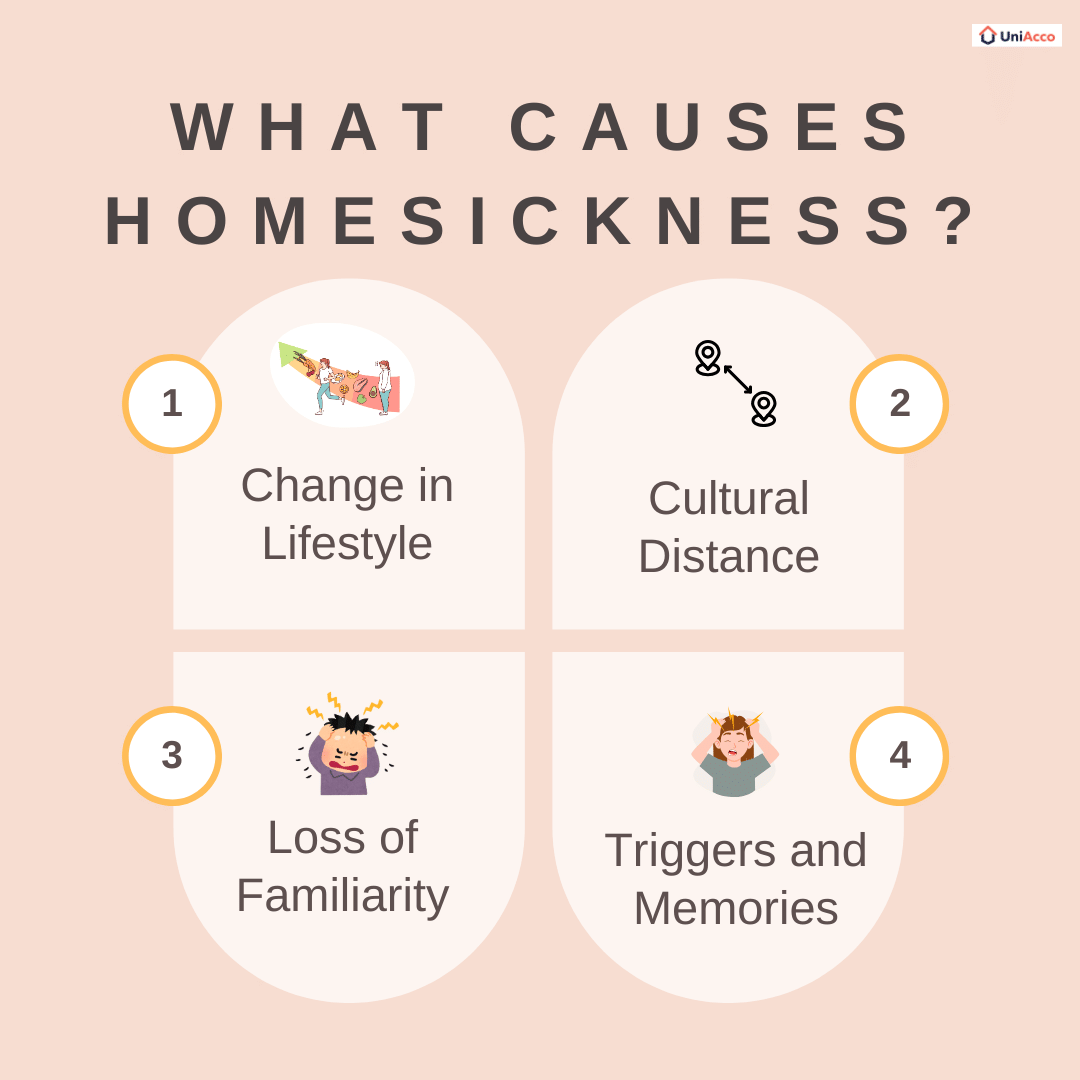
In order to cure something from the source, it’s important to reach the source. Now that we’ve discussed the various techniques to deal with homesickness at university, let’s understand the factors causing homesickness.
Change in Lifestyle
Overnight, you become the captain of the ship of your life. That’s a massive shift from a teenager to an adult. From feeding yourself to cleaning up to self-studying. The exhaustion of adulting is real.
Cultural Distance
If you’re moving countries, that’s a bigger change in lifestyle. From clothes to food to language, everything changes 10x. This might make you feel like an alien, and you might want to run away. But know that it’s all a part of the journey. You’ll eventually make your place.
Loss of Familiarity
Our brain is designed to function in patterns. Once the touch of familiarity is wiped off, initially, the brain doesn’t understand how to adjust to the new normal. When you move, your cognitive map is wiped. The systems are different, and it takes time to be a part of this new system.
Triggers and Memories
Sometimes, it’s inexplicable as to which memory triggered you. It could be the smell of a perfume or the taste of food, or even a face that reminds you of someone familiar back home. These sensory triggers bypass logic to hit you right in the feels.
Conclusion
Learning how to deal with homesickness is a journey that cannot be tackled overnight. Nobody can. One day you may feel like you’re ‘on top of the world’ like ABBA, and the next, you’ll find yourself lying on the bed channelling your inner Lana Del Rey, staring at the ceiling and wondering why you ever thought leaving your comfort zone was a vibe. And that’s ok. This isn’t a verdict on how good of an adult you are. It’s more about how you’re dealing with homesickness.
You’re not just moving cities — you’re building a new version of home. With UniAcco, find verified student accommodation that fits your vibe, your budget, and your journey.
🔑 Find Your Perfect Student Stay











0 Comments