
Your friend posts an Instagram story with a caption “Studying in Italy this semester”, and you’re confused for a second because they were also studying at the same university as you last month? Turns out, they joined an international student exchange program. Student exchange and study abroad opportunities are growing sooner than you can imagine. In fact, more than 6.9 million students studied outside their home country in 2022.
In this blog, we’ll break down what a student exchange program is, the different types of exchange programs, and some of the most popular programmes and destinations. We’ll also cover the cost of international student exchange programs, eligibility requirements, and share a few tips to help you prepare if you’re thinking about joining one.
What is a Student Exchange Program?
In simple terms, instead of spending your entire degree on one campus, you get the chance to study at a partner university in another country for a semester or year, all while still being enrolled at your home university. International student exchange programmes are basically the ultimate university upgrade.
Types of Student Exchange Programs
Long-Term Exchange Programs
Long-term exchange programmes usually last an entire academic year. If you’re planning to be a long-term exchange student, you’ll be spending a longer period studying at a partner university in another country while continuing your degree from your home institution. Because the stay is longer, you get more time to adapt to the culture, build friendships, and fully experience student life in another country. These programmes are ideal for students who want deeper international exposure.
Short-Term Exchange Programs
Short-term exchanges generally last a few weeks to a few months. In these short-term exchange programmes, you learn academic courses, cultural activities, language classes, or skill-based workshops. Short-term exchanges are perfect for students who want an international experience but cannot spend a full semester or year abroad.
University/Semester Exchange Programs
University/Semester Exchange programs are a popular option. You, as a student, get to study abroad either for one academic semester or a full academic year. So, without paying the high cost of a full degree abroad, you gain experience with new cultures, learn academically, and connect with people worldwide.
Domestic Exchange Programs
Domestic Exchanges simply mean that these exchanges take place within the same country, allowing you to study in a different region and experience new cultures and teaching styles without actually having to travel abroad.
Packing your bags for a short-term exchange program in the UK? Get the best deals and guaranteed lowest prices on short-term student accommodation with UniAcco.
🏡 Explore Short-Term UK AccommodationPopular International Student Exchange Programmes and Destinations
We know you must be wondering which country or types of student exchange programmes will be the right fit for you. We’ve compiled several well-known international student exchange programs that connect universities and students globally. Take a quick look at them.
Erasmus+ (Europe)
Erasmus+ is one of the most well-known student exchange programmes in the world. It started in 1987, and since then, more than 16 million people, including university students, teachers, and young learners, have taken part in it. For students, they offer the opportunity to study at a partner university in another European country for a semester or a year while continuing their degree at their home institution. Popular destinations include Germany, France, Spain, Italy, and the Netherlands.
The programme is funded by the European Union and has a large budget of about €26.2 billion. You get to take courses abroad, experience different teaching styles, and immerse yourself in a new culture. You also receive financial support to help cover travel and living expenses during your exchange. The programme is managed by the European Commission, along with national agencies that help organise exchanges locally. You can usually apply through your home university’s international office, which coordinates the exchange with partner universities abroad.
| Fee Type | Cost | What You Need to Know |
| Application Fee | €0–€50 (₹0–₹4,500) | Erasmus+ itself doesn’t charge a fee. Some universities may charge a small admin fee when you apply. |
| Placement Fee | 0 | There is no placement fee. Your university’s international office helps match you with partner universities. |
| Program Fee | Pay home university fees | You usually pay tuition to your home university, while the host university tuition is free under Erasmus agreements. |
| Extension Fee | 0 | If you extend your exchange (up to 12 months total), there is no extra fee, but your grant amount may change. |
| Academic Training / Internship | Grant support available | Some Erasmus internships include extra monthly financial support for students. |
ISEP Exchange Program (Multiple Countries)
ISEP connects students with 300+ universities in over 50 countries. Students can study in destinations such as the United States, South Korea, Japan, Sweden, and Australia, to name a few. The programme focuses on making exchange opportunities accessible to more students worldwide. The ISEP Exchange Programme has been around for more than 40 years, helping students from different countries study abroad and experience new cultures. It works like a global community where universities partner with each other, making it easier for students to spend time studying in another country while also welcoming international students to their own campus.
One of the biggest advantages of ISEP is that it usually costs about the same as studying at your home university. Instead of paying tuition to the university abroad, students typically continue paying their home university fees for tuition, housing, and meals. The only extra costs are usually things like flights, visa fees, application charges, and health insurance. You’ll also get support from an ISEP Student Services Officer before you leave, during your exchange, and even after the programme ends. At the host university, there is usually a local coordinator who helps exchange students settle in and provides orientation when they arrive. During the exchange, you attend regular classes with local students, taught by professors from that university. You’ll also have access to everything the campus offers, such as libraries, academic support services, and other campus facilities, just like any other student studying there.
| Fee Type | Cost | What You Need to Know |
| Application Fee | $100 | Paid when you apply for the ISEP exchange program. This fee is not refundable. |
| Placement Fee | $450 | Paid after you accept your exchange placement. It covers the cost of ISEP arranging your university abroad. |
| Program Fee | Depends on your home university | Instead of paying the host university, you usually continue paying your home university fees for tuition, housing, and meals. |
| Extension Fee | $100 | Paid if you decide to extend your exchange from one semester to a full year. |
| Academic Training Fee (J-1 visa students) | $150 | Required if you choose to do training or work experience related to your studies during the program. |
| Health Insurance | About $29 per week | Mandatory insurance that covers medical help, emergencies, and travel support during your exchange. |
Global UGRAD Program (USA)
The Global Undergraduate Exchange Program (UGRAD) allows undergraduate students to spend one semester studying in the United States while participating in cultural and leadership activities. Run by the U.S. Department of State, unlike a full degree programme, this is a non-degree exchange, which means students spend a semester at a U.S. university and then return to continue their studies at their home institution. You take academic courses at American universities while also participating in community service, leadership training, and professional development activities. Their goal is to help you improve your academic knowledge, develop leadership skills, and understand U.S. culture and values. You may also get the chance to connect with U.S. organisations and companies. By the end of the exchange, you get firsthand experience of studying in the U.S, learn how different education and work systems work, and also develop global perspectives that you can bring back to your home countries.
| Fee Type | Cost | What You Need to Know |
| Application Fee | $0 | It’s completely free to apply. You just need to submit your application, essays, transcripts, and test scores. |
| Placement Fee | $0 | If selected, the program places you at a U.S. university automatically. There is no placement cost. |
| Program Fee | $0 (Fully Funded) | The program covers tuition, books, housing, meals, and university fees for the entire semester. |
| Extension Fee | Not applicable | The program is only one semester long, so extensions are not allowed. |
| Visa & Training Costs | $0 | The program covers the J-1 visa and related processing costs. |
| Health Insurance | $0 | Full health insurance is provided during the exchange program. |
Those of you who did an exchange semester abroad – r/PersonalFinanceNZ from r/PersonalFinanceNZ
Eligibility Requirements for International Student Exchange Programmes
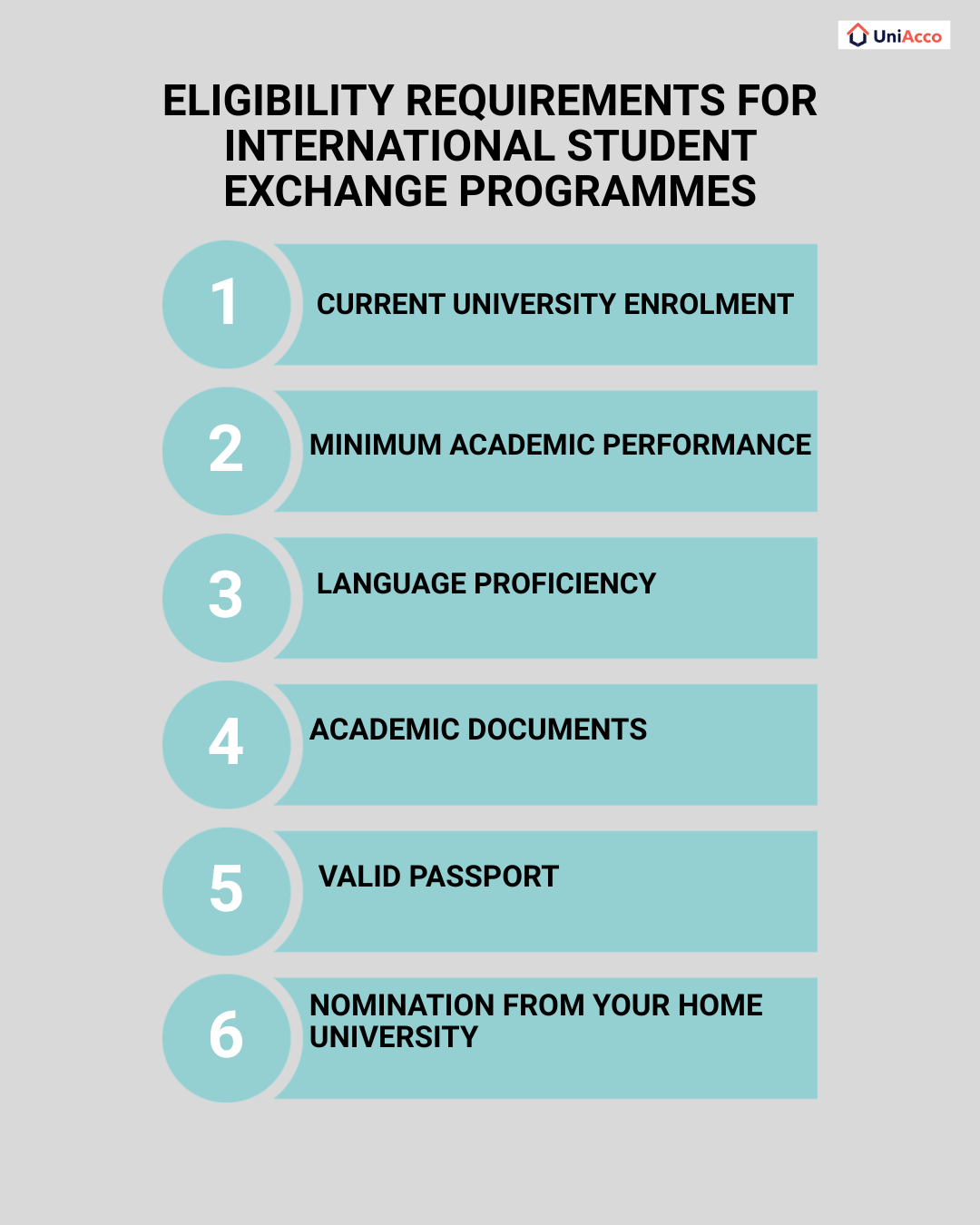
Here are the general eligibility requirements for your International student exchange programs. Also, keep in mind that some requirements can vary between universities, so make sure you check those requirements with the university thoroughly.
Current University Enrolment
You must be currently enrolled at a recognised university to apply for an exchange programme. Usually open to students in their second or third year of undergraduate studies, or those enrolled in Master’s or PhD programmes, who have a strong academic record.
Minimum Academic Performance
This simply means you should be doing well in your studies and passing all your subjects. You shouldn’t have any failed subjects or pending exams (backlogs) when you apply for the exchange programme. Universities also usually expect students to maintain a minimum GPA or grade average, which shows that you are performing well academically. The exact score required can be different for each university, and it is usually decided by your home institution.
Language Proficiency
You need to prove that you can understand and study in the language used at the university you’re going to. For example, if the classes are taught in English, you may need to take tests like TOEFL or IELTS to show that your English skills are good enough. If the programme is in another language, like French or German, the university may ask for language test scores or proof that you have studied that language before.
Academic Documents
A few important documents are needed when you’re applying for the international student exchange programs. One of them is an academic transcript, which is an official record of your marks and subjects from your current and previous years of study.
You usually have to write a Statement of Purpose (SOP), where you explain why you want to join the exchange programme and what you hope to learn from it. Sometimes universities may ask for Letters of Recommendation (LOR) from professors who can talk about your academic abilities and character.
Valid Passport
A must-have if you’re planning for a study abroad exchange program is a valid passport. Most universities require the passport to be valid for at least 12 months from the date of application, since you will be travelling and staying in another country.
Nomination from your Home University
Another important step is nomination by your home university. This means your university’s International Relations Office (or a similar department) officially recommends or selects you for the exchange programme and sends your name to the partner university abroad.
Got selected for the Global UGRAD Program in the USA? Find tailored student housing in the US with UniAcco in just 20 seconds and get ready for a smooth start to your exchange journey.
🏠 Find Student Housing in the USATips to Prepare for an International Student Exchange Program
Research Your Destination
Once you’ve picked which country you’re going to for your student exchange program, make sure to learn more about the country’s culture, weather, and university before you go. This helps you settle in faster.
Plan Your Finances Early
In many exchange programmes, you usually continue paying your home university fees for tuition, housing, and meals, so the cost is often similar to studying at home. However, you should still budget for flights, visa fees, insurance, and personal expenses.
Prep Important Documents
We’ve already covered what important documents are required in the Eligibility Requirement section. However, once again, we are making you aware that your passport, visa, academic documents, and travel insurance should be ready well in advance to avoid last-minute stress.
Stay Open-Minded
The hardest yet the most exciting part about your international student exchange program is how well you keep an open mind. How living in a new country can feel different at first. But remember, you chose this path to be open to new experiences, cultures, and people. This will make your exchange journey more enjoyable.
Got your exchange destination sorted? The next step is finding all-inclusive student accommodation. UniAcco helps you compare verified options so you can settle in quickly and focus on the experience ahead.
🏠 Find Student Accommodation







0 Comments