

Results day has a very specific energy. You open the portal, the numbers load, and for a second, you just stare. Maybe it’s not as bad as you feared, maybe it’s worse. Either way, there’s that familiar knot, the one that arrives when you realise your GPA isn’t reflecting the effort you thought you were putting in, or worse, the effort you know you weren’t.
But remember, GPA is recoverable. It doesn’t move overnight, and there’s no shortcut that works without the work behind it, but with the right approach, you can improve your GPA. Students raise their GPAs every term. The ones who do it consistently are usually not the most naturally talented in the room; they’re the ones who figured out where they were going wrong and fixed it.
This guide breaks down how to improve GPA in a way that’s actually usable, whether you’re one semester in and trying to set the right foundation, or three years in and trying to undo some damage before you graduate.
What Is GPA?
GPA is short for “Grade Point Average.” It is a number that tells you how well you did in all of your classes by giving you a single score. This is how your school turns all of your tests, assignments, and evaluations into one number that admissions committees, employers, and scholarship boards can read quickly.
Your semester GPA solely shows the grades you got this term. Your cumulative GPA is the average of all the semesters you’ve taken. This one is the most important one for your future. The 4.0 system is the most common scale. An A usually equals 4.0, and a C equals 2.0.
Australian universities commonly utilise a 7.0 scale, whereas UK universities usually use degree categories (First, 2:1, 2:2) with percentage equivalents instead of a GPA. The scale is different, but the idea is the same: all of your grades are added together and averaged to get one score.
Still confused about what GPA is? Read this Reddit thread to find the simple answers from students and professors.
What exactly is a GPA? – r/AskAnAmerican
Why Is It Important to Improve GPA?
- Better chances for scholarships
Most merit-based scholarships, including several government-funded ones, have minimum GPA or percentage requirements. A stronger GPA keeps more doors open, including ones you haven’t considered yet.
- Helps with university progression and postgraduate admissions.
Whether you’re applying for a master’s, a PhD, or simply trying to progress into your next year without academic conditions attached, your cumulative GPA is one of the first things reviewed.
- Improves internship and job opportunities.
A lot of competitive internship programmes and graduate schemes ask for a minimum GPA. Some employers, particularly in finance, consulting, and tech, filter applications at the shortlisting stage based on academic performance.
- Builds academic confidence.
When your grades start moving in the right direction, the way you approach deadlines and exams shifts too. That’s harder to quantify than a GPA number, but it’s real.
7 Important Tips to Improve GPA
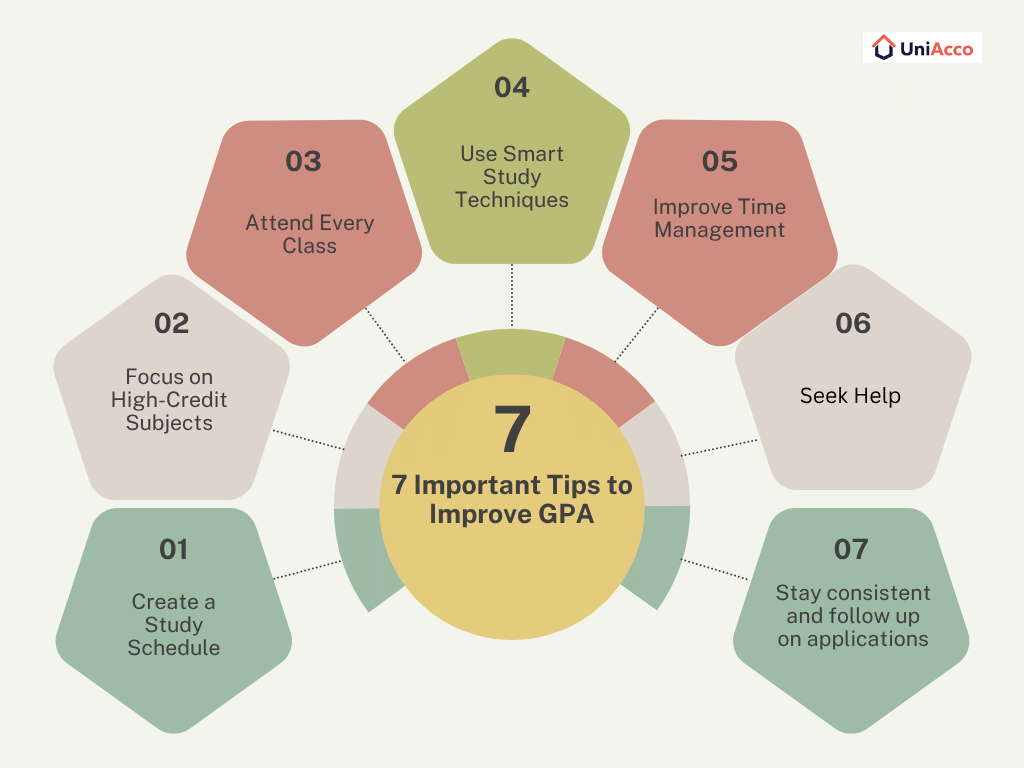
Create a Study Schedule
Not having a clear plan to “study more” doesn’t help. A set schedule does. Set aside time each week for each subject, not just when tests are coming up. Treat those times like you would a class you can’t avoid. It’s better to study a little bit every week than to cram the week before every exam.
Focus on High-Credit Subjects
Your GPA doesn’t count all subjects the same way. A 6-credit module has a far bigger effect on your average than a 2-credit module. Find out which classes this semester have the most credits and put them at the front of your study plan. An extra grade point in a class with a lot of credits is worth more than the same improvement in a class with fewer credits.
Attend Every Class
Very obvious and genuinely underestimated. Students who miss lectures often do poorly not only because they missed the content, but also because they missed the context: how the lecturer explains important ideas, what they stress, and what the exam will probably be about. It’s also a lot more difficult to ask a teacher for help when you haven’t really been to class.
Use Smart Study Techniques
Reading over notes is the least helpful approach to learning, but it’s what most students do nonetheless. Active recall (testing yourself without looking), spaced repetition (going back to the topic at longer intervals), and the Feynman technique (explaining a concept in basic words until you really understand it) are all better than passive review. Use the time you already have to work better.
Improve Time Management
Most GPA difficulties are caused by not managing your time well, not a lack of intelligence. If you don’t start your work on time, it builds up. When you wait until the last week to study for an exam, the stress level goes up. Time-blocking, weekly planning sessions, and deadline trackers aren’t new ideas, but they work when you utilise them all the time.
Seek Help Early
If you wait until you’ve already failed a test to ask for help is the most common and most avoidable mistake. University tutors, academic support services, study groups, seniors and online resources exist specifically for this. The earlier you flag where you’re struggling, to yourself and to the relevant support, the more time there is to actually fix it before it affects your grade.
Track Your Progress
You can’t design a plan to raise your GPA if you don’t know what it is right now. Find out what your current GPA is, figure out which topics are bringing it down, and make a realistic goal for the next test period. People say “what gets measured gets managed”, but it’s really true here.
“Success is the sum of small efforts, repeated day in and day out.” – Robert Collier
30 / 60 / 90 Day GPA Improvement Plan
If you really stick to it, three months is enough time to make a big difference in your GPA. Here’s a useful plan on how to quickly improve your grades without burning out:
- First 30 Days: Identify Weak Subjects and Build a Routine
Look at your grade history and be honest about where you need to improve. What subjects are not at the right level? What kinds of tests do you always do poorly on? This is important. Make a daily study plan that focuses on these weak spots, go to every class, and stick to the plan for 30 days before you check in.
- 60 Days: Improve Consistency and Track Scores
On the 30th day, the routine is in place. Making it stick is the goal for days 31 to 60. Take regular practice exams and timed tests to evaluate if your understanding is really becoming better, not just because you’ve spent more time with the content. Change how you study for subjects where the work isn’t leading to improved grades.
- 90 Days: Focus on Performance and Revision
The latter part is all about getting things done. Review important topics, answer questions like those on the test, and put your time and energy into the areas where you can make the biggest difference in your score. This phase should be mostly on courses with high credit scores and themes with high exam weightage.
Studying abroad and want to focus on your grades? A comfortable, distraction-free living space can make all the difference. Find verified and affordable student accommodation in the UK with UniAcco, featuring modern amenities, fully furnished rooms, and all-inclusive bills.
🔍 Explore Student Housing in the UKHow Is GPA Calculated?
Understanding how to improve GPA is easier once you understand exactly how it’s calculated, because it shows you which levers actually move the number.
- Basic Formula
GPA = Total grade points earned ÷ Total credits attempted
- GPA Systems in Different Countries – UK/ US and Australia
Different countries and universities have different grading methods; knowing what they are helps you prepare and aim better. The UK uses degree classifications such as first class and 2:1; the US uses a 4.0 scale; and Australia uses a 7.0 scale. Below is the clear classification of 3.
| Grade / Performance Level | United Kingdom (Degree Classification) | United States (4.0 GPA Scale) | Australia (7.0 GPA Scale) |
| Outstanding / Excellent | First Class Honours (70%+) | 4.0 GPA (A) | 7.0 GPA (High Distinction) |
| Very Good | Upper Second Class – 2:1 (60–69%) | 3.0–3.7 GPA (B to A-) | 6.0–6.9 GPA (Distinction) |
| Good | Lower Second Class – 2:2 (50–59%) | 2.0–2.9 GPA (C to B-) | 5.0–5.9 GPA (Credit) |
| Satisfactory / Average | Third Class Honours (40–49%) | 1.0–1.9 GPA (D) | 4.0–4.9 GPA (Pass) |
| Fail | Below 40% | Below 1.0 GPA | Below 4.0 GPA |
Note: Grade point values vary by university. Always check your institution’s grading policy.
Trying to improve your GPA in the US? Find comfortable, verified, and affordable student accommodation with UniAcco. Explore fully equipped rooms, modern amenities, and all-inclusive bills designed for student living.
🔍 Explore Student Housing in the US- Role of Credits
Each subject carries a credit weighting. A subject worth 6 credits contributes three times as much to your GPA as a subject worth 2 credits. This is why focusing on high-credit subjects is the most efficient way to improve grades; the maths is in your favour.
- Calculation Example
| Subject | Grade | Grade Points | Credits | Points × Credits |
| Economics | A | 4.0 | 3 | 12.0 |
| Statistics | B | 3.0 | 4 | 12.0 |
| Communication | A- | 3.7 | 2 | 7.4 |
| Total | 9 | 31.4 |
GPA = 31.4 ÷ 9 = 3.49
- GPA vs Percentage
GPA is a weighted point system; percentage is marks-based. Converting between them is approximate; a 3.5 GPA broadly corresponds to around 75-80% depending on the institution. Most universities provide their own conversion guidelines, and many postgraduate programmes accept either format.
How to Address a Low GPA After Graduation
If you’ve already graduated and your GPA isn’t where you want it to be, the conversation changes, but it doesn’t end. Even after you graduate, there are actual, useful techniques to raise your grades.
- Highlight Academic Improvement.
If your grades improved significantly in your final year or final semesters, make sure that’s visible in your application. Upward trends are noticed by admissions committees.
- Build a Strong Statement of Purpose (SOP).
A strong SOP doesn’t make up for a poor GPA, but it does put it in context. Explain what happened, what you learnt, and what you’ve done since then, but don’t make excuses.
- Gain Relevant Work Experience.
If you have a lot of work experience in the sector you’re applying to, it can be just as important as a higher GPA, especially for graduate programmes that favour industry expertise.
- Add Certifications and Short Courses.
Getting relevant certifications, taking courses on Coursera or edX, and getting professional qualifications show that you are still studying and can help ease worries about your academic background.
- Choose Universities with Flexible Requirements.
Not all schools have a strict GPA cutoff. Look into research programmes that look at applications as a whole and focus on those, along with more selective ones.
- Get Strong Letters of Recommendation.
A recommendation from someone who knows your work in depth and can speak to your capabilities beyond your transcript carries real weight.
- Consider Alternative Pathways.
Foundation programmes, graduate diplomas, and pathway courses can demonstrate academic readiness at the postgraduate level, even if your undergraduate record is mixed.
Improving your GPA for postgrad studies? Find verified and affordable student accommodation in Australia before you land. Explore fully furnished rooms, modern amenities, and 24×7 support with UniAcco.
🔍 Explore Student Housing in AustraliaConclusion
Your GPA is where you are right now, not where you’re stuck. And current scores change when you change the approach behind them.
Students who successfully figure out how to improve GPA are not doing anything magical. They’re attending classes consistently, studying the right material in the right way, asking for help before things get critical, and understanding which subjects matter most to their average. That’s it. The 30/60/90-day plan in this guide gives you a structured way to start that process today rather than waiting for the next semester to somehow feel different. And staying at the right accommodation makes a big difference; it gives you privacy to focus on improving your GPA. UniAcco helps students find verified, affordable student accommodation near universities worldwide, with 24×7 personal support and a lowest price guarantee.


 LinkedIn










0 Comments