
Have you just recently moved to Australia and can’t figure out how the public transport works? Then, keep reading this. Australia is a country for dreamers and nature lovers. The lifestyle it offers comes with a bunch of experiences and studying at renowned universities. Once students are done with their planning and applications, the question of public transport in Australia for students arises. Yes, the connectivity is amazing, but to find out what route, card, or mode is ideal for you, continue to read on. We clear all of your doubts in this blog.
Public Transport in Australia for Students: At a Glance
Travelling in and around Australia is very easy once students get used to the basics, such as which card to tap, which concessions are available, and how to get to the different modes of transport. Public transport in Australia for students can be easily managed within the decided budget, making student life comfortable.
Modes of Public Transport in Australia for Students
Train: The most used mode of transport is the train. Trains promise efficiency and time management for students, and run in cities such as Sydney, Melbourne, Brisbane, Perth and Adelaide. Most networks use a smartcard tap-on/tap-off system that you top up with credit, and many also accept contactless bank cards and phones.
Tram: The tram is Melbourne’s iconic network. In Melbourne’s CBD, trams are free within the Free Tram Zone, which students studying in Melbourne can use to their advantage. Trams and light rail also run in Sydney, Canberra, Adelaide and on the Gold Coast, though these networks are much smaller.
Bus: The bus network is the backbone in smaller capitals such as Canberra, Hobart and Darwin, and a crucial transport mode in larger cities.
Ferries: Found where the sea is abundant. Sydney, Brisbane, Perth and Hobart all offer scenic and practical ferry routes. Ferries are part of the Opal network in Sydney and count towards weekly caps.
The options of accommodation are just as good as the modes of transport—comfortable and easy to find. Book student accommodation in Australia and get a fully furnished room with all utility bills included. Land your perfect stay with UniAcco.
Public Transport by State and Territory
Australian Capital Territory (ACT)
Canberra’s public transport for students is mainly buses and light rail. Fares are capped monthly: once you’ve made 40 paid trips in a calendar month, the rest of your travel that month is free. Full-time tertiary students, including international students, are eligible for tertiary concession fares.
| Transport Information | Details |
| Modes of Transport available | Buses, Light Rail |
| Types of Ticket Card Used | MyWay+ card (or contactless) |
| Concession for International students | Tertiary concession fares for full-time students |
| Cost of Travel | ~AUD $51/month maximum on tertiary fares (40 paid trips at $1.71) |
| Official website to check the information | https://www.transport.act.gov.au |
New South Wales (NSW)
Sydney is Australia’s most happening city. Here, students can expect all modes of transport, such as trains, metro, buses, ferries and light rail. Concessions, however, are not available to most international students studying in Sydney, so they usually pay the adult fare.
| Transport Information | Details |
| Modes of Transport available | Trains, Metro, Buses, Ferries, Light Rail |
| Types of Ticket Card Used | Opal card (or contactless bank card/device) |
| Concession for International students | Students are not eligible. Exceptions are for certain government scholarship recipients only. |
| Cost of Travel | Up to ~AUD $216/month (adult weekly cap of $50) |
| Official website to check the information | https://transportnsw.info |
Northern Territory (NT)
The Northern Territory includes Darwin, whose compact bus network makes it easy for students to travel between university and other parts of Darwin and Palmerston. Public bus travel across Greater Darwin and Alice Springs is currently free, under an NT Government policy extended from 1 July 2025. Check nt.gov.au for the current status before relying on this, as free-travel periods can change.
| Transport Information | Details |
| Modes of Transport available | Buses |
| Types of Ticket Card Used | Tap and Ride card |
| Concession for International students | Not needed while bus travel is free |
| Cost of Travel | ~AUD $0/month (public bus travel is currently free) |
| Official website to check the information | https://nt.gov.au/public-transport |
Queensland
Brisbane and the Gold Coast have trains, buses, ferries (including Brisbane’s CityCat) and light rail on the go card system. Queensland has permanent 50-cent fares: every trip on Translink services costs a flat 50 cents, no matter how far you travel or which mode you use. The only exception is the Airtrain to Brisbane Airport.
| Transport Information | Details |
| Modes of Transport available | Trains, Buses, Ferries, Light Rail |
| Types of Ticket Card Used | go card (or contactless) |
| Concession for International students | Flat 50-cent fare applies to everyone |
| Cost of Travel | ~AUD $20–$25/month for a daily commute |
| Official website to check the information | https://translink.com.au |
South Australia
Adelaide’s public transport is an integrated network of trains, trams and buses that uses the metroCARD for easy access. Full-time international tertiary students at approved institutions are eligible for concession fares.
| Transport Information | Details |
| Modes of Transport available | Trains, Trams, Buses |
| Types of Ticket Card Used | metroCARD (or the Adelaide Metro Buy & Go app) |
| Concession for International students | Concession available for full-time tertiary students |
| Cost of Travel | ~AUD $60/month (Concession 28-Day Pass: $59.60) |
| Official website to check the information | https://www.adelaidemetro.com.au |
Tasmania (TAS)
Hobart’s public transport is mainly buses, with Derwent Ferries also crossing the river. When it comes to concessions, international students receive the same benefits as local students. Bus and ferry travel across Tasmania is currently free for everyone under a state government initiative running until 30 June 2027.
| Transport Information | Details |
| Modes of Transport available | Buses, Ferries |
| Types of Ticket Card Used | Greencard |
| Concession for International students | Same concessions as local students |
| Cost of Travel | ~AUD $0/month (buses and ferries free until 30 June 2027) |
| Official website to check the information | https://www.metrotas.com.au |
Victoria (VIC)
Melbourne is the city with the most renowned universities and an exciting nightlife, which explains the connectivity students can expect living here. Trains, trams and buses are very frequent and use Myki. International undergraduates can get a 50% discount on Myki passes via the International Student Travel Pass (ISTP). Postgraduates and part-time students usually don’t qualify unless they hold another concession card. Public transport across Victoria is also half price for all passengers until 1 January 2027.
| Transport Information | Details |
| Modes of Transport available | Trains, Trams, Buses |
| Types of Ticket Card Used | Myki card |
| Concession for International students | 50% discount via International Student Travel Pass (ISTP) for eligible full-time international undergraduates at participating institutions |
| Cost of Travel | ~AUD $125/month at the half-price daily cap; less with an ISTP |
| Official website to check the information | https://transport.vic.gov.au |
With amenities and locations of student accommodation across Australia, options are varied. With UniAcco, you have various options to select from. Explore student accommodation in Sydney and get a fully furnished room with all utility bills included.
Western Australia (WA)
When it comes to Western Australia, Perth’s connectivity is as good as Melbourne and Sydney’s. Here, trains, buses and ferries run on SmartRider. Since 1 January 2026, Perth has a one-zone fare cap, so every trip costs the same no matter how far you travel. Full-time international students are eligible for concession fares through a Tertiary SmartRider.
| Transport Information | Details |
| Modes of Transport available | Trains, Buses, Ferries |
| Types of Ticket Card Used | SmartRider card (or contactless) |
| Concession for International students | Concession fares for full-time students with a Tertiary SmartRider |
| Cost of Travel | Up to ~AUD $70/month on concession fares (daily cap $3.20) |
| Official website to check the information | https://www.transperth.wa.gov.au |
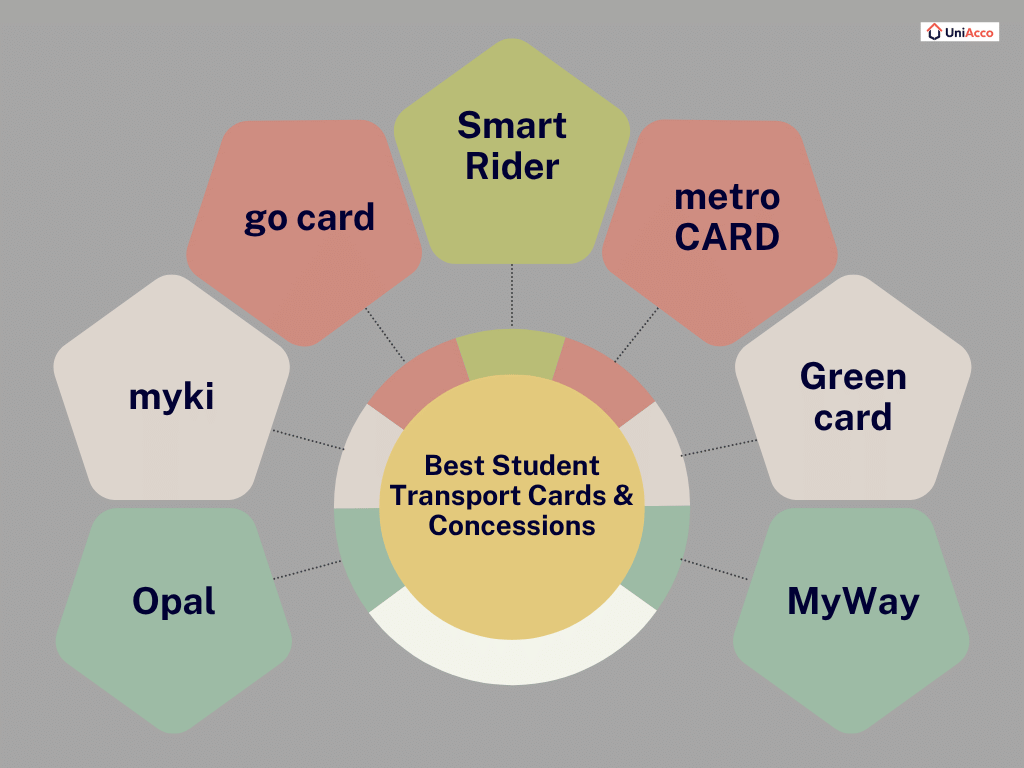
Best Student Transport Cards & Concessions
Opal
Opal is a contactless smartcard for public transport across Sydney, the Central Coast, Hunter Region, Blue Mountains, Illawarra and Southern Highlands. It’s an all-mode card. However, concessions for international students are rare unless you hold certain government scholarships.
| Key Information | Details |
| Student Concession Eligibility | Mostly not available. Limited exceptions for certain Australian Government scholarship holders |
| Typical Student Fare/Discount | Adult fares apply for most (weekly cap AUD $50). Concession card holders (limited to specific scholarship recipients) are capped at AUD $25/week. |
| How to Get It | Order online or pick up at retailers. Students can top up via the app or the website |
| Official Website | https://opal.com.au |
Myki
Myki is specifically for Victoria and can be used on buses, trains and trams. Eligible international undergraduates use the International Student Travel Pass (ISTP) for 50% off myki passes.
| Key Information | Details |
| Student Concession Eligibility | Eligible full-time international undergraduates at participating institutions via International Student Travel Pass (ISTP) |
| Typical Student Fare/Discount | 50% off 90-, 180-, or 365-day myki passes via ISTP (state-wide pass: $297 for 90 days, $594 for 180 days, $1,073 for 365 days; may be lower during the half-price period). All fares are also half price until 1 January 2027. |
| How to Get It | Apply through your university for an ISTP code, then buy your pass on the ISTP website. Otherwise, buy a standard Myki |
| Official Website | https://transport.vic.gov.au |
go card
This travel card is designed for South East Queensland’s network, including Brisbane and the Gold Coast. All Translink trips cost a flat 50 cents, so students pay very little regardless of concession status.
| Key Information | Details |
| Student Concession Eligibility | Concession available for eligible tertiary students, but the flat 50-cent fare applies to everyone |
| Typical Student Fare/Discount | Flat 50-cent fare on all Translink trains, buses, ferries and trams (excluding Airtrain) |
| How to Get It | Buy from Translink retailers or stations, or simply tap a contactless bank card |
| Official Website | https://translink.com.au |
SmartRider
This is Perth’s smartcard. It offers easy travel on ferries, buses and trains, with concession fares available to full-time international students through a Tertiary SmartRider.
| Key Information | Details |
| Student Concession Eligibility | Concession for full-time international students (Tertiary SmartRider) |
| Typical Student Fare/Discount | Concession fares (roughly half the standard fare), with a daily cap |
| How to Get It | Apply through your university or TAFE, or at a Transperth InfoCentre |
| Official Website | https://www.transperth.wa.gov.au |
metroCARD
The metroCARD is Adelaide’s smartcard and can be used on trains, buses and trams. Concessions are available for full-time international tertiary students.
| Key Information | Details |
| Student Concession Eligibility | Concession available for full-time tertiary students at approved institutions |
| Typical Student Fare/Discount | Concession fares apply. Concession 28-Day Pass: AUD $59.60 |
| How to Get It | Get a Concession metroCARD and carry your concession proof (student ID) |
| Official Website | https://www.adelaidemetro.com.au |
Greencard
Greencard is Tasmania’s smartcard, used on Metro Tasmania buses, Tassielink and Derwent Ferries. When it comes to concessions, international students receive the same benefits as local commuters.
| Key Information | Details |
| Student Concession Eligibility | Same concessions as local students |
| Typical Student Fare/Discount | Travel is currently free until 30 June 2027. When fares resume, concession fares apply, plus a discount for using a Greencard |
| How to Get It | Not needed while travel is free (Metro has paused GreenCard applications until 30 June 2027). When fares resume, apply via Metro Tasmania with student documentation |
| Official Website | https://www.metrotas.com.au |
MyWay+
MyWay+ is Canberra’s travel card and can be used on buses and light rail. Full-time international students in the ACT are eligible for tertiary concession fares.
| Key Information | Details |
|---|---|
| Student Concession Eligibility | Tertiary concession for full-time students studying in Canberra |
| Typical Student Fare/Discount | AUD $1.71 per trip, with free travel for the rest of the month after 40 paid trips |
| How to Get It | Set up a MyWay+ account online or visit a MyWay+ retail outlet with your student ID |
| Official Website | https://www.transport.act.gov.au |
How Much Does Public Transport Cost in Australia for Students?
With lectures almost every day of the week, the cost of commuting depends heavily on your city. Students should expect to budget anywhere from under AUD $25 a month in Brisbane to around AUD $216 a month in Sydney. Wherever you are, check for concessions, as you can save a reasonable amount of money.
| City | Indicative Student Transport Budget/Month |
| Sydney | ~AUD $150–$216 |
| Melbourne | ~AUD $125 (half-price period; lower with ISTP) |
| Brisbane | ~AUD $20–$25 (50-cent fares) |
| Perth | Up to ~AUD $70 (Tertiary SmartRider) |
| Adelaide | ~AUD $60 (Concession 28-Day Pass) |
| Canberra | Up to ~AUD $68 (tertiary fares) |
| Darwin | AUD $0 (buses currently free) |
| Hobart | AUD $0 (buses and ferries currently free) |
How to Use Public Transport in Australia?
Step 1: Check Your Route
First, find out where you need to go. Use official journey planners such as Transport NSW, PTV, Translink, Transperth or Adelaide Metro. You can also use Google Maps. Check bus and train timings, travel zones and any service disruptions before you leave.
Step 2: Get the Right Travel Card
Don’t assume you can use the same card everywhere in Australia. Each city has its own travel card:
- Sydney uses Opal.
- Melbourne uses Myki.
- Brisbane and the Gold Coast use the go card.
- Perth uses SmartRider.
- Adelaide uses metroCARD.
- Canberra uses MyWay+.
- Tasmania uses Greencard.
- Darwin uses Tap and Ride.
You can get these cards online or from a service point.
Step 3: Add Money to Your Card
Make sure your card has enough money before you travel. If you need more, you can add it online or through the city’s transport app. Some cards also let you set up automatic top-ups. If you use your debit or credit card to tap and pay, make sure it is set up on your phone.
Step 4: Tap On
Tap your travel card or contactless bank card on the reader before starting your journey. You may need to do this at train station gates, bus doors, tram stops or ferry terminals. Wait for the beep or green light before continuing.
Step 5: Change Services if Needed
If you need to change from a train to a bus, tram or ferry, follow the transfer rules for that network. Some transport systems allow transfers within a set time without charging you for a completely new journey.
Step 6: Tap Off When Required
Tap your card when you finish your journey if the transport system requires it. This helps make sure you are charged the correct fare. For example, in Melbourne, you need to tap off when leaving trains and buses but not trams. Forgetting to tap off can sometimes result in a higher fare.
Step 7: Check Your Fare and Balance
Check your card balance regularly to make sure you have enough money for your next journey. You can usually check your balance online or through the transport app. Also check your daily or weekly travel costs so you can manage your transport budget.
Tips to Save Money on Public Transport as a Student
Check Your Concession Eligibility
Concessions for public transport in Australia for students depend on the city:
- WA, SA, Tasmania and the ACT: full-time international students can access concession fares.
- Queensland: everyone pays a flat 50-cent fare.
- Victoria: eligible international undergraduates can get 50% off myki passes via the International Student Travel Pass (ISTP).
- NSW: most international students pay adult fares unless they hold specific government scholarships.
Choose Accommodation Near Your University
The best way to cut down on the cost of transportation in Australia is to stay close to your university. When you’re shortlisting your student accommodations in Australia, check the real-time commute and not just the distance.
Compare Weekly/Monthly Passes With Pay-As-You-Go
If you commute daily, passes like Melbourne’s International Student Travel Pass (ISTP) (90-day/180-day/365-day) or Adelaide’s 28-Day Pass often beat pay-as-you-go. Elsewhere, rely on smartcard daily, weekly or monthly caps. We recommend you take some time to find out which option will be best for you.
Use Student Transport Offers
States run their own schemes that help students cut costs:
- Victoria: the International Student Travel Pass (ISTP) for international undergraduates, plus half-price fares for everyone until 1 January 2027.
- Queensland: a flat 50-cent fare on all Translink services.
- Darwin, Alice Springs and Tasmania: public buses (and Tasmania’s ferries) are currently free.
Walk or Cycle for Short Trips
If your destination is a 10–15 minute trip away, choose to cycle or walk. Many campuses have bike storage for students opting for a bike ride.
Travel During Off-Peak Periods Where Possible
Public transport in Australia for students is cheapest during off-peak periods; in Sydney, for example, off-peak fares are 30% cheaper. You also save time, and this makes your travel more pleasant.
Use Fare Caps
Many cities have a daily or weekly limit on travel costs. Once you reach this limit, you can travel more without paying extra. This is useful if you use public transport every day.
Avoid Unnecessary Airport Transfers
Airport surcharges can be expensive (e.g., Sydney’s Opal airport station fee, or Brisbane’s Airtrain, which isn’t covered by 50-cent fares). For your first arrival, compare train vs shuttle vs rideshare to understand what is cheaper.
Be among nature and at the top spots of Australia, with UniAcco. Get in touch with our experts and secure your spot now.
Public transport in Australia for students is extremely easy to navigate. Once the student has understood the basics, travelling within and on the outskirts of Australia’s cities will be an easy and comfortable experience. This article helps students understand the cost of transportation in Australia and know which card to go for, enabling a much easier transition to student life in Australia.


 LinkedIn








0 Comments