
There’s a moment every aspiring international student hits, you’ve shortlisted your US universities, you’ve started your application, and then you see it: “Standardised test scores required.” And suddenly you’re staring at two acronyms, ACT vs SAT, wondering which one is actually worth your time, money, and six weeks of prep.
Here’s the thing: this isn’t a trick question. Both tests are accepted by every accredited US university, including Ivy League schools. But they’re built differently, they test different things, and depending on how your brain works, one of them might give you a real edge. The ACT is an assessment that tests students’ understanding of their high school curriculum, while the SAT has traditionally been considered more of an aptitude test.
This guide cuts through the noise. By the end of it, you’ll know exactly which test fits you, and why.
ACT vs SAT: Quick Comparison
| Feature | SAT | ACT |
| Format | Digital, adaptive | Linear, paper + digital |
| Pacing | Slower | Faster |
| Math | Algebra-focused | Broader (trig, stats) |
| Science | Not included | Optional section |
| Calculator | Allowed throughout | Math only |
| Scoring | Adaptive | Fixed |
| Best For | Deep thinkers | Fast problem-solvers |
What is the ACT?
The ACT (American College Testing) has been around since 1959. It was created with a clear goal in mind: to test what students really learned in school. Not aptitude, not abstract reasoning. Give them a test on real schoolwork.
The ACT evaluates students across four main subjects, with an optional writing section: English (grammar, punctuation correction, sentence structure, and rhetorical skills), Math (algebra, geometry, trigonometry, and basic statistics), Reading (comprehension across literature, social studies, humanities, and sciences), and Science (data interpretation, experiment analysis, and scientific reasoning). An optional Writing section requires students to analyse an issue and present an argument. The ACT exam has become significantly shorter, shifting from a 3-hour test to approximately 2 hours. The new format has 44 fewer questions, bringing the total from 215 to 171. Reading and English sections now feature shorter passages, and students have 22% more time per question.
Beginning in April 2025, the ACT offers a shortened, online format, although students may still opt for the original, longer paper version. The Science Section is now optional, and the Composite Score is now the average of English, Math, and Reading scores; Science is no longer included in the composite. Big changes. And they matter for how you plan your prep.
What is the SAT?
The SAT (Scholastic Assessment Test) is developed by the College Board and has been a cornerstone of US college admissions for decades. There are many reasons why the SAT is the #1 college admission test in the US, taken by more students, more than two million in the class of 2025, than any other test.
Since March 2024, the SAT has been fully digital and adaptive worldwide. The test now has just two sections: Reading & Writing, which includes short passages, one question per passage, organised into four skill domains: Structure and Craft, Information and Ideas, Conventions of Standard English, and Expression of Ideas. Math, where a calculator is allowed throughout; a mix of multiple-choice and student-produced responses.
The SAT has no individual science section; it integrates science reasoning into reading passages and math problems. The adaptive format means your second module adjusts in difficulty based on how well you did in the first, which changes how you should practice for it.
Still confused why the SAT and ACT confusion never gets old? Read this Reddit thread and find the answer to why it’s always SAT vs ACT.
Why the SAT vs ACT? – r/Sat
ACT vs SAT: Key Differences
Both tests get you to the same destination. But the roads are very different. Here’s a side-by-side breakdown:
| Feature | ACT | SAT |
| Full Form | American College Testing | Scholastic Assessment Test |
| Administered By | ACT, Inc. | College Board |
| Exam Pattern | 4 sections: English, Math, Reading, Science (+ optional Writing) | 2 sections: Reading & Writing, Math |
| Duration | ~2 hours 5 minutes (without Science/Writing) | ~2 hours 14 minutes |
| Science Section | Included (optional from 2025) | Not included (integrated into passages) |
| Math Focus | Wider topics, more straightforward | Conceptual, reasoning-heavy |
| Calculator Use | Math section only (not Science) | Allowed throughout Math |
| Scoring Range | 1–36 | 400–1600 |
| Question Style | Direct, fast-paced | Analytical, adaptive |
| Test Format | Paper or digital (choice from 2025) | Fully digital |
| Essay | Optional | Not included |
| Cost (International) | ~$100–$125 | ~$111 (base + international fee) |
“Choosing between the ACT and SAT doesn’t have to be stressful. It comes down to what kind of thinker you are, not which test sounds more impressive.”
ACT vs SAT: Score and Conversion
Scoring System
ACT scoring runs on a 1–36 composite scale, calculated as the average of your English, Math, and Reading section scores (from 2025). Each section is scored 1–36 individually.
SAT scoring runs on a 400–1600 scale, with two sections, Reading & Writing and Math, each scored 200–800.
Score Comparison
ACT and the College Board completed a concordance study to examine the relationship between ACT and SAT scores. These concordance tables do not equate scores; rather, they provide a tool for finding comparable scores.
Here’s a snapshot of the official concordance:
| ACT Composite Score | Equivalent SAT Score |
| 36 | 1590–1600 |
| 34 | 1510–1540 |
| 32 | 1430–1460 |
| 30 | 1360–1390 |
| 28 | 1280–1310 |
| 26 | 1200–1230 |
| 24 | 1110–1150 |
| 22 | 1030–1060 |
| 20 | 950–980 |
| 18 | 870–900 |
A concordance score is not a perfect prediction of how you’d perform on the other test. It represents comparable percentile standing, not identical academic ability.
Planning to study in the UK? Get your student accommodation sorted even before you land. UniAcco connects international students with verified, affordable housing near top UK universities, with 24/7 support and a lowest-price guarantee.
🔍 Explore UK Student HousingACT vs SAT: Which is Better?
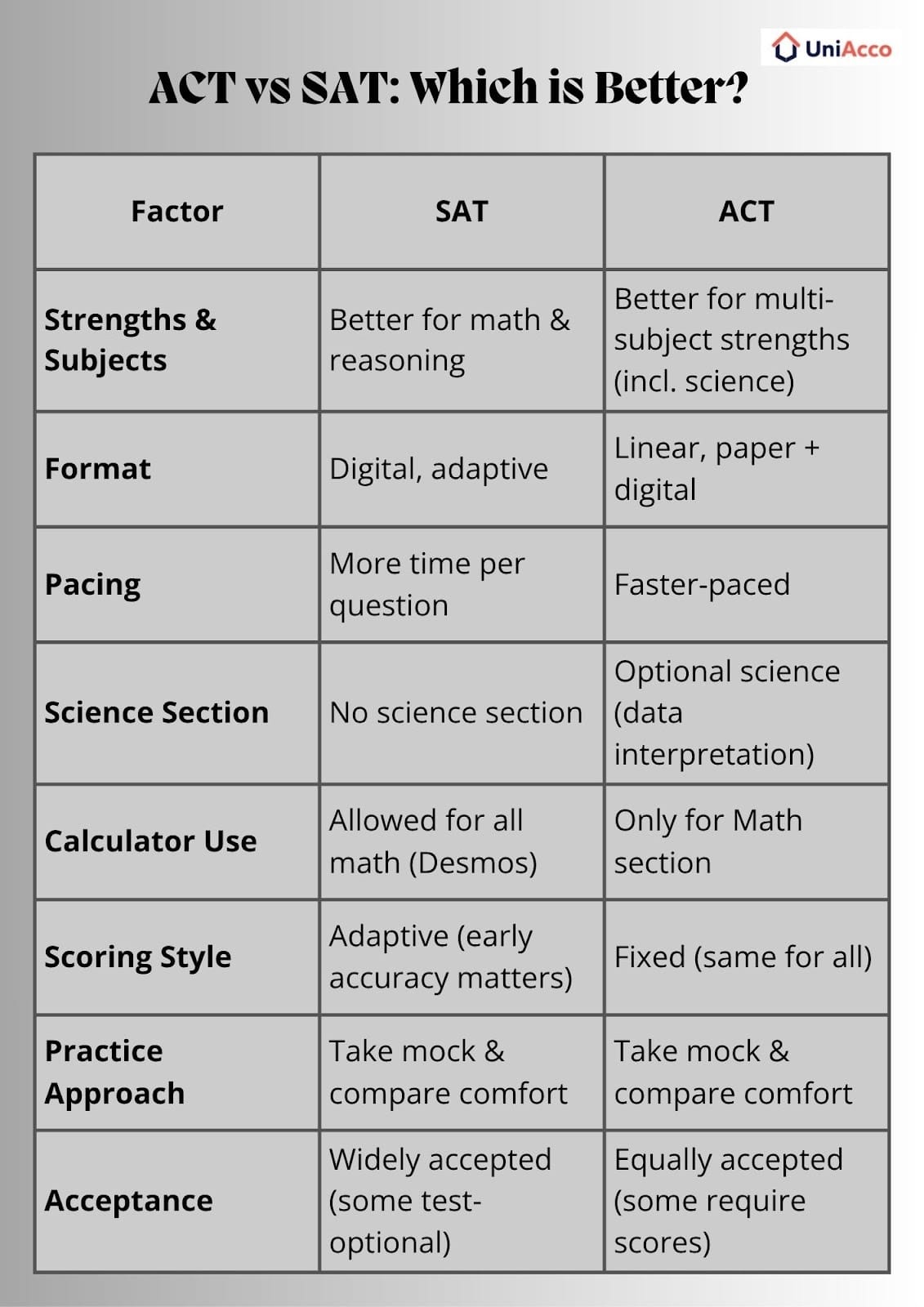
There’s no universal answer. But there is a right answer for you. Here’s how to figure it out:
- Based on Your Strengths and Subject Preferences
If you’re inherently good at multiple subjects, like science, the ACT’s wide range of topics may actually help you. Students who love math might do better on the SAT, whereas people who read well might do better on the ACT. The SAT’s Math part is more about algebra and reasoning, while the ACT covers a wider range of topics, such as statistics and trigonometry.
- Based on Test Format and Structure
The SAT is now a digital, multistage, adaptive exam administered on testing devices, while the ACT has rolled out an “enhanced” format with an optional Science section and a revised Composite calculation. If you want flexibility in how you test, paper or digital, the ACT now gives you that option. The SAT is digital-only globally.
- Based on Time Pressure and Pacing
This one is significant. The ACT fits students who work fast and can handle tight pacing. The SAT suits those who prefer more time per question and deeper reasoning. The updated ACT gives students 22% more time per question than the old format, but it’s still faster-paced than the SAT overall.
- Based on Comfort with the Science Section
The ACT’s Science section tests data interpretation and scientific reasoning, not memorised facts. While the ACT has a separate science section, starting in spring 2025, that section is “optional.” If science isn’t your strong suit, you now have the choice to skip it, though some STEM-focused universities may still want to see that score.
- Based on Calculator Usage in Math
The SAT allows the use of an on-screen Desmos calculator for all math questions. The ACT allows an approved calculator on the Math section but not on the Science section. If you rely heavily on your calculator for complex problems, the SAT’s full-Math calculator access is a practical advantage.
- Based on Scoring Style and Evaluation
The SAT’s adaptive format means the difficulty of your second module depends on how you performed in the first. Accuracy in the early questions matters more on the SAT. The ACT is linear; every student gets the same questions, which some find more predictable and easier to pace.
- Based on Practice Test Performance
The easiest thing to do is to take one full-length practice test for each and then compare your scores and how comfortable you feel. You can get free ACT practice materials from ACT.org and official digital SAT practice exams via the College Board’s Bluebook app. Your gut feeling after each test is information. Believe it.
- Based on University Requirements and Acceptance
The ACT and SAT are equally accepted and considered by all US colleges and universities, including the Ivy League. However, policies are shifting. MIT, Georgetown, and Florida State require scores again for the 2025 cycle, while Harvard, Yale, and the University of California remain test-optional. Always check each university’s current admissions page before deciding.
Found your university? Now find your home. UniAcco offers verified student accommodation near Coventry University, with flexible booking, no hidden fees, and support at every step of your journey.
🔍 Explore Coventry Student HousingACT vs SAT for International Students
The ACT vs SAT for international students question has a few layers that domestic students don’t have to think about.
Both tests are available all around the world. The SAT is completely computerised all throughout the world. The ACT is also available, largely on computers, but in some places you can still take paper tests. Availability varies by country and region. The SAT costs about $111 for students from other countries as of August 2025. This includes a $68 basic fee and a $43 international tax, as well as any expenses for local test facilities.
Both scores are equally important for students who want to attend college in the US or Canada. Standardised testing gives admissions officers a clear sense of academic preparation, even when transcripts, grading scales, and curricula vary widely across countries.
For students also considering UK universities, the picture is different. Most UK universities accept SAT and/or AP Exam scores to help applicants meet requirements for undergraduate programs, and some may require them. The ACT is less commonly referenced in UK university admissions requirements, making the SAT the stronger dual-purpose option if you’re applying to both US and UK institutions.
Wanna know what is suitable for international students? Explore this Quora discussion and find answers to which is the best for international students from students themselves.

ACT and SAT Preparation
Good ACT and SAT preparation is less about the number of hours you put in and more about the quality of what you practice with.
- For SAT prep:
Official practice for the SAT is free and includes 7 full-length practice tests in Bluebook™, the same testing app you’ll use on test day, that are automatically scored. The College Board has partnered with Khan Academy to offer Official SAT Prep, where you can develop the knowledge and skills tested on the SAT.
- For ACT prep:
The ACT offers only 1 free downloadable practice test and 2 web-based practice tests (1 timed and 1 untimed). For the updated 2025 format, make sure you’re using the Enhanced ACT practice materials. You should avoid using old prep books that still show 215 questions and a 3-hour format.
General tips for both:
- First, set a date for the test, and then plan your study time around it.
- Use only approved resources; third-party prep materials may use old formats.
- Set up the exam settings as closely as possible, including the timing and the device (particularly for the digital SAT).
- Before choosing one, take both practice tests. Your gut feeling after each test is good data.
- A lot of students only turn in one test result because giving in both scores doesn’t normally help them get into college. Choose the test you do best on and go all out.
Prepping for your Canada future? Start with where you’ll live. Thousands of international students trust UniAcco to book verified, affordable student accommodation in Canada near their campus—before they even land.
🔍 Explore Canada Student HousingConclusion
The ACT vs SAT debate doesn’t have a winner; it has a right answer for each student. If you’re fast, curriculum-confident, and comfortable with science reasoning, the ACT’s straightforward style might work better for you. If you prefer more time per question, adaptive challenge, and a fully digital format, the SAT could be your edge.
And once you’ve nailed your test choice, the next step is figuring out where you’ll actually live when you get there. UniAcco helps international students find verified, affordable student accommodation across the US, UK and beyond, so that part of the journey is already taken care of.


 LinkedIn










0 Comments