

As Blair Waldorf from the famous Gossip Girl saga once said — Destiny is for losers. It’s just a stupid excuse to wait for things to happen instead of making them happen. With this hard-hitting thought in mind, let’s assume you are at your desk or on your lazy-boy chair, thinking about how to begin studying for the exam that’s just around the corner.
To start with, breathe for real. Don’t rush. Take a look around your desk, your room. Is it saying — Organise me. Dump those empty coffee mugs in the sink. Neon highlighters have lost their caps; find them. Why is there a heap of books? Only keep the books for the upcoming exam on the desk.
In the high-stakes world of getting through the 2026 academic examination, there’s no way you can wait for inspiration to strike. The performance pressure is paralysing, but know that it is manageable. By transforming a chaotic schedule into an organised one, become a high-performing machine. In this blog, we’ll tell you exactly how. No fancy words, straight up actionable points to get you started with a light heart and a smile on your face. Remember how Joker says — Let’s put a smile on that face. Keep that energy.
In this blog, we are going to break down the top 10 game-changing strategies to help you crack open the gate to your future self. Not just that, we’ll highlight the common traps you must avoid to protect the House of Cards in your mind from falling apart. After all, isn’t it all in the mind and about the mind? So let’s begin.
Wait — before that, if you’re dreaming about studying in London, visualise your future student accommodation in London near your university. Stay close to campus, enjoy modern amenities, and experience the best of student life in the city.
🔎 Explore Student Accommodation in LondonTop 10 Practical Study Tips to Score High for an Exam in 2026
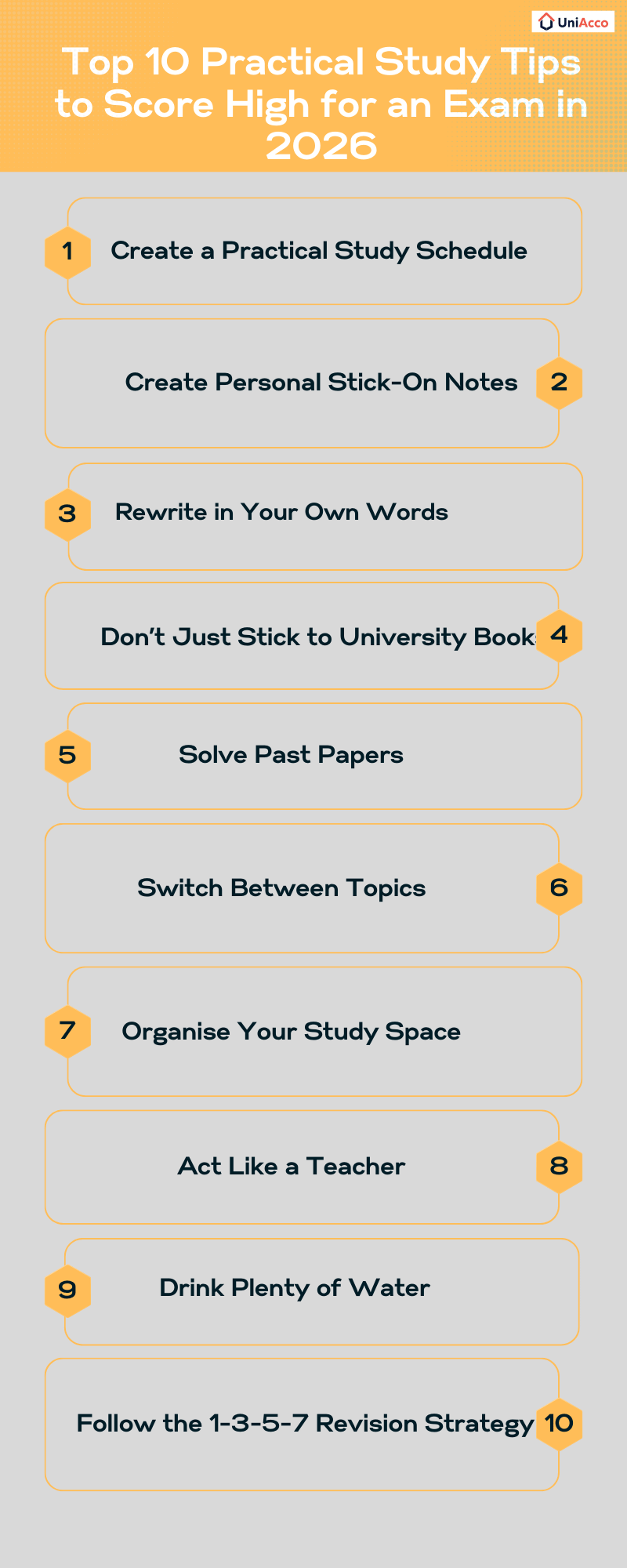
Productive studying is not about burying your head in a book till the time you forget the difference between a night and a day. Overstudying often leads to cognitive burnout. What does this mean? Your brain is telling you — Try as hard as you may, I have stopped absorbing new data. This is where you listen to your brain and start thinking methodically. Here’s how.
- Create a Practical Study Schedule
Have you heard of this concept called Time Blocking? It is a time management technique where you divide your day into dedicated blocks of time, with each block assigned for a specific task. In your case, a specific subject. Assign specific hours to specific topics. This helps in reducing decision-making fatigue. By the way, do you have a desk clock? If not, get it now. When time faces you, you learn to face it too.
- Create Personal Stick-On Notes
This is a personal favourite for it literally helps in sticking notes on the mind’s wall. You see, our brain loves visual cues. I say think of a purple elephant, and now you can’t stop thinking about a purple elephant. Similarly, write down the most stubborn formulas, dates, and keywords on colourful sticky notes and place them in high-traffic areas of your room. Does the bathroom mirror count? Yes.
- Rewrite in Your Own Words
In the age of AI, copy-pasting is an easy-peasy job. But remember, if it’s easy, it doesn’t last long. On the other hand, if you simplify a complex concept in your own words after reading the notes, you are halfway through. When you’re taking notes, summarise the learning as if you’re explaining it to a friend. Did we mention writing with a pen and paper creates a higher impact than typing? Science backs it, too. So go for it. Let the ink flow.
- Don’t Just Stick to University Books
This is a secret study tip for an exam. So shhh… If you’re seeking the right knowledge to crack an entrance exam, the right knowledge will seek you back; not only via prescribed university books but via other forms — podcasts, documentaries, discussions, libraries. You get the drill. So diversify your resources like the tributaries of the river Nile. How does this help? It gives you a unique perspective that examiners love. Especially if you are applying for Art or Architectural schools or Humanities.
- Solve Past Papers
Some things in life are non-negotiable, like a room close to your university [LINK]. This strategy is one of those. Solve as many past papers as possible. Past papers are the closest thing you have to a time machine. They reveal the different moods of the examiner so that you can tune in and gauge what’s to come. Of course, don’t just depend on the past. There’s always a possibility for uncertainty. If you’ve already bought the desk clock we suggested, time yourself while solving these papers. It helps in building exam stamina.
- Switch Between Topics
In the community of study tips for an exam, this strategy is known as Interleaving. How does it work? Avoid studying a subject for 10 hours at a stretch. Instead, switch between 2-3 subjects. This is called Interleaving. This technique shapes your brain to stay alert and helps you distinguish between different types of problems. So keep the switch button on every 2-3 hours as if you’re switching from one Masterclass video to another.
- Organise Your Study Space
This is what we hinted at at the beginning of this blog. Organise. Organise. Organise. Cannot stress more. Because a messy desk means a messy mind. WYSIWYG. If you know what this means, you know what we’re talking about. Keep your stationery ready, clear the clutter and flip your mind to study mode.
- Act Like a Teacher
Have you ever thought this way — Before you go to sleep, you have to ‘act’ as if you are sleeping, and that’s how everything in life works. To truly test your knowledge, pretend to teach the concept as a teacher to an imaginary class. If you can’t explain something and you go blank, that’s where your knowledge gap lies. Work on that. Act like a teacher. It’s called The Feynman Technique.
- Drink Plenty of Water
Drinking water with absolute awareness is a crucial part of the ‘revision strategy’. Dehydration leads to brain fog. Hydration brings clarity equivalent to the clarity of the water you drink. Lack of water in the body impairs your concentration and short-term memory. Keep a bottle handy and sip regularly.
- Follow the 1-3-5-7 Revision Strategy
This study tip for an exam is like 1357 kg of gold. It’s the mitochondria of memory retention. Instead of a full blast of revision, revise your material in progression. Even CEOs have approved this strategy.
- Day 1: Immediately after learning a topic, do your first revision.
- Day 3: Brush up on what you’ve studied, and do your second revision.
- Day 5: Reinforce the core concepts, do your third revision.
- Day 7: Shift to long-term memory retention, do your fourth revision.
Here’s a Reddit thread that pulls together some of the best exam study tips — from focus hacks to memory tricks that actually stick.
Reddit’s best study tips compiled from 100 posts – r/GetStudying from r/GetStudying
Things to Avoid While Studying for an Exam
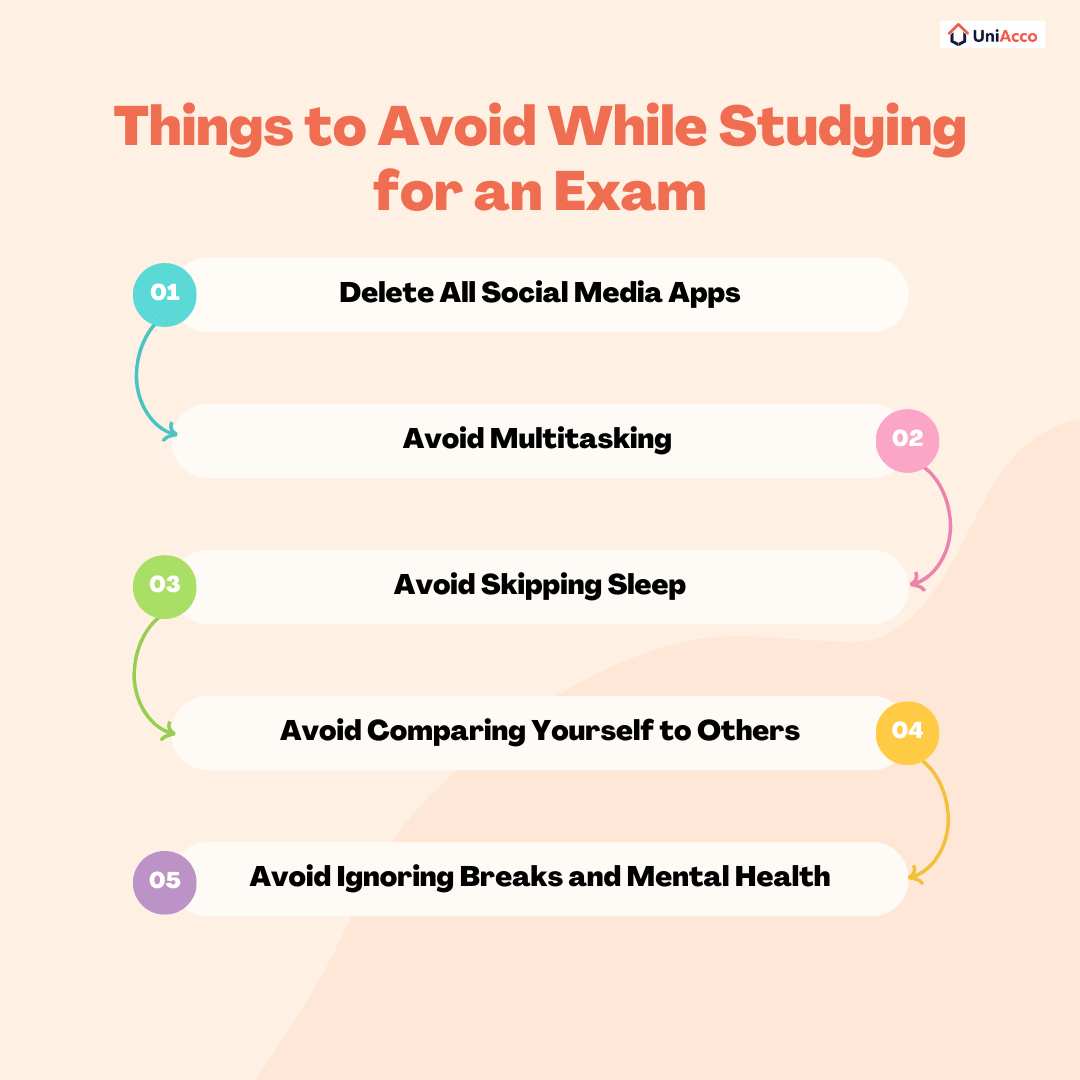
You know what sets the top 1% from the rest? It’s the power of negation. While knowing what to do to clear an exam is half the battle won, the other half is won by the sword of negation. In the age of digital distraction, knowing what to avoid separates the toppers from the rest. You may have the best strategy in place, but if you also have a phone that’s reel-ing constantly, then you’re in for a ride which will mostly go south. Here are a few things to avoid.
- Delete All Social Media Apps
An important study tip for an exam. Social media apps and their creators are smart. So they added this button. It’s called — Delete Account Temporarily. Use that button for your good. There is no study that can happen on Reels or Shorts, no matter what piece of golden information you may receive. If the app isn’t there, the vibration won’t distract you. As a reward, when you clear the exam, bring back the app. Who’s gonna stop you after you clear the exam!?
- Avoid Multitasking
Did you know that multi-tasking comes naturally to women? Here’s research by the journal BMC Psychology that says so. Women can flip an omelette with one hand while talking to Rachel. While doing both activities, they can think about which movie to watch later that night. It’s possible, but is it necessary? Not when you have an exam to clear tomorrow. We can show our multitasking skills if there’s a competition, but otherwise, no need. Focus on one topic, finish it, and then move on.
- Avoid Skipping Sleep
People who love the idea of sleep won’t have a problem here. But when there’s an exam sitting on top of your head, I doubt one can sleep. But that’s exactly what we must avoid. Sleep is when memory consolidation happens. Aim for 7-8 hours of sleep to keep your cognitive juices flowing. Get that much-needed deep sleep.
- Avoid Comparing Yourself to Others
This is a trap. Calling up your friend to check how much they’ve covered is not going to help you. In fact, it will add stress to your schedule. Why would you want that? Switch off the phone unless really needed. Focus on productive studying over competitive studying. This study tip for an exam is sure to boost your confidence.
- Avoid Ignoring Breaks and Mental Health
The Pomodoro Technique will come in handy here. For every 50 minutes of study time, take a 10-minute break. Take a break to do some physical activity like a quick workout. Don’t take a break to scroll. Wash your face with cold water. Take your pet (if you have one) for a walk. If not, take yourself for a walk.
Studying in Australia but haven’t found a student room where you can study peacefully? Explore verified student accommodation in Australia on UniAcco and discover rooms with premium amenities, including dedicated study spaces, cinema rooms, gyms, and much more.
🔍 Explore Student Accommodation in AustraliaConclusion
To cross this bridge of the 2026 exam isn’t a matter of luck or destiny (go back to the Blair Waldorf quote at the top), it’s a result of the systems and strategies you put in place. We’ve handed you the baton with the best study tips for an exam in 2026. Now take this baton, and light up the torch of your success. Get started with the right attitude because it all starts from there. 1-3-5-7. Go for that college of your dreams. The power lies behind you so that you stay ahead of your time.
But before that, if you are fed up with your old student accommodation, find a new one through UniAcco for affordable, all-inclusive rent.












0 Comments