Australia’s top universities are raising the bar for international admissions, and IELTS remains the one test they all trust without hesitation. Every Group of Eight university and hundreds of specialised institutions list IELTS as a primary requirement, making it one of the simplest pathways into competitive programmes.
For students comparing IELTS accepting universities in Australia, knowing updated requirements early can make a measurable difference in course eligibility and visa planning. This blog profiles the top 10 Australian institutions, their 2026 band expectations, and the practical insights you need before submitting your application.
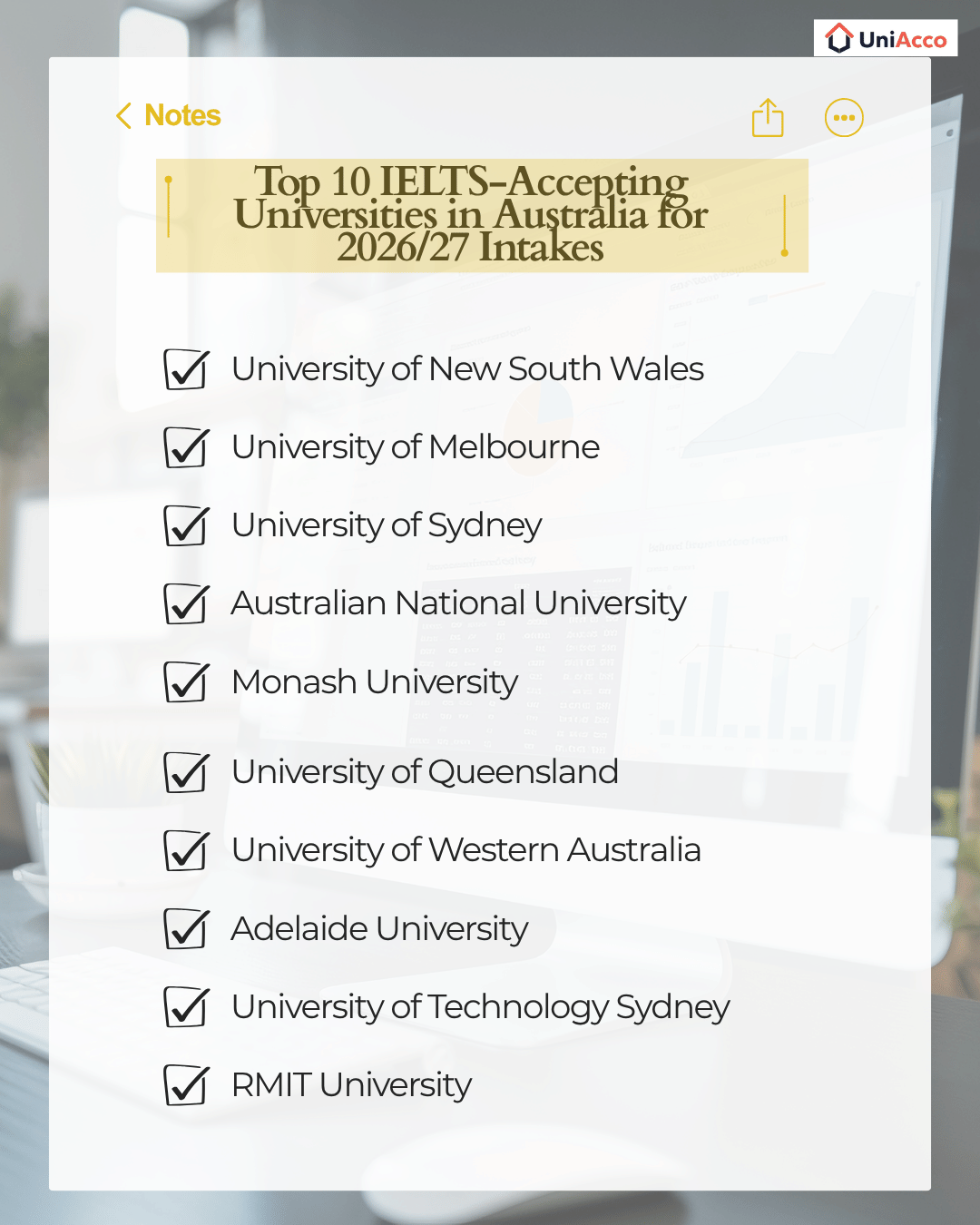
Top 10 Australian Universities Accepting IELTS: An Overview
| University | QS World Ranking (2026) | Minimum IELTS Score* |
| Australian National University (ANU) | 32 | 6.5 |
| University of Sydney | 25 | 6.5 |
| University of Melbourne | 19 | 6.5 |
| University of New South Wales (UNSW Sydney) | 20 | 6.5 |
| Monash University | 36 | 6.0 |
| University of Queensland (UQ) | 42 | 6.5 |
| University of Adelaide | 82 | 6.5 |
| University of Western Australia (UWA) | 77 | 6.5 |
| University of Technology Sydney (UTS) | 96 | 6.5 |
| Macquarie University | 138 | 6.5 |
Also read: Best IELTS Practice Test For International Students
From university dorms to private apartments, find a space that fits your lifestyle and budget. Focus on studying and living fully — UniAcco has got your back.
🏠 Browse Verified Sydney AccommodationsUnderstanding the IELTS Test for Australia Admission
The IELTS (International English Language Testing System) is the most widely trusted English proficiency test for students applying to Australian universities. Universities prefer IELTS because its scoring has remained consistent for decades, making admission decisions easier and more reliable across undergraduate and postgraduate programs.
The test assesses listening, reading, writing, and speaking under timed conditions, with the speaking section conducted directly with an examiner for an accurate assessment of communication skills. Since every Australian university accepts IELTS, it remains the most dependable choice for 2026 aspirants.
Key Features of the IELTS English Test
- Accepted by all Australian Universities: IELTS is approved by 100% of institutions across Australia, covering undergraduate, postgraduate, and professional programmes. Its long-established reliability gives admissions teams a uniform, trusted benchmark for judging English proficiency.
- Choice of Computer or Paper Formats: Candidates can select their preferred mode: computer-delivered for faster results and more test dates, or paper-based for a traditional testing approach. This flexibility helps international students choose a format that aligns with their comfort and application deadlines.
- Holistic Assessment of Language Skills: IELTS evaluates listening, reading, writing, and speaking using academically focused tasks. The in-person speaking interview provides universities with a realistic view of how well students can communicate in academic and everyday situations.
- Predictable Result Timelines: Computer-delivered IELTS results are issued within 3–5 days, while paper-based results take around 13 days. These fixed timelines help applicants organise their offer acceptance, visa documentation, and university submissions without last-minute pressure.
- Standardised 9-Band Scoring: Scores are reported on a strict 1–9 band scale, with most Australian universities requiring 6.0–6.5 overall. Because this scoring is identical worldwide, institutions trust that every IELTS score reflects consistent proficiency levels.
- Widespread Global Accessibility: IELTS is available in 140+ countries with frequent test dates, allowing international students to book appointments without complex travel or scheduling issues. This accessibility makes IELTS one of the most practical options for applicants bound for Australia.
IELTS English Exam Pattern for Australia
| Feature | Description |
| Test Format | Available in computer-delivered and paper-based modes. Listening, Reading, and Writing occur in one continuous sitting; Speaking is scheduled on the same day or within 7 days. |
| Modules Covered | Listening, Reading, Writing, and Speaking. (All Australian universities require minimum scores in each module) |
| Speaking & Interview Format | Conducted one-on-one with a certified examiner, either in person or via online video call. Assesses fluency, coherence, pronunciation, and real-time communication skills. |
| Duration | Total: 2 hours 45 minutes. • Listening: ~30 mins • Reading: 60 mins • Writing: 60 mins • Speaking: 11–14 mins |
| Scoring Scale | Each module is graded on a 9-band scale. The final band score is the average of all four modules, rounded to the nearest 0.5. |
| Result Time | Computer-delivered: 3–5 days Paper-based: ~13 days |
| Validity | 2 years; accepted for university admissions, student visas, and professional registrations across Australia. |
| Retake Policy | Unlimited retakes allowed. IELTS One-Skill Retake (OSR) is available in many countries, allowing students to retake only one module instead of the full test. |
If you’d like a real-world perspective, this Reddit thread breaks down what students are saying about computer-based IELTS acceptance in Australia:
Is computer‑based IELTS accepted for Australia? – r/IELTS
Top 10 Universities To Study In Australia With IELTS

Australian National University (ANU)
The Australian National University (ANU), consistently ranked among the top universities globally, accepts IELTS as a primary English proficiency qualification for international admissions. Known for its strength in politics, international relations, data science, engineering, and public policy, ANU attracts applicants from over 140 countries. It maintains some of the most selective entry standards in Australia.
With clear requirements, the university provides a reliable pathway for students to study in Australia with IELTS while maintaining its strong academic and research reputation.
Minimum IELTS English Test Score Requirements:
| Course / Level | Minimum IELTS (Academic) |
| Undergraduate (All courses) | 6.5 overall, with no band less than 6.0 |
| Postgraduate (Regular degree programs) | 6.5 overall, with no band less than 6.0 |
Key Highlights:
- Location and Student Life: ANU is located in Canberra, Australia’s capital, and one of the safest academic cities for international students. Its campus is surrounded by national institutions, research hubs, and policy bodies, providing students with unique exposure to government, diplomacy, security, and global affairs. For students choosing universities in Australia that accept IELTS, Canberra offers a focused environment with reliable public transport, low living stress, and strong community support.
- Placements & Career Pathways: The ANU Careers team delivers targeted guidance through personalised consultations, resume and cover-letter refinement, interview prep, employer sessions, and industry networking events. International students benefit from structured job-readiness programs and insights into Australia’s post-study work pathways. For applicants meeting IELTS requirements, this support ensures a smoother transition into competitive local and global job markets.
- Student Support & Academic Preparation: ANU’s support ecosystem includes academic tutoring, writing workshops, counselling, disability services, and wellbeing programs tailored for international cohorts. Students who meet the IELTS requirements but want added preparation can access pre-sessional and in-sessional English support. The university also runs academic skills modules and transition programs to help new arrivals adapt quickly to Australian teaching standards.
University of Sydney
The University of Sydney, ranked 25th globally (QS 2026), is one of Australia’s leading institutions and a top choice for international students planning to study in Australia with IELTS. Known for excellence in business, engineering, medicine, law, data science, and the humanities, Sydney attracts applicants seeking academically rigorous, globally recognised programs. With precise, consistent IELTS requirements for Australian universities, the University of Sydney offers a reliable admissions pathway that helps students avoid uncertainty about alternative exams.
Minimum IELTS English Test Score Requirements:
| Course / Level | Minimum IELTS (Academic) |
| Undergraduate – Standard Courses | 6.5 overall, no band below 6.0 |
| Undergraduate – Education / Law / Media Communication | 7.5 overall, no band below 7.0 |
| Postgraduate (Coursework & Research) – most programs | 6.5 overall, no band below 6.0 |
Key Highlights:
- Prime Location: The University of Sydney sits in Camperdown/ Darlington, minutes from Sydney’s CBD, tech precincts, and major cultural districts. International students studying at this top IELTS-accepting university in Australia benefit from unmatched access to internships, part-time jobs, public transport, and global exposure. The city’s multicultural environment helps new students settle in quickly while enjoying everything from beaches to world-class museums.
- Strong Placements & Employability: Sydney ranks consistently among Australia’s top universities for graduate employability, backed by deep partnerships across consulting, tech, finance, healthcare, and engineering. Most courses include internships, clinical placements, and industry-linked projects. This practical structure helps IELTS-qualified international students build job-ready skills long before graduation.
- Career Support Tailored for International Students: The Careers Centre provides personalised coaching, CV/portfolio refinement, interview prep, employer networking events, and mentoring programmes. International applicants who enter through IELTS receive dedicated guidance on job-readiness, workplace communication, and post-study visa pathways, ensuring a smooth transition into Australia’s competitive workforce.
- Comprehensive Academic & Well-Being Support: The university offers robust academic advising, counselling, peer mentoring, and skill-building workshops. International students can access academic English enhancement programmes, bridging courses, and orientation support explicitly designed for IELTS entrants. This ensures strong academic performance and a confident adjustment to Australia’s teaching style and university expectations.
From university dorms to private apartments, find a space that fits your lifestyle and budget. Focus on studying and living fully — UniAcco has got your back.
🏠 Browse Verified Brisbane AccommodationsUniversity of Melbourne
The University of Melbourne, ranked 19th in the QS World Rankings 2026, is one of Australia’s top institutions accepting IELTS for both undergraduate and postgraduate admissions. This university attracts candidates seeking rigorous academic standards and practical job outcomes because of its reputation for research-led instruction and strong industry ties.
Minimum IELTS English Test Score Requirements:
| Course / Level | Minimum IELTS (Academic) |
| Undergraduate (Bachelor’s) – Arts, Commerce, Science, Biomedicine | 6.5 overall, with no band less than 6.0 |
| Bachelor of Oral Health | 7.0 overall, with no band less than 7.0 |
| Master’s Coursework (other programs) | 6.5 overall, with no band less than 6.0 |
| Master of Business Administration (MBA) | 7.0 overall, and no band less than 6.5 |
| PhD / Doctor of Philosophy | 7.0 overall, written 7.0, with no band less than 6.0 |
Key Highlights:
- Prime Inner-City Location: Melbourne’s Parkville campus places you within one of Australia’s biggest academic and innovation districts. Students have direct access to research hospitals, biotech hubs, cultural institutions, and reliable public transport. For international applicants entering via IELTS, the city’s safety, diversity, and student-friendly infrastructure make it a smooth transition into Australian academic life.
- Strong Placements & Industry Exposure: The university collaborates with leading employers across consulting, banking, engineering, technology, public health, and creative industries. Many degrees include embedded internships, industry studios, clinical rotations, or capstone projects. These structured experiences help international students build real-world skills and move closer to graduate roles with organisations such as Deloitte, PwC, ANZ, CSIRO, and major research networks.
- Career Development for International Students: Melbourne’s Careers & Employability service offers personalised support, from CV and LinkedIn reviews to industry workshops and employer networking events. Students receive guidance tailored to the Australian job market, including insights on post-study work visas and workplace expectations. This helps IELTS-qualified students turn academic progress into job-ready confidence.
- Comprehensive Student Support: International students get access to academic writing sessions, peer-assisted learning, counselling, wellbeing initiatives, and course-specific study help. The university also offers pre-sessional English courses for those who need language reinforcement after IELTS. With dedicated international student advisers and 24/7 emergency support, students feel anchored academically and personally from the day they arrive.
University of New South Wales (UNSW Sydney)
The University of New South Wales (UNSW Sydney), ranked 20 in the QS World Rankings 2026, is one of Australia’s most industry-focused universities and accepts IELTS for all major undergraduate and postgraduate courses.
It lures students seeking hands-on, innovative learning and is especially strong in engineering, business, computer science, law, and environmental sciences. With more than 65,000 students from more than 130 countries and most programs requiring a minimum IELTS score of 6.5 overall, UNSW provides international applicants wishing to study in Australia with IELTS a clear, organised path.
Minimum IELTS English Test Score Requirements:
| Course / Level | Minimum IELTS (Academic) |
| Undergraduate – Arts, Design & Architecture, Engineering, Science, Medicine & Health | 6.5 overall, min. 6.0 in each subtest |
| Undergraduate – Business, Law & Justice | 6.5 overall, min. 6.0 in each subtest |
| Postgraduate Coursework (most programs) | 6.5 overall, min. 6.0 in each subtest |
| Master of Teaching (Primary / Secondary) | 7.5 overall, min. 7.0 in writing & reading, 8.0 in speaking & listening |
Key Highlights:
- Location: UNSW Sydney is located in Kensington, one of the city’s most vibrant academic and cultural hubs. Students benefit from quick access to beaches like Coogee and Bondi, extensive public transport links, multicultural food districts, and a lively campus atmosphere, ideal for international learners adjusting to life in Australia.
- Placements & Careers: UNSW has one of Australia’s strongest employability outcomes, with graduates ranked among the top in the country for employer reputation. The university collaborates with industry leaders across engineering, business, fintech, renewable energy, and health sectors. Internships, co-ops, and industry-integrated learning are embedded into many degrees, helping students gain real-world experience before graduating.
- Career Support: UNSW’s Careers & Employability team provides personalised guidance through one-on-one coaching, CV and portfolio reviews, mock interviews, and career-readiness workshops. The university hosts large-scale employer events and networking fairs throughout the year, offering students a direct route to companies seeking early-career talent.
- Student Support: International students receive extensive academic and well-being support, including peer mentoring, academic skills workshops, counselling services, and English-language development programs. Dedicated orientation activities and ongoing learning support help students settle comfortably, especially those planning to study in Australia with IELTS.
Monash University
Ranked 36th in QS 2026, Monash University stands out for its scale, research intensity, and global footprint, making it a compelling choice for international students. Instead of focusing only on traditional pathways, Monash emphasises innovation-driven learning, offering access to cutting-edge labs, cross-disciplinary studios, and international campuses in Malaysia, China, Italy, and India.
Minimum IELTS English Test Score Requirements:
| Course / Level | Minimum IELTS (Academic) |
| Undergraduate (Bachelor’s) | 6.5 overall, with no band less than 6.0 |
| Postgraduate Coursework | 6.5 overall, with no band less than 6.0 |
| Research / PhD | 6.5 overall, with no band less than 6.0 |
Key Highlights:
- Location: Monash University operates across Melbourne’s major academic hubs, Clayton, Caulfield, Parkville, and Peninsula, offering students access to a mix of urban culture, research precincts, and industry clusters. Melbourne’s reputation as one of the world’s most liveable cities provides international students with a welcoming environment, diverse food, arts, and transport networks, making it easier to settle and begin their journey to study in Australia with IELTS.
- Placements & Careers: Monash has one of Australia’s strongest employability profiles, with graduates ranked among the most sought-after in the Asia-Pacific region. Many programmes incorporate work-integrated learning, industry capstones, and internships with leading companies such as Deloitte, PwC, CSIRO, ANZ, AstraZeneca, and Siemens. Students benefit from hands-on experience in sectors such as engineering, business, healthcare, data science, and pharmaceuticals.
- Career Support: The Monash Career Connect team provides personalised guidance, including one-on-one consultations, job-readiness workshops, interview practice, and employer networking events. The university also hosts large-scale career fairs throughout the year and offers volunteering, leadership pathways, and micro-credential programmes to strengthen students’ professional profiles.
- Student Support: Monash provides comprehensive support through academic mentoring, mental health and well-being services, peer-learning programmes, and specialist services for international students. Additional resources such as library training, study-skills development, and English language enhancement programmes help students adapt smoothly to academic expectations while maintaining strong overall well-being.
University of Queensland (UQ)
Ranked 42nd in the QS World University Rankings 2026, the University of Queensland (UQ) accepts IELTS as a standard benchmark for English proficiency across all major degrees. As part of Australia’s prestigious Group of Eight, UQ is globally recognised for excellence in engineering, business, health sciences, environmental studies, agriculture, and AI-driven research.
Minimum IELTS English Test Score Requirements:
| Course / Level | Minimum IELTS (Academic) |
| Undergraduate (standard entry) | 6.5 overall (with no sub-score below 6.0) |
| Postgraduate (higher-than-minimum / “advanced” programs) | 7.0 overall, with 7.0 in each sub-band for some specialised programs. |
Key Highlights:
- Location: UQ’s flagship campus is situated in St Lucia, Brisbane, offering students a scenic riverside setting with lush greenery, historic architecture, and modern facilities. The city itself balances relaxed, outdoor Queensland vibes with a vibrant urban energy, making it an ideal base for international learners who want both quality academic life and access to Australia’s booming east coast.
- Placements & Careers: UQ graduates enjoy strong employability. According to the QILT Graduate Outcomes Survey, 81% of UQ undergraduates secure full-time work within four months of graduation, outperforming the national average. The university’s rich connections with industry, particularly through its Engineering, Business, and IT faculties, mean students regularly benefit from internships, work-integrated learning (WIL), and live projects tied to real companies.
- Career Support: UQ’s Careers & Employability team offers dedicated, personalised support, including one-on-one mentoring, CV clinics, mock interviews, and networking events with employers. Through the Student Enrichment & Success unit, students can also access leadership programs, global internship placements, and tailored career development strategies aligned with their fields.
- Student Support: With a student body of over 55,000, including 21,500+ international students from 141 countries, UQ fosters a truly global campus environment. The university invests heavily in student experience and wellbeing, offering academic mentoring, structured leadership programs, flexible learning pathways, and modern campus facilities.
University of Adelaide
The University of Adelaide, ranked 82nd in QS 2026, is a highly respected research university that accepts IELTS for all undergraduate and postgraduate programmes. With recognised strengths in engineering, health sciences, business, computer science, and agricultural sciences, it attracts students pursuing strong academic training and practical industry exposure. The university hosts more than 29,000 students, including over 7,000 international students.
It typically requires a minimum IELTS overall score of 6.5, giving applicants a clear entry benchmark when planning to study in Australia with IELTS. Its straightforward language requirements help students focus on preparing competitive applications for Adelaide’s research-driven courses.
Minimum IELTS English Test Score Requirements:
| Course / Level | Minimum IELTS (Academic) |
| Undergraduate (Standard Coursework) | 6.0 overall, with 6.0 in each band |
| Postgraduate Coursework (Graduate Business, Health Sciences, etc.) | 6.5 overall, no band less than 6.0 |
| Postgraduate (Standard Coursework) | 6.5 overall, with 6.0 in all other bands |
Key Highlights:
- Location: Situated in the heart of Adelaide, South Australia, the University of Adelaide operates from a historic urban campus on North Terrace, surrounded by architectural landmarks and green spaces that combine a traditional university environment with city convenience.
- Placements & Careers: The university’s Careers International Project team offers tailored support for global students. Through their CareerHub platform, you get access to internships, local and international job opportunities, and online employer events. Adelaide also runs programs such as the International Peer Mentor Program, Global IQ Connect, and the Language & Cultural Engagement Program to build employability skills in both Australian and home-country markets.
- Career Support: The award-winning Career Services at Adelaide provide one-on-one mentoring, virtual career advice, CV and cover-letter reviews, and interview training. These resources are specifically designed to help students who choose to study in Australia with IELTS meet both academic and professional goals.
- Student Support: International students benefit from a strong support network through International Student Support (ISS), which offers dedicated advisors for personal, visa, and academic concerns, along with cultural and social programs. The English Language Centre (ELC) at Adelaide offers English pathway programs (PEP, GEAP), well-being workshops, and orientation sessions to help students adapt. Additionally, the Writing Centre provides one-on-one consultations and self-guided modules to strengthen academic writing, particularly for students from non-English speaking backgrounds.
University of Western Australia (UWA)
The University of Western Australia (UWA), ranked 77th in QS 2026, welcomes international students through well-defined IELTS requirements for both undergraduate and postgraduate entry. Recognised for excellence in engineering, business, earth sciences, health sciences, and marine biology, UWA offers a potent mix of academic depth and industry links. With a community of over 25,000 students from 150+ countries, applicants typically aim for an overall IELTS score of 6.5 when planning to study in Australia.
Minimum IELTS English Test Score Requirements:
| Course / Level | Minimum IELTS (Academic) |
| Undergraduate / Postgraduate Coursework (most programs) | 6.5 overall, with no band less than 6.0 |
| Higher-English-Demand Programs (e.g., Law, Education, Dentistry, Medicine) | 6.5 overall, no band less than 6.0 |
Key Highlights:
- Location: UWA’s main campus in Crawley is one of Australia’s most picturesque, set along the Swan River and just minutes from Perth’s city centre. The area blends waterfront views, modern academic facilities, botanical gardens, and easy transport access, creating an ideal environment for international students adjusting to studying in Australia with IELTS.
- Placements & Careers: UWA maintains strong industry connections across mining, energy, biomedical sciences, agriculture, engineering, and environmental research, key sectors of Western Australia’s economy. With employer partnerships including Woodside, BHP, Rio Tinto, Chevron, Deloitte, and CSIRO, students regularly secure internships, co-op placements, and graduate pathways that lead to high employability outcomes.
- Career Support: The university’s Career and Employability Centre provides tailored one-on-one guidance, résumé and cover-letter reviews, mock interviews, networking workshops, and employer-led recruitment events. UWA also runs career readiness programs that help students build professional portfolios and transition smoothly into the Australian workforce.
- Student Support: UWA offers extensive academic and well-being services, including peer mentoring, counselling, learning workshops, and Academic Skills Centres for help with writing, research, and communication. International students benefit from orientation programs, visa guidance, housing support, and English-language development options that ensure a smooth academic and social transition.
University of Technology Sydney (UTS)
The University of Technology Sydney (UTS) accepts IELTS scores for all major international admissions, providing students with a straightforward way to meet English requirements. Ranked 96th in the QS World Rankings 2026, UTS is known for its strong emphasis on industry experience across engineering, IT, business, design, and communication.
With applicants coming from more than 120 countries and clear IELTS criteria, UTS offers an accessible and predictable entry pathway for those preparing to join its practical, innovation-focused academic environment.
Minimum IELTS English Test Score Requirements:
| Course / Level | Minimum IELTS (Academic) |
| Undergraduate (Most Coursework) | 6.5 overall, with no band less than 6.0 |
| Undergraduate – Teacher Education / Humanities / Social Sciences | 7.0 overall, with no band less than 7.0 |
| Undergraduate Engineering | 6.0 overall, with no band less than 6.0 |
| Postgraduate Coursework / Research | 6.5 overall, with no band less than 6.0 |
Key Highlights:
- Location: UTS is located in the heart of Sydney’s innovation hub, Tech Central, just steps from Central Station and in close proximity to the city’s business, creative, and technology precincts. This dynamic, urban setting offers students both a buzzing city life and access to major companies and research institutions.
- Placements & Careers: UTS strongly emphasises work‐integrated learning, with mandatory internships and a Professional Experience Program in fields such as engineering, IT, and business, totalling over 1,000 hours, in partnership with global firms such as Google, IBM, and Deloitte. The university also reports that a significant portion of its graduates move quickly into full-time employment: for instance, about 78.7% of UTS undergraduates (Australian residents) are in full-time roles four months after graduation.
- Career Support: UTS offers tailored career support through its CareerHub, where students can access job listings, internships, volunteer roles, and graduate opportunities. Peer Career Advisors provide one-on-one guidance for resume writing, interview prep, and career planning, especially for international students.
- Student Support: International students at UTS benefit from robust support via the International Student Centre, which offers academic advising, visa assistance, and personal counselling. UTS also provides a suite of well-being services, including free counselling, health support, and legal advice, as well as academic help through its HELPS program (workshops for writing, speaking, study skills) and peer mentoring via student-led networks.
Macquarie University
Macquarie University recognises IELTS for all central international admissions, providing students with a uniform, simple baseline for meeting English requirements. Macquarie, ranked 138th in the QS World Rankings 2026, is known for its excellence in business, finance, engineering, cybersecurity, media, and health sciences.
The university’s strong employer reputation and diverse community from more than 100 countries make it an attractive choice for globally focused students. Most programs require an overall IELTS score of 6.5, with no band below 6.0, allowing applicants to clearly understand expectations as they prepare for Macquarie’s practical, industry-connected learning environment.
Minimum IELTS English Test Score Requirements:
| Course / Level | Minimum IELTS Score (Academic) |
| Most Undergraduate & Postgraduate Coursework | 6.5 overall, with 6.0 in each band |
| Postgraduation in Education / Law (UG) | 7.0 overall, with 7.0 in Reading & Writing, 8.0 in Listening & Speaking |
| Undergraduate translation courses | 7.0 overall, with 7.0 in each band |
Key Highlights:
- Location: Macquarie University is located in Sydney’s Macquarie Park, one of Australia’s largest business and technology districts. The campus offers a modern, self-contained environment with a private on-campus train station, libraries, sports facilities, cafés, and easy access to shopping and entertainment. Its strategic location places students next to global companies like Microsoft, Optus, and Cochlear, creating an ideal setting for international students adjusting to life and study in Australia.
- Placements & Careers: Macquarie is widely recognised for its strong industry engagement, with thousands of students undertaking internships and real-world projects every year. With over 3000 corporate partners, including leaders in finance, cybersecurity, media, biotech, and consulting, students gain practical exposure that significantly strengthens career outcomes. Many degrees integrate work placements directly into the curriculum, making graduates job-ready in competitive fields.
- Career Support: Macquarie’s Careers and Employment Service provides tailored career guidance, resume and interview coaching, employer networking opportunities, and job-readiness programs throughout the year. Students also benefit from the award-winning PACE (Professional and Community Engagement) program, which connects them with industry placements, volunteering opportunities, and global experiences that align with their future ambitions.
- Student Support: Macquarie provides extensive support through academic skills workshops, peer-assisted learning, counselling services, international student advisors, and 24/7 wellbeing assistance. Dedicated English language and learning programs, helpful for students entering through IELTS pathways, ensure smooth academic adjustment. With multicultural clubs, campus events, and mentorship initiatives, students receive all the support they need to thrive both academically and personally.
Why Opt For IELTS To Study in Australia?
Choosing a reliable English proficiency test is essential for a smooth admission process, and the IELTS remains the most trusted choice for students planning to study in Australia. Known for its rigorous evaluation and global recognition, it helps applicants demonstrate real-world language competency across academic and professional settings.
Here’s why thousands of students prefer the IELTS for Australian university admissions:
Highly Accepted: Almost every Australian university, pathway college, and professional body, including nursing, engineering, and teaching regulators, accepts IELTS scores, making it the safest option for long-term academic and career goals.
Accurate & Skill-Based: The test assesses all four language skills through real communication scenarios, providing a comprehensive measure of English proficiency that Australian institutions rely on for academic readiness.
Test Flexibility: Students can choose between IELTS on Paper, IELTS on Computer, and IELTS Online (for selected regions), allowing them to pick the mode that suits their comfort and timelines.
Quick Results: Computer-based IELTS typically provides results within 3–5 days, enabling faster applications and helping students meet tight university deadlines.
Supports Visa & PR Pathways:
Unlike some alternative tests, IELTS is fully accepted for Australian student visas and migration pathways, making it ideal for students who plan to study in Australia with IELTS and explore long-term opportunities.
Tips to Prepare for the IELTS Test

Preparing for the IELTS becomes much more manageable when you follow a structured plan and prioritise consistent practice. Since the test assesses real-world communication skills, your preparation should focus on accuracy, clarity, and understanding different question types, especially if you plan to study in Australia with IELTS.
1. Use Official IELTS Australia Prep Resources
Start with sample questions and practice tests from IDP Australia, the organisation that delivers IELTS nationwide. These materials match the exact test style used by Australian universities and help you understand how each section is graded.
2. Build Academic English Relevant to Australia
Australian courses often rely on reports, case studies and research-based assignments. Strengthen vocabulary and comprehension by reading Australian news, journals, and university sample materials to get familiar with the academic writing style used across Australian campuses.
3. Train Your Ear for the Australian Accent
IELTS Listening frequently includes Australian speakers. Watch ABC News, listen to Triple J radio, and follow Australian podcasts to tune your ear to local pronunciation, slang, and intonation. This directly improves your Listening score and prepares you for daily life in Australia.
4. Practise Writing for Higher-Band Programs
Many Australian degrees require higher writing bands, especially in the health and education fields. Practise writing structured essays, data interpretations, and task responses that focus on clarity, coherence and analytical depth, criteria Australian universities prioritise.
5. Perfect Your Speaking with Realistic Scenarios
Australian teachers expect confident, natural communication. Record yourself responding to IELTS-style prompts on everyday topics such as studies, travel, or work. Focus on clear pronunciation, steady pace and cohesive ideas.
Also read: Dictation Words For IELTS
6. Understand Score Requirements for Your Target Universities
Universities like Melbourne, ANU, Sydney and UNSW often require 6.5 overall, while specialised programs at Monash, UQ, or Deakin may require higher section scores. Knowing your target band early helps you structure your preparation effectively.
Curious how others navigated the IELTS benchmarks for Australia? This Quora discussion offers firsthand experiences from students:
Alternatives to IELTS for Studying in Australia
Each alternative test comes with its own strengths. TOEFL offers substantial academic depth; PTE is known for quick results and computer-based precision; Duolingo provides unmatched flexibility and affordability; and Cambridge exams offer long-term, internationally recognised certification. The best choice depends on your program requirements, target universities, and the testing format you feel most confident with.
| Test Name | Duration | Approx. Cost | Result Time | Global Acceptance |
| TOEFL iBT | 2 hours | USD 195–255 | 4–8 days | Accepted in 160+ countries, including Australia |
| PTE Academic | 2 hours | USD 190–220 | 24–48 hours | Recognised by all Australian universities & Australian immigration |
| Duolingo English Test (DET) | 60 minutes | USD 59 | 48 hours | Accepted by 5,000+ institutions globally |
| Cambridge C1 Advanced (CAE) | 4 hours | USD 160–260 | 2–3 weeks | Accepted in Australia, UK, Europe & globally |
| OET (for healthcare) | ~3 hours | USD 455 | 2–3 weeks | Accepted for healthcare courses & registration bodies worldwide |
Conclusion
IELTS remains one of the most trusted and widely accepted English proficiency tests for students planning to study in Australia for the 2026 intake. Its structured format, global recognition, and detailed skill assessment make it a strong choice but it’s equally important to check your chosen university’s specific score requirements and begin preparing well in advance.
By understanding the exam pattern, practising consistently, and aligning your preparation with your academic goals, you can approach the IELTS with confidence. And as you plan your move, securing your student accommodation in Australia early can greatly ease your transition, allowing you to settle comfortably and focus fully on your academic journey.
From university dorms to private apartments, find a space that fits your lifestyle and budget. Focus on studying and living fully — UniAcco has got your back.
🏠 Browse Verified Adelaide Accommodations


0 Comments