
Ever wish writing an essay was as easy as sending a long paragraph to your friend? Staring at the laptop for hours and then coming up with nothing can kill your confidence. A scholarship essay is an important document of your application. But, trust us, it’s no Sherlock task. You don’t have to be Shakespeare to write an essay for a scholarship. Every essay is unique; there’s no cheat sheet to write a scholarship essay. But with smart tips and information, you can ace this task.
In this blog, we are going to help you with some helpful tips and the mistakes that you should avoid while writing a scholarship essay to minimise your stress and maximise your chances of getting the scholarship you’ve been eyeing.
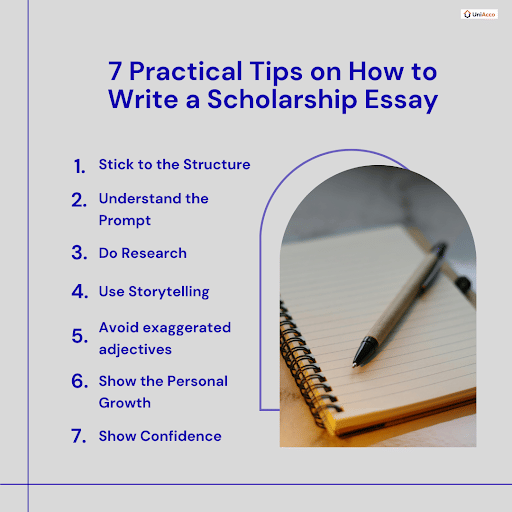
7 Practical Tips on How to Write a Scholarship Essay
A scholarship essay is a statement that helps get to know a student better and learn about their passions, inspirations, and goals. It’s not how we used to write in school; this is an exciting task where you get to show more than just your academic achievements, and it’s also the crucial document that decides your destiny. Don’t let the thoughts in your mind overwhelm you; just follow the practical tips below to win the scholarship award.
Stick to the Structure:
As soon as a student opens the document, they feel lost. Not knowing how to structure an essay can make this process more difficult than it already is. Stick to the “Introduction – Main Body – Conclusion” structure. Start the essay with an interesting introduction, followed by the main body, where you will write your story in paragraphs, but avoid including all the information in one paragraph. It makes the essay hard to read. Use line and paragraph breaks. After finishing the essay, conclude it in one paragraph.
Understand the Prompt:
Every step of the scholarship essay shows competency. How competent are you in understanding the prompt or a question? Before starting an essay, read the prompt. The common prompts are, “Describe a time you demonstrated leadership or contributed to your community,” or “Describe a failure and what you learned from it.” Understand what they are asking and how you can answer the prompt. Take a break for an hour, re-read and rethink what you have gone through, scribble the moments where you felt you showed leadership, and then just write it, but don’t go off-topic. If the prompt is about showing leadership, do not include kindness.
Do Research:
Students from different countries are competing for the scholarship you are aiming for. To stand out in that crowd, you will have to be one step ahead of everyone else. What most students miss is the research, and it’s not just about how to write an essay; it’s about what you want to include in your essay. Research about the scholarship, what their goals are, what they prioritise, what they are looking for, and explain how your goals align with them. Research your coursework and your industry as well. Know everything there is to know about the scholarship and the course you are choosing. That keeps you ahead of everyone and also shows commitment and sincerity.
Use Storytelling Style:
A scholarship essay is to get to know you better, and what can be better than your voice? Use a narrative style rather than a history paper style or an achievement list. Use the mantra, “show, don’t tell.” The scholarship committee would remember you by your story, not by your characteristics. Keep it authentic and transparent.
Avoid Exaggerated Adjectives:
COVID has hit all of us hard, but some are still carrying those stories with them. The same resilience and perseverance in every other scholarship essay are becoming boring. Avoid using big adjectives. Instead of writing, “I am a resilient person,” tell the story; write down the incident that made you feel like that. Most scholarships get rejected because they contain a lot of adjectives with no proof.
Show the Personal Growth:
Everyone loves a good story. You have spent most of your years collecting those stories; weave those into your goals and aspirations. Start the story with hardships and your obstacles, and smoothly end with how you overcame those. Show your personal growth; how a course you did during the summer vacation changed your view or helped you upskill. Listing the courses you did would not help you get the scholarship. Explain them instead of just listing them.
Show Confidence:
A scholarship committee doesn’t get to meet you; they judge you by your essay. Students are judged by every word, every sentence they write. So even a small word can make a big difference. When you are writing an essay, choose your words wisely. Avoid writing, “It may be a good opportunity,” or “I could have done better.” This shows uncertainty. Be confident in your writing. Remember, they can read your self-esteem as well.
You’ve hit submit. Now secure your stay. Explore verified student accommodation on UniAcco and lock in a space that’s safe, student-friendly, and ready when you are.
🔑 Find Verified Student HousingWhat to avoid when writing a winning scholarship essay

Most scholarship applications get rejected because either they overdo it or they just lose the plot midway through the writing process. To avoid those mishaps, read the below don’ts.
Don’t get too emotional:
There’s a fine line between being emotional and being cringe. Students delve into the story so deeply that they forget they are writing an essay, not a paragraph to a friend. Showing too many emotions lacks personality; it just shows one side of you. Avoid victimising yourself; it contradicts your other paragraphs and can end up looking narcissistic. So, after you finish the paragraph, sit back, re-read, and analyse whether you are victimising yourself or telling a story. Avoid telling a story that has no outcome.
Don’t disregard the requirements:
Many scholarship essays get rejected because they do not follow the requirements. Every organisation clarifies its requirements and what it wants. If the word count is from 500 to 1000, then don’t write below 500 or above 1000. Don’t ignore the prompt, and most importantly, when asked to give one example, give one example only. Giving extra examples will not help you get the scholarship; it will just take up more space.
Don’t use filler words or phrases:
Sometimes, writing a scholarship essay gets tiring. It’s a lengthy task, not a boring task. So remember, whenever you feel tired, take a break instead of filling your essay with unnecessary words and phrases. The aim is not to reach the word limit; it is to show competency. For example, if you want to write that you were upset, then write it in concise words instead of writing “It felt like someone had stabbed a knife into my soul.”
Avoid adding quotes:
Quotes are a great way to grab attention, but they’re not advisable anymore. There was a time when students used to grab attention by starting their essay with a random quote, but now it’s overused. This makes your essay sound performative and also kills the flow. Instead of that, you can write about a book that you liked and, with an example, write how it left an impression on you
Don’t neglect proofreading:
Proofreading is the most important part of the scholarship essay. Read the essay multiple times, wear The Devil Wears Prada glasses, and look for every rookie mistake. And when you feel you can’t find any errors anymore, call your friends and ask them to proofread your essay. Because a small punctuation mark can also make a big impact on the organisation committee. Remember, “Write without fear, and edit without mercy.”
Skip the last-minute scramble. Book furnished, verified student accommodation in the UK and move in stress-free, knowing everything’s sorted before you land.
🏠 Book UK Student AccommodationConclusion:
Writing an essay for a scholarship isn’t about Shakespeare writing; it’s about how well you can communicate your ideas and thoughts. Don’t overthink the process, just grab the laptop and scribble your experience. Follow the guidelines given by the organisation and edit thoroughly. In the end, just be authentic, transparent and honest to the committee. And to stay ahead of everyone, after finishing your essay, book the student accommodation from UniAcco for a comfortable stay.


 LinkedIn










0 Comments