
So you’re thinking about dentistry in the UK. Maybe you’ve already got a place on a BDS course. Maybe you’re an international dentist wondering if the UK is worth the move. Or maybe you just googled “dentist salary in the UK” at 2 am because someone told you dentists are loaded, and you wanted to check.
Fair enough. Money matters. You’re not shallow for asking. Studying dentistry is years of hard work, and knowing what’s waiting on the other side is a pretty smart way to plan your life.
Here’s a spoiler: the dentist salary in the UK is better than most people assume, but it comes with strings attached. It depends on where you work, who pays you, and how many years you’ve got under your belt. An NHS foundation dentist in year one earns a very different amount from a private practice owner in central London. Same job title. Completely different pay packet. Wild, right?
So, if you’re wondering about the salary of a dentist in the UK per month, we’ve got you covered. This guide walks you through what the dentist salary in the UK actually looks like in 2026-2027. NHS pay, private earnings, monthly figures, the best courses, city-by-city differences, and how international dentists can get started here.
Is Dentistry a Good Career in the UK?
Short answer: yes, if you know what you’re signing up for.
Let’s start with demand. The UK has a genuine shortage of dentists. NHS dental waiting lists have been a headline issue for years, and lots of areas, especially outside big cities, are struggling to get patients seen. That means one thing for you: job security. When there are more patients than dentists, your skills are needed, and that puts you in a strong position.
But demand alone doesn’t tell the whole story. Let’s look at the pros and cons like two columns in a comparison app.
The good stuff
Dentists earn well above the UK average salary. The pay is consistent, and it grows as you gain experience. You get flexibility too, whether that’s choosing NHS work, going fully private, or doing a mix. You can even own your own practice one day and be your own boss. And let’s not ignore the respect factor. “I’m a dentist” lands differently at a party than “I work in admin.”
The not-so-good stuff
It takes five years to complete the BDS training plus one more year for foundation training. This is hard work. For those who take the NHS path, the UDA approach becomes very stressful in trying to achieve the set target rather than just seeing to the patient’s needs. There are costs involved such as tuition, equipment, indemnity cover and registration at the GDC.
So who should choose dentistry?
People skills, steady hands, and the ability to remain cool under pressure make an ideal candidate for this field. This is an excellent choice for those who are interested in combining their interests in science, technique, and business into one profession. However, it is definitely not for people who prefer desk jobs with no human contact.
Living in the UK can be expensive, but finding the right accommodation can make budgeting easier. Explore affordable student accommodation in the UK with UniAcco, featuring fully furnished rooms and all-inclusive bills for a comfortable and convenient stay.
🔍 Explore Affordable Student Accommodation in the UKHow Much Does a Dentist Earn in the UK in 2026-2027?
Now the question you actually came for. Let’s break it down properly.
National average salary
The average dentist salary in the UK sits somewhere between £60,000 and £90,000 a year for most working dentists. NHS salaried dentists, mainly those in community dental services, earn between £54,502 and £116,573 depending on experience and role. The median salary, which is the middle point where half of dentists earn more and half earn less, is around £70,000 a year.
Monthly salary
If we’re talking about the salary of a dentist in the UK per month, a dentist earning £60,000 a year takes home about £5,000 a month before tax. Someone at £80,000 gets around £6,700 a month gross. After tax, National Insurance, and student loan repayments, the take-home number drops, but it’s still comfortably above the average UK worker.
Hourly earnings
The rates charged will depend entirely on how the business is run. The hourly pay of an associate dentist could range from £26 to £35. NHS dentists on a higher pay grade will range from £40 to £55. Private dentists earn more hourly pay since they are the ones who determine their rates.
Typical salary progression
This is where dentistry gets interesting. Your earnings climb in clear stages, kind of like levelling up in a game:
- Dental foundation training (your first year): £42,408 per year from April 2025
- Dental core trainee (years 2-3): £55,355 to £67,325 basic salary from April 2026
- Dental speciality trainee: £67,325 to £77,348
- Salaried NHS dentist: £54,502 to £116,573
- Consultant: £113,565 to £150,569, depending on seniority, with clinical awards on top
Highest-paying roles
If you want the big numbers, specialise. Oral and maxillofacial surgeons, orthodontists, and dental consultants are at the top of the tree. Practice owners who build a successful private clinic can also earn £150,000 plus, because they’re not just earning from their own chair; they’re earning from everyone else’s too.
One important note: the NHS figures above are the official 2026-2027 pay scales. For 2026, salaried dentists in community dental services received a 3.75% pay increase, backdated to 1 April 2026. So the numbers keep moving up, which is good news if you’re entering the profession.
NHS vs Private Dentist Salary in the UK
This is the big fork in the road for every UK dentist, so let’s get into it properly.
NHS pay structure
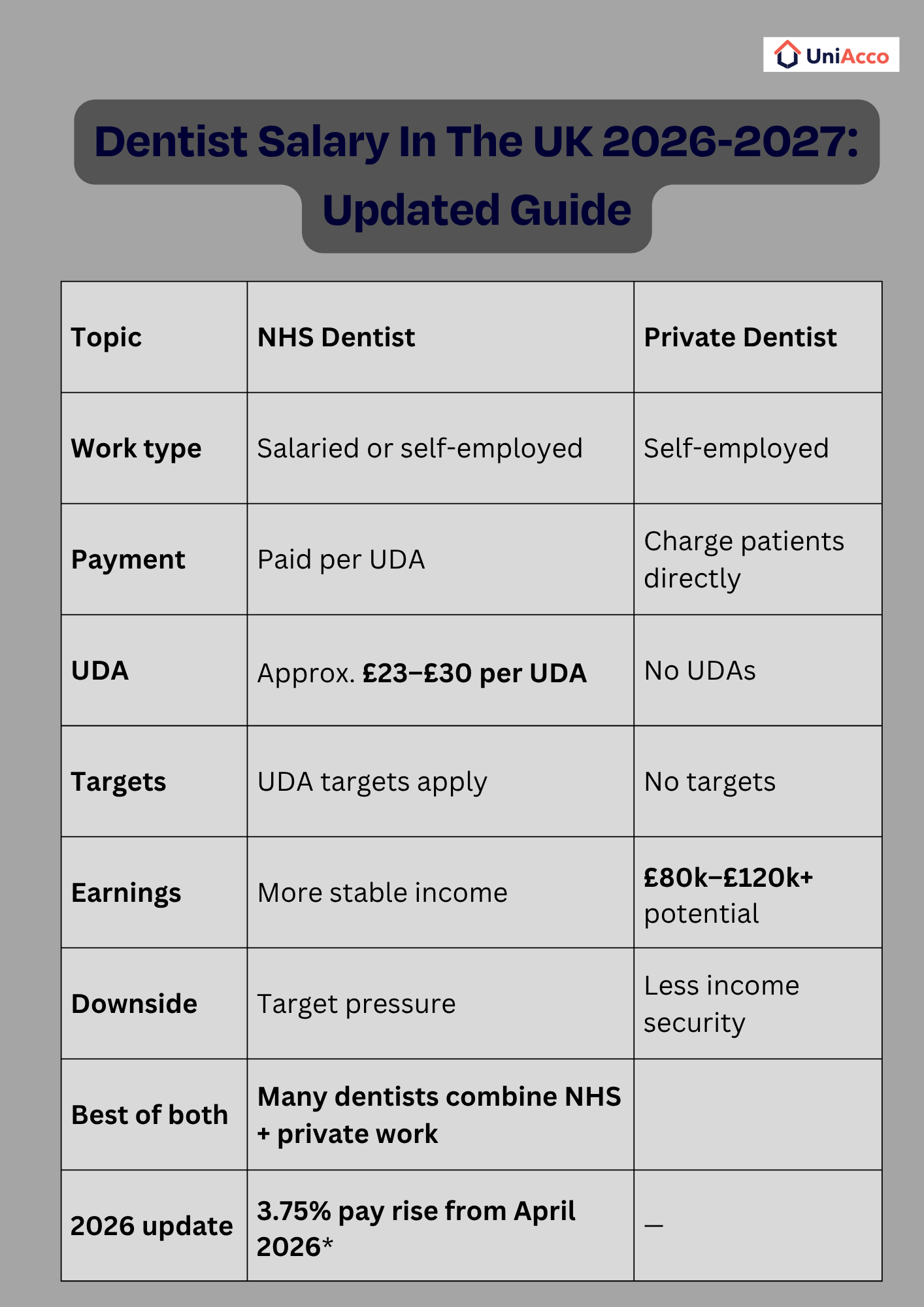
NHS dentists fall into two main groups. Salaried dentists work for the NHS directly, mostly in community dental services or hospital settings, and earn a fixed salary on the official pay scales we mentioned above. But here’s the catch: most NHS dentists in high street practices aren’t salaried at all. They’re self-employed contractors. They agree to deliver a certain amount of NHS work for a practice, and they get paid per unit of work done.
The UDA system
This is what gets confusing to everybody, but here’s the easiest way of explaining it. In the NHS, the unit of dental activity is used to measure dental procedures. The UDAs can be likened to arcade tokens, where each procedure is worth some tokens. The NHS contracts the dental clinic for a certain number of UDAs annually and then pays according to UDAs done.
The price for one UDA is not consistent throughout the nation and depends on the location and contract, and ranges from about £23 to £30. The NHS Dental Recovery Plan has increased the minimum UDA cost from £23 to £28 in the year 2024 to assist those dental surgeries which were facing hardships.
The catch with UDAs is the target pressure
If the contract states 6,000 UDAs per year, that needs to be fulfilled, or the payments will be reduced. In other words, it works in a similar fashion to a gym membership when one loses money for not showing up. This is one of the reasons why dentists use the term “chasing UDAs.”
Private earnings
Private dentists do not have to worry about UDAs at all. They simply charge the patient for the treatments provided at their discretion and get to retain more of the income. A hard-working private dentist working in a good area can make around £80,000 – £120,000 annually, and those who work really well can even make more than that. The downside, however, is that there is no NHS back-up if the business does poorly.
Mixed practices
Here’s the reality: the majority of UK-based dentists do not go for one option exclusively. They practice both. For instance, work for three days a week under the NHS agreement to make sure they earn something, but spend another two days working independently in order to earn more money. It’s like receiving a stable income for working half the week and freelancing the other half.
The 2026 pay award
Quick update for the nerds: As early as March 2026, the government has announced that salaried dentists working in community dental services will receive a 3.75% pay increment from April 2026. This is in addition to previous increments already awarded. The NHS pay outlook for dentists has been looking brighter in recent years after many years of stagnant wages, making the UK a good place for dentists.
Foundation training comes with a decent income, but London living costs can quickly add up. Make budgeting easier with UniAcco by exploring affordable student accommodation in London with transparent pricing and no hidden fees.
🔍 Explore Student Accommodation in LondonWhat are the Best Dentistry Courses in the UK?
If you want to become a dentist in the UK, there’s one qualification that matters above all: the Bachelor of Dental Surgery, or BDS. This is the primary qualification required to practise, and it’s regulated by the General Dental Council, or GDC. No BDS, no registration, no practising. Simple as that.
The UK has a wide range of dentistry programmes at undergraduate, postgraduate, and specialist levels, and some of the best dental schools in the world are here. Based on the QS World University Rankings for Dentistry 2026, these are the standout options:
King’s College London
Ranked fifth in the world for dentistry. KCL has one of the largest and most respected dental schools in Europe. If you want cutting-edge research and clinical training in the heart of London, this is the gold standard.
Queen Mary University of London
Ranked 12th globally. QMUL is known for its strong clinical focus and excellent links with East London’s diverse patient community. You get real-world experience from very early on, which is exactly what you want.
University of Birmingham
Ranked 19th globally. Birmingham’s dental school has a brilliant reputation for teaching and research, plus a modern clinical facility. It’s also in one of the UK’s biggest cities, which means plenty of clinical exposure.
University of Sheffield
Ranked 35th in the world. The University of Sheffield is well-known for being very friendly and having good community spirit, and its dental college is truly great. The cost of living there is less expensive than in London.
UCL (University College London)
Ranked 37th globally. UCL’s Eastman Dental Institute is a world-famous name in postgraduate dentistry, especially if you want to specialise later. It’s a powerhouse for research and specialist training.
A quick tip: apart from ranking, consider the amount of exposure that will be gained during the clinical year, the location of the city, the cost of living, and the nature of the programme structure.
Dentist Salary by UK City
A dentist salary in London isn’t the same as a dentist salary in Newcastle, even with the same experience. Why? Because of demand, cost of living, the mix of NHS and private opportunities, and how many dentists are competing in that area.
London has the most private practices and the highest earning potential at the top end, but it also has the highest living costs and the most competition. Northern cities like Manchester, Leeds, and Sheffield often show higher average salaries in job data because demand is strong and there are fewer dentists chasing the work. Plus, your money goes further when rent is lower.
Here’s a table with indicative figures. The average salary figures are based on UK job listing data from Indeed UK (2026), and the cost of living figures come from Numbeo’s Cost of Living Index (2026).
| City | Average Salary | Cost of Living (Numbeo Index) | Demand |
| London | £75,000 – £95,000 | 88.0 | High (lots of competition, high private potential) |
| Manchester | £51,000 – £98,000 | 67.7 | High (growing city, strong NHS and private mix) |
| Birmingham | £85,000 – £95,000 | 70.2 | High (big population, lots of NHS contracts) |
| Leeds | £47,000 – £103,000 | 66.7 | High (strong demand, lower living costs) |
| Glasgow | £80,000 – £90,000 | 68.0 | Medium-High (good NHS presence) |
| Edinburgh | ~£99,000 | 73.5 | High (private sector strong, higher living costs) |
| Bristol | £85,000 – £95,000 | 70.5 | Medium-High (expensive but desirable) |
| Liverpool | £80,000 – £90,000 | 67.3 | Medium-High (solid NHS demand) |
| Sheffield | £64,000 – £103,000 | 64.5 | Medium-High (great pay-to-living-cost ratio) |
| Newcastle | £75,000 – £85,000 | 67.5 | Medium (lower competition, lower costs) |
Do you see the trend? The places where salaries are high but the cost of living is lower, such as Leeds, Sheffield, and Manchester, turn out to be the most financially sensible choices. London may look glamorous, but high rental prices quickly reduce your earnings.
Wanna know what people think about dentists in the UK? Read this Reddit thread and find out why dentists earn more than doctors.
Do doctors really make less than dentists? – r/doctorsUK
Requirements to Work as a Dentist in the UK and How International Dentists Can Work in the UK
Whether you’re a UK student or an international dentist, there’s a clear checklist to get you practising. Let’s walk through it.
Basic requirements for the role
You have to hold an approved dental qualification, which is generally the BDS or something comparable. You should have to register with the General Dental Council, as it is the regulatory body for dentistry in the UK. You will also need to meet the criteria for English language proficiency in addition to other requirements, which might include IELTS or OET. While practising, you will also have to get indemnity insurance against any claims made against you. It can be thought of as something like motor vehicle insurance.
GDC registration
This is the big one. The GDC is the body that decides who can call themselves a dentist in the UK. UK graduates get registered after completing their BDS and foundation training. International dentists need to prove their qualifications match UK standards, and that’s where the next step comes in.
ORE/LDS pathway
If your dental degree isn’t automatically recognised in the UK, you take the Overseas Registration Examination, or ORE, run by the GDC. It has two parts. Part 1 is a computer-based exam testing your clinical knowledge. Part 2 is a practical exam held over several days at the UCL Eastman Dental Institute, where you demonstrate your clinical skills on patients and mannequins. Pass both parts, and you can apply for GDC registration.
Visa routes
Here is the area that many foreign dentists find problematic; hence, take note. It is the Health and Care Worker visa, which is the primary option. This visa category includes dentists among the eligible occupation list, which is great news indeed. The benefits offered by this visa include great ones such as exemption from the Immigration Health Surcharge, lower visa costs, and expedited visa decision. You will have to provide proof of employment with an authorised sponsor, who could be an NHS trust or other dental practices with a sponsorship licence, and also meet the salary threshold.
There’s also the standard Skilled Worker visa if your employer is eligible but not part of the health and care scheme. And if you graduate from a UK dental school, you can use the Graduate route to stay and work for up to two years after your degree, which gives you time to find a sponsored job.
NHS opportunities
The NHS employs the highest number of dentists in the UK and is hiring continuously. You can work as a salaried dentist in community dental services, work under an NHS contract as an associate, and work in hospital dental services either as a trainee or a consultant dentist. There are many benefits associated with NHS jobs for dentists, and most foreign dentists find it easy to be sponsored through such jobs.
Private opportunities
This is where the money lies. After you have been registered with the GDC, you can become an associate dentist in a private practice and earn a share of the fees that you earn, or else you can set up your own private practice. Private practice allows you to control your earnings, time, and fees. But it means that you have to get your own clients and pay your own bills. You are trading security for freedom and opportunity, just like the difference between freelancing and getting a salaried job.
Moving to Manchester for dental school or a new job can be stressful enough without adding a flat hunt to your list. Browse student accommodation in Manchester with UniAcco and find fully furnished rooms with all utility bills included for a more convenient stay.
🔍 Explore Student Accommodation in ManchesterConclusion
So what is the true dentist salary UK situation for 2026-2027? This is an attractive job with good pay and great flexibility, which all depends on how you choose to earn it. The annual earnings for NHS salaried dentists are around £54,502 – £116,573. Dentists working in private practice can earn over £100,000. And consultants will earn over £150,000.
Dentistry is demanding. The training is long, the UDA system can be stressful, and the early years aren’t the highest-paid. But the ceiling is high, the demand is real, and the career gives you options: NHS, private, mixed, specialisation, or even running your own practice.
If you’re serious about it, start with the right course, get your GDC registration sorted, and think carefully about where you want to live and work. The rest is just showing up, treating patients well, and letting your experience compound over time.
The UK needs dentists. It could be you. And with the salary numbers on your side, it’s a pretty good place to be.


 LinkedIn










0 Comments