
For decades, the Ivy League has represented the gold standard of global higher education. When one thinks of the Ivy League schools, it has become synonymous with world-class research, transformative growth, and top-level professional networks. And this is exactly what makes these Ivy League universities the hardest to crack. Understanding the Ivy League schools based on their ranking, acceptance rates, and a method to choose gives students a strategic perspective about how to approach the admission reality.
This in-depth guide provides you with a comprehensive breakdown of all 8 Ivy League institutions. From the acceptance rates of these Ivy League schools to the hardest and easiest Ivy League schools to get into, we’ve covered all you need to plan your application procedure.
Overview of the Ivy League Schools Ranking 2026
The official Ivy League list includes 8 private research universities located across the Northeastern United States. In the table below, we’ve mentioned the Ivy League schools ranking based on the U.S. News & World Report 2026.
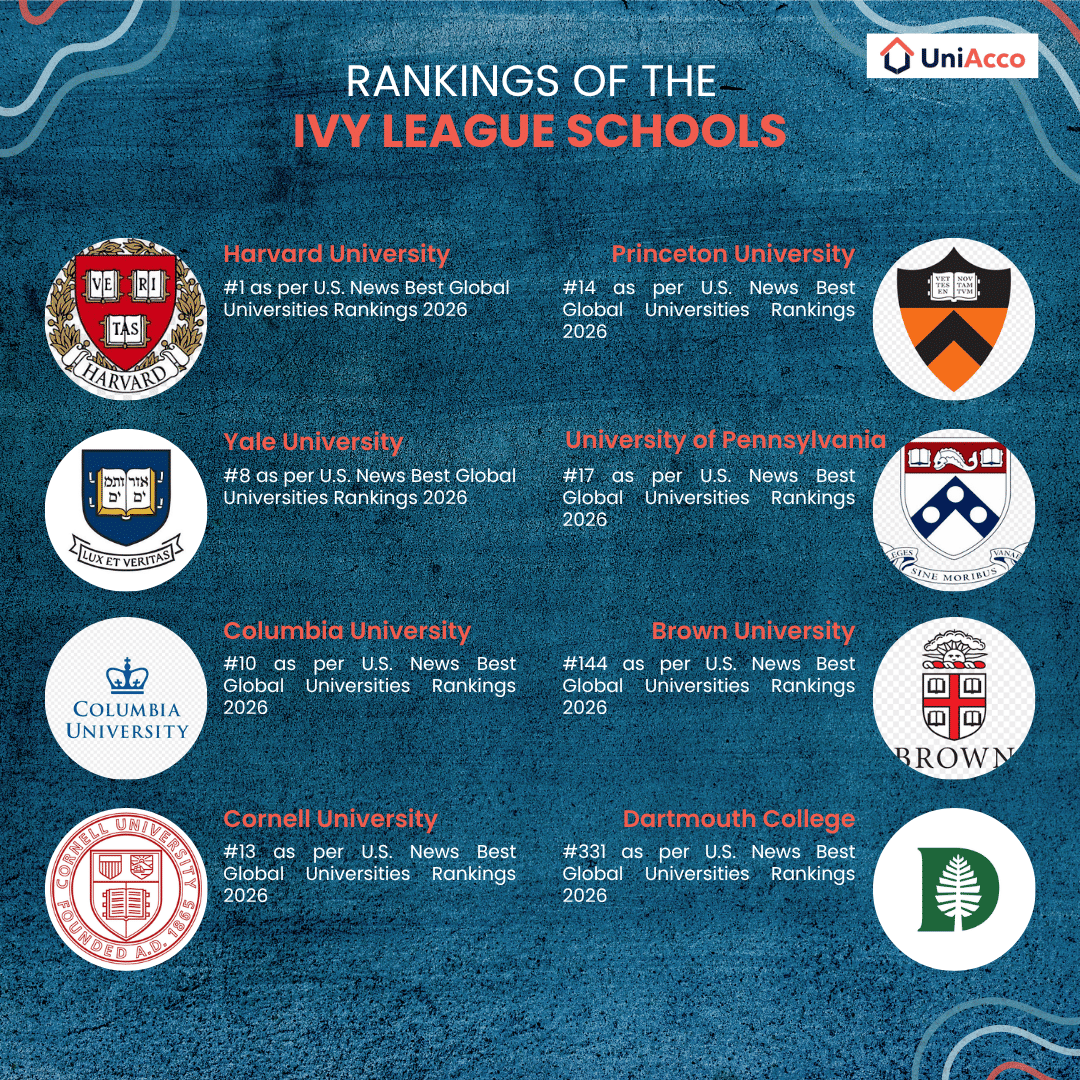
| Ivy League University | Global Universities Ranking as per US News 2026-27 | Acceptance Rate | Location |
| Harvard University | #1 | 3.41% to 4.18% | Cambridge, Massachusetts |
| Yale University | #8 | 3.73% to 4.24% | New Haven, Connecticut |
| Columbia University | #10 | 3.86% to 4.23% | New York City, New York |
| Cornell University | #13 | 7.90% to 8.38% | Ithaca, New York |
| Princeton University | #14 | 4.50% to 4.62% | Princeton, New Jersey |
| University of Pennsylvania | #17 | 4.90% to 5.38% | Philadelphia, Pennsylvania |
| Brown University | #144 | 5.16% to 5.35% | Providence, Rhode Island |
| Dartmouth College | #331 | 5.41% to 5.84% | Hanover, New Hampshire |
What Is the Ivy League?
The term Ivy League has some popular etymological origins, of which the most commonly accepted historical root stems from the traditional planting of the ivy ceremonies, which were held at Northeastern colleges during the mid 19th century. The graduating classes planted ivy vines outside academic halls, symbolic of endurance and tradition. While sportswriter Caswell Adams is central to the popular origin story of the term ‘Ivy League,’ which he invented during the 1937 football match between Columbia University and the University of Pennsylvania, sports editor Stanley Woodward of the New York Herald Tribune used this phrase ‘Ivy League’ in his column, most probably after he overheard or learned of this remark from Adams.
7 out of the 8 member institutions were founded during the American colonial era before the American Revolution. Cornell University is the only post-colonial institution founded in 1865. Historically, the Ivy League schools have a tradition of generating Nobel Laureates, World Leaders, and Fortune 500 CEOs. Some of the popular names include Elon Musk from the University of Pennsylvania, Jamie Dimon from Harvard, CEO of JPMorgan Chase, and Chris Kempczinski, CEO of McDonald’s, with Harvard credentials.
What Makes A School Ivy League?
A school is Ivy League because it is one of the 8 universities that belong to the Ivy League athletic conference. There is no application process to become an Ivy League school. There is no academic threshold that qualifies a university. No ranking system determines Ivy status. If a school is not one of those 8 institutions, it is not Ivy League. That’s what makes a university Ivy League — official membership in the Ivy League conference. When students ask, “What does an Ivy League university mean?” They’re asking about reputation. While the official definition is athletic, the phrase Ivy League University has become synonymous with highly selective admissions, strong academic reputation, significant research funding, influential alumni networks, and long institutional history.
How Are Ivy League Rankings Determined?
Sophisticated data modelling, peer evaluation, and institutional metrics are the primary factors behind the mechanism of any Ivy League school ranking. Official ranking bodies like U.S. News & World Report, QS World University Rankings, and Times Higher Education (THE) evaluate universities using certain formulas in which the rankings fluctuate based on each of the 3 publisher’s lists. Let’s understand these primary factors in-depth.
- Academic Reputation & Peer Assessment
The publishers conduct an in-depth survey of presidents and admissions deans across the country to rate the rival institutions. Peer assessments account for 15% to 20% of a school’s overall score in these ranking methodologies. Since Ivy League professors are pioneers in their fields of academia, these 8 schools score consistent marks in peer perception.
- Faculty Resource & Student-Faculty Ratio
The student-to-faculty ratio typically sits at 5:1 and 8:1 across the Ivies. Plus there’s a significant advantage to these institutions as undergraduates are directly taught by senior professors over graduate teaching assistants.
- Research Output & Citation Impact
Global ranking publishers like QS, THE, and U.S. News place heavy weight on the research metric, which specifically includes citations per faculty member, international collaboration, and volume of publications in peer-reviewed journals.
- Graduate Outcomes & Earning Potential
Social mobility, PG salary metrics, 6-year graduation rates, and student loan default rates are some of the modern methodologies that determine the Ivy League rankings. Plus, Ivy League graduates have a strong alumni network. The earning potential ranges from $94,000 to over $135,000, depending on the school and the program.
- Student Satisfaction & Retention Rates
Retention rate is the percentage of first-year students returning for their sophomore year. First-year retention rates and 6-year graduation rates reflect the campus community culture. All the 8 Ivies have retention rates above 97%, and 6-year graduation rates are between 95% and 98%.
- Financial Resources & Endowment per Student
Harvard, Yale and Princeton lead the nation in endowment per undergraduate with $56.9B, $44.1B, and $36.4B, respectively, which enables massive financial aid budgets for high-standard facilities. The total financial expenditure per student heavily factors in institutions with multi-billion-dollar endowments.
- Alumni Success & Philanthropic Engagement
Alumni donating back to their alma mater serves as a strong proxy for long-term loyalty. The higher the donations, the higher the university’s development and scholarship funding.
The primary reason for the varying Ivy League universities ranking system is the way these metrics are weighted. For instance, U.S. News emphasises undergraduate outcome metrics, social mobility, graduation rate performance, and domestic peer reputation. On the other hand, QS World Ranking emphasises employer reputation, research citations, and student-to-faculty ratio. While THE (Times Higher Education) emphasises research environment, doctorate-to-bachelor ratios, and global teaching reputation.
Relying on any single factor is a major misstep. Applicants frequently obsess over whether a university holds the top position. However, this often makes them overlook other structural factors like campus culture, pedagogical style, academic structure, and professional growth outcomes.
Also Read: 10 Most Expensive Universities in the USA
Take a look at some of the best student apartments near top Ivy League universities. With UniAcco, explore affordable, fully furnished student accommodation featuring all-inclusive bills, modern amenities, and verified listings.
🔍 Explore Student AccommodationIvy League Schools Ranking 2026: Detailed Breakdown
Harvard University
Founded in 1636, Harvard University is the oldest institution of higher education in the US. It holds the world’s largest endowment, which is $53.2B. It is one of the hardest Ivy League schools to get into. Harvard’s academic system emphasises intellectual independence, which is highly supported by the Harvard Library System, the largest academic library in the world with over 20 million volumes. Students are seen living in historic residential houses like Adams, Eliot, and Lowell. Located across Cambridge and Boston, Harvard has a seamless cross-registration with MIT and direct access to a pool of research institutes.
| Global Rankings | #1 (U.S. News Best Global Universities Rankings) #5 (QS World University Rankings 2027) #5 (THE World University Rankings 2026) |
| Acceptance Rate | 3.41% to 4.18% (approx) |
| Popular Programs | EconomicsComputer SciencePolitical ScienceMolecular & Cellular BiologyApplied Mathematics |
| Campus Highlights | Harvard yardWidener libraryAnnenberg dining hallHarvard innovation labs |
| Career Outcomes | Global alumni network in venture capitalPoliticsSupreme CourtBiotechLeadership roles |
| Best Suited For | Independent self-startersResource-driven learning |
Yale University
Yale University traces its roots to the 1640s, when colonial clergymen led an effort to establish a local college in the tradition of European liberal education. In 1701, the Connecticut legislature adopted a charter to erect a Collegiate School. The school officially became Yale College in 1718, when it was renamed in honour of Welsh merchant Elihu Yale, who had donated the proceeds from the sale of nine bales of goods together with 417 books and a portrait of King George I. Yale College, the university’s undergraduate school, is the nucleus of its identity. Undergraduates are spread across the 14 distinct residential colleges, which have Gothic architecture equipped with dining halls, libraries, theatres, and massive courtyards. Yale’s curriculum covers a wide array of subjects from Ethics, Politics, & Economics (EP&E) and Humanities. With a student-to-faculty ratio of 5:1 and an endowment exceeding $41B, Yale offers UG students funding for summer internships, travel, and research.
| Global Rankings | #8 (U.S. News Best Global Universities Rankings) #16 (QS World University Rankings 2027) #10 (THE World University Rankings 2026) |
| Acceptance Rate | 3.73% to 4.24% (approx) |
| Popular Programs | HistoryPolitical ScienceEconomicsPsychologyEthicsPolitics & Economics Theatre studies |
| Campus Highlights | Yale University Art Gallery Sterling Memorial LibraryBeinecke Rare Book & Manuscript Library |
| Career Outcomes | Public ServiceCreative Writing Performing ArtsFinanceConstitutional Law |
| Best Suited For | Deep engagement in humanities and social sciencesCollaborative-minded thinkingCommunity Living |
Columbia University
Founded in 1754 as King’s College, Columbia University is situated in Morningside Heights, Upper Manhattan. It offers a world-class academic education. Columbia’s UG programs are anchored by the legendary Core Curriculum, which is a shared academic sequence where all undergraduates engage in seminar-like discussions analysing Western Literature, Philosophy, Arts, Music, and Science. The idea of a Core Curriculum is to bridge academic theory with internships across New York’s Wall Street, United Nations, media houses, and major art institutions.
| Global Rankings | #10 (U.S. News Best Global Universities Rankings) #43 (QS World University Rankings 2027) #20 (THE World University Rankings 2026) |
| Acceptance Rate | 3.86% to 4.23% (approx) |
| Popular Programs | EconomicsPolitical ScienceComputer ScienceFinancial Engineering Neuroscience Comparative Literature |
| Campus Highlights | Butler Library Alma Mater StatueManhattanville Campus Low Memorial Library |
| Career Outcomes | Access to NYC’s global headquarters across finance, publishing, journalism, legal services, and urban research |
| Best Suited For | Academically rigorous students Urban-minded thinkers |
Cornell University
Cornell University, founded in 1865 in Ithaca, New York, is a private Ivy League University as well as a federal-grant institution of New York State. Cornell is the largest and most academically diverse among the Ivies, with a student enrollment of 16,000 undergraduates. Undergraduates can apply directly to one of the 7 distinct colleges, which are: the College of Engineering, the College of Agriculture and Life Sciences (CALS), the Dyson School of Applied Economics, and the School of Hotel Administration. If you closely track the Ivy League schools ranking, you’ll find Cornell University’s 2,300-acre campus overlooking Cayuga Lake offers one of the best STEM infrastructures.
| Global Rankings | #13 (U.S. News Best Global Universities Rankings) #16 (QS World University Rankings 2027) #18 (THE World University Rankings 2026) |
| Acceptance Rate | 7.90% to 8.38% (approx) |
| Popular Programs | Computer ScienceHotel Administration Mechanical Engineering Agricultural ScienceDyson Applied Economics |
| Campus Highlights | Cornell Botanic GardensMcGraw TowerBeebe LakeIthaca GorgesUris Library |
| Career Outcomes | Silicon Valley TechAgricultural Biotechnology Architectural Design HospitalityLeadership |
| Best Suited For | Scholars seeking world-class STEM education Agricultural Research Specialised Business DegreesLeadership roles |
Princeton University
Singular focus on undergraduate learning is what sets Princeton University apart in American higher education. Established in 1746 and situated in a 500-acre suburb and campus in New Jersey, Princeton was earlier known as the College of New Jersey. Since Princeton operates without standalone graduate schools, it ensures that the $34.1 billion endowment is channelled directly towards undergraduate education. Every Princeton graduate completes the mandatory research by working one-on-one with the tenured faculty. Moreover, Princeton utilises a 6-college residential system where students live and dine as a community, which is great for international students.
| Global Rankings | #14 (U.S. News Best Global Universities Rankings) #27 (QS World University Rankings 2027) #3 (THE World University Rankings 2026) |
| Acceptance Rate | 4.50% to 4.62% (approx) |
| Popular Programs | Public & International AffairsComputer ScienceEconomicsOperations ResearchFinancial Engineering |
| Campus Highlights | Gothic-style 500-acre campusNassau hallFirestone library Student-run eateries |
| Career Outcomes | Quantitative financeCentral bankingManagement consultingPhD |
| Best Suited For | Undergraduates preferring independent researchCloser mentorshipCampus community seekers |
University of Pennsylvania
The University of Pennsylvania, founded in 1740 by Benjamin Franklin, was designed with a pragmatic vision to combine professional and technical training with liberal arts. University of Pennsylvania is unique among the Ivies because it houses 4 distinct UG schools on a common urban campus in West Philadelphia. The 4 schools are — College of Arts & Science, Penn Engineering (SEAS), School of Nursing, and Wharton School. Penn University encourages students to pursue interdisciplinary studies through their signature dual-degree programs like the Jerome Fisher Program in Management & Technology (M&T) and the Huntsman Program in International Studies & Business. Moreover, Penn has an endowment of over $22B, which makes it a powerhouse.
| Global Rankings | #17 (U.S. News Best National Universities Rankings) #15 (QS World University Rankings 2027) #14 (THE World University Rankings 2026) |
| Acceptance Rate | 4.90% to 5.38% (approx) |
| Popular Programs | NursingFinance & ManagementBioengineering Computer ScienceEconomics |
| Campus Highlights | Locust WalkPenn Museum Singh Center for NanotechnologyHistoric College Hall |
| Career Outcomes | Investment BankingManagement & Consulting HealthcareEntrepreneurship Leadership |
| Best Suited For | Career-driven learnersStudents looking to blend professional training with liberal arts |
Brown University
Founded in 1764, Brown University is located on College Hill in Providence, Rhode Island. The university is globally known for its radical and student-centred approach to higher education. In 1969, Brown University adopted this famous Open Curriculum system, which eliminated the mandatory courses. Through this reform, UG students are able to design customised academic plans, choose from over 80 concentrations, and opt for any course on a Satisfactory/No Credit basis. Brown is also home to a comprehensive 8-year PLME Program (Program in Liberal Medical Education) which allows high school seniors to secure admission to Brown’s Warren Alpert Medical School without having to give the MCAT.
| Global Rankings | #144 (U.S. News Best Global Universities Rankings) #66 (QS World University Rankings 2027) #65 (THE World University Rankings 2026) |
| Acceptance Rate | 5.16% to 5.35% (approx) |
| Popular Programs | BiologyComputer ScienceEconometricsPublic HealthApplied MathematicsPLME (Program in Liberal Medical Education) |
| Campus Highlights | Van Wickle GatesThe Quiet GreenJohn Hay LibraryPerry & Marty Granoff Center for Creative Arts |
| Career Outcomes | Software Development Medical ResearchCreative ArtsTech StartupLeadershipNonprofit Organisations |
| Best Suited For | Self-Directed StudentsStudents looking for an autonomous academic path with rigid requirements |
Dartmouth College
Established in 1769, Dartmouth College in rural Hanover, New Hampshire, brings together research capabilities and an intimate teaching environment of a liberal arts college. Dartmouth operates on a unique quarter-based academic plan known as the D-Plan, which allows undergraduates to customise their terms. Dartmouth heavily promotes undergraduate teaching, focusing on laboratory and research programs at the Thayer School of Engineering, Tuck School of Business, and Geisel School of Medicine. Dartmouth undergraduates enjoy a tightly knit campus culture with approximately 4,500 students who are deeply engaged in the college’s tradition and outdoor recreational activities in the WHite Mountains around the campus.
| Global Rankings | #331 (U.S. News Global National Universities Rankings) #270 (QS World University Rankings 2027) #180 (THE World University Rankings 2026) |
| Acceptance Rate | 5.41% to 5.84% (approx) |
| Popular Programs | Government StudiesEconomicsComputer ScienceEngineering ScienceEnvironmental Studies |
| Campus Highlights | Baker-Berry LibraryHood Museum of ArtMoosilauke Ravine LodgeDartmouth Green |
| Career Outcomes | Management & Consulting Wall Street RecruitmentsEnvironmental Policy CentersTech startup |
| Best Suited For | Adventure-loving students with a tradition-rich residential community living. |
Also Read: Cost Of Living In The USA For Students 2026
Hardest Ivy League School to Get Into
To understand the criteria for the hardest Ivy League to get into, one needs to look beyond just overall acceptance rate and national ranking. Other deciding factors being early decision yield rates, application volume, program capacity, and geographic diversity goals. Based on these consolidated admission stats, the top 4 hardest Ivy League to get into are:
Harvard University (3.41% to 4.18% acceptance rate, approx)
Yale University (3.73% to 4.24% acceptance rate, approx)
Columbia University (3.86% to 4.23% acceptance rate, approx)
Princeton University (4.50% to 4.62% acceptance rate, approx)
Let’s deep-dive into the Ivy League schools’ acceptance rate data, which demonstrates why these 4 institutions are the hardest to get into.
- Acceptance Rate & Applicant Volume
Harvard, Yale, Columbia, and Princeton consistently have acceptance rates below 4.5%. Harvard admits about 2000 students annually; it receives about 54,000 to 60,000+ applications. For the Harvard University Class of 2029 admissions cycle, total applications dropped 11% to 47,893 as compared to 54,008 for the Class of 2028. This is partly driven by the return of mandatory SAT or ACT testing requirements. Columbia’s high application volumes create a tighter selection pool with only 1450 seats per year.
- Academic Expectations
For these 4 institutes, an unweighted 4.0 GPA is considered the baseline requirement. Applicants are expected to take a rigorous course with 8 to 12 Advanced Placement (AP), International Baccalaureate (IB) Higher Level, or dual-enrollment courses. Standardised testing requirements at Yale and Dartmouth, which are the middle 50% SAT scores range between 1510 and 1580, while ACT scores fall between 34 and 36.
- Extracurricular Profile
Most of these Ivies look beyond just the traditional approach, where candidates with a distinct academic or extracurricular spike are prioritised. This means if the undergraduates have national or international recognition in a specific field like research competitions, publishing academic research, founding a Non-Profit Organisation, or achieving athletic performance, it is considered a win.
- Supplemental Essays
Top-tier courses utilise supplemental essay prompts to evaluate an applicant’s intellectual capability, self-awareness, and cultural fit. Harvard is keen on personal integrity, initiative, and leadership qualities. Columbia assesses the depth of an applicant’s engagement with its Core Curriculum and NYC setting. Yale values intellectual curiosity with collaborative energy. While Princeton examines the applicant’s capacity for scholarly inquiry.
Easiest Ivy League Universities to Get Into
While we discuss the easiest Ivies to get into, setting up a context is crucial because when applying for an Ivy League school, there is no such thing as easy. Each of the 8 institutions eliminates more than 90% of the applicants, even students with straight As. That said, compared with Columbia or Harvard, some Ivy League institutions have relatively higher acceptance rates due to larger class capacity, geographical preference, and specialised undergraduate schools. The top 4 relatively accessible Ivy League schools include:
Cornell University: 7.90% to 8.38% acceptance rate, approx
Dartmouth College: 5.41% to 5.84% acceptance rate, approx
Brown University: 5.16% to 5.35% acceptance rate, approx
University of Pennsylvania: 4.90% to 5.38% acceptance rate, approx
Below is an analysis that reveals why these Ivies are relatively accessible to get into.
- Acceptance Rate & Class Size
Cornell University accepts a higher percentage of applicants because of its size. With a capacity of over 16,000 undergraduates, Cornell admits about 5000 to 5800 students per year across the 7 undergraduate colleges. This is more than double the class size of Yale, Dartmouth, or Columbia.
- Academic Expectations
Although there is no compromise on high academic performance, the academic profiling of students at Cornell or Dartmouth shows score variability depending on the program. For instance, if you’re applying for the CALS program (Cornell’s College of Agriculture and Life Sciences) or the School of Hotel Administration, it involves evaluating a certain sense of passion with extracurricular involvement along with traditional standardised testing.
- Extracurricular Profile
Brown and Dartmouth place high value on personal alignment along with community collaboration. Brown seeks independent self-starters while Dartmouth seeks adventurous and collaborative students who are willing to embrace the residential community in Hanover. If you show a proven track record of extracurricular involvement, like building a non-profit organisation, these schools will put significant weight on you.
- Essay Strategy
When you apply to these institutions, it requires writing a tailored SOP or an essay to align with the institutional tradition. For instance, applicants to Pennsylvania University must explain why they want to combine pre-professional training with liberal arts. Cornell applicants, on the other hand, are required to write a college-specific essay tailored to one of its 7 undergraduate institutes. Brown applicants must elaborate on how they plan to utilise the Open Curriculum system.
Looking for perspectives beyond the rankings? Explore this Quora thread to see what students and graduates have to say.

Best Ivy League Universities by Subject
| Subject | Best Ivy League University | Why study here? |
| Business | University of Pennsylvania (Wharton) | Specialised dual-degrees like Jerome Fisher (M&T) and Huntsman International StudiesDirect access to $22B+ endowment along with Bachelor of Science in Economics degreeWall Street recruitment Global alumni network |
| Computer Science | Cornell University | Direct access to Cornell Tech and specialised robotic labs, machine learning, and cybersecurityCarnegie Mellon and MIT level programs for Computer Science and Artificial Intelligence A faculty unit of 120 members offering UG research grants from the first year. |
| Engineering | Cornell University | Excellent facilities like the Nanscale Science and Technology Facility (CNF)Ivy with the largest engineering program with 12 specialised majors like Aerospace, Biomedical, etc. A dedicated project team that historically has been winning at international collegiate competitions like the Cornell Mars Rover, Formula SAE, etc. |
| Economics | Harvard | Princeton | World-famous faculty in Economics including Nobel Laureates and Federal Reserve governors.Direct access to central banking, top PhD programs, and hedge funds.Princeton prioritises senior thesis original research while Harvard offers specialised quantitative tracks |
| Law | Yale | Harvard | Excellent placement rates into T14 law schools, federal clerkship, and public interest fellowships.Direct access to Yale Law School and Harvard Law School’s faculty, legal rooms, and trial libraries. Yale’s EP&E program and Harvard’s Government program are tailored for legal analysis for undergraduate majors. |
| Medicine | Harvard | University of Pennsylvania | Direct access to hospital networks like Massachusetts General and Children’s Hospital of Philadelphia. Large-scale funding in undergraduate research funding through Harvard Medical School and Penn Medicine Labs.Compared to the 40% national average, Harvard and Penn have over 85% pre-med acceptance rates in top medical schools. |
| Psychology | Yale | Harvard | The famous Mind Development Lab and Social Cognitive Development Lab is well known at Yale amongst the undergraduates. Interdisciplinary tracks that link behavioural sciences, neuroscience, and clinical psychology. Direct mentorship on research papers. |
| Humanities | Yale | Princeton | Direct access to the archives at Yale’s Beinecke Library and Princeton’s Firestone Library. 5:1 student-to-faculty ratio which enables small seminar discussions.Fully-funded humanities research grants for summers along with opportunities to study abroad in Europe and Asia. |
Key Takeaways Before Choosing an Ivy League University
While you evaluate the best Ivy League colleges, it is crucial to consider the culture, tradition and long-term career goals. Consider the below takeaways while evaluating your decision to apply to either of these Ivy League schools.
- Don’t simply chase rankings
Institutional rankings fluctuate year on year based on the independent methodologies of the publishers like the QS World Ranking, THE, and U.S. News. In terms of overall education quality, a #1 or a #15 is negligible based on academic difference. Instead, it is ideal to focus on the depth of the department or the program, the research opportunities, and the faculty.
- Match your Academic Goals with the University
Focus on how you prefer to learn. Whether you are looking for a structured exploration across philosophy and literature, then Columbia’s Core Curriculum is ideal for you. But if you are looking for complete academic freedom with no distribution requirements, then Brown’s Open Curriculum is a better fit for you. And if you are keen on independent research that culminates in a senior thesis, then Princeton should be your goal.
- Evaluate based on Cost, Location, Culture and Career Opportunities
For domestic students, all 8 Ivy League schools demonstrate need-blind admission, which offers 100% proven financial aid without student loans. This also applies to international students.
- Lock Early Accommodation to Avoid Last-minute Stress
Housing structures vary from campus to campus. For instance, Princeton and Yale guarantee a 4-year housing facility within the campus in their residential college systems. However, Columbia or Pennsylvania involves navigating urban housing markets in New York City or Philadelphia during the junior and senior years. Consider researching accommodation as early as possible to avoid last-minute hassle.
Looking for student apartments near top Ivy League universities? Explore affordable, fully furnished, and verified student accommodation with UniAcco. Enjoy all-inclusive bills, modern amenities, and a hassle-free booking experience.
🔍 Explore Student AccommodationTips to Improve Your Chances of Getting Into an Ivy League University
When applying to Ivy League universities, chalk out a holistic strategy that highlights academic excellence, intellectual depth, and authenticity. Below are a few actionable tips to improve your chances of getting into an Ivy League school.
- Maintain High GPA Expectations
While taking the most rigorous courses, aim for an unweighted GPA near 4.0. The admissions officers evaluate your academic performance within the context of your high school curriculum.
- Prepare for Standardised Testing
Prepare early for the SAT or ACT. For the SAT, keep a score goal of 1530+ or 34+ for the ACT. For international non-English speaking students, get a high score in your TOEFL (105+), IELTS (7.5+), or Duolingo English Test (135+).
- Build Research Experience & Leadership
Instead of filling up memberships in 10 different clubs, focus on 1-2 specialised areas. Showcase your leadership, initiative, and impact in terms of publishing independent academic research, winning national awards, or scaling a community project.
- Secure Recommendation Letters
In order to get a fine recommendation letter, start building a relationship with at least 2 of your core academic teachers from junior high school in STEM and Humanities, along with your school counsellor. Consistently share with them your interests, highlighting your intellectual curiosity and class contributions.
- Craft Deeply Reflective Essays
Use the tool of SOP to demonstrate your authenticity in your voice, your values, and a reflection of yourself. Avoid copy-pasting your resume accomplishments. While a resume acts as the highlight of your journey so far, an SOP or an essay gives you the liberty to tell your story in detail. For supplemental essays, do in-depth research on labs, courses, and campus traditions to demonstrate your fit into the culture.
- Plan Application Timeline & Financial Aid
To access fully funded aid, submit documents like the CSS Profile and FAFSA early. The chances of your acceptance would be higher if you apply through Early Decision or Early Action by November 1 as compared to Regular Decision rounds, for which the deadline is January 1.
Conclusion
The Ivy League is a group of 8 private universities in the Northeastern United States. A school is considered an Ivy League because it belongs to the Ivy League athletic conference. The 8 Ivy League schools are Harvard, Yale, Princeton, Columbia, Brown, Dartmouth, Cornell, and the University of Pennsylvania. Ivy League originally referred to athletics, but today it is associated with prestige, selective admissions, and academic excellence. Many non-Ivy League schools offer equally strong academics. The best college choice is purely subjective, not simply based on an Ivy League label. An Ivy League education is not the right fit for every student. Before focusing solely on Ivy League schools, consider — academic programs that match your goals, campus size and culture, geographic location, financial aid and affordability, mental health and support resources, overall student experience. And lastly, start looking for accommodation as early as you can to avoid last-minute confusion.


 LinkedIn






0 Comments