

While you find your way from the lecture hall to the library, chances are high that you may see campus flyers plastered across the walls screaming about the latest happenings of the students. One word for the move behind this movement? Student Union. This union is a socio-political powerhouse designed to protect students’ rights. In a crisis situation, these student unions are the first ones to walk to the front line.
What are these Student Unions? What do they do when they aren’t rolling out such massive campaigns? How do they function on a day-to-day basis? What do Student Unions really do? This blog answers all these questions and more.
What is a Student Union?
A student union is a fully functional, self-governing republic right inside your university, run by students for students. It operates as an independent legal entity, funded by budgets allocated by the university. It is completely isolated from the university’s executive board and administrative managers. It’s a collective voice of students against maybe an unfair grading policy, a sudden hike in campus housing costs or a lack of mental health resources, etc.
How to join a student union? It is up to each union to organise its membership recruitment and potential fees. For some unions, you can become a member for free, while others may require a fee for activities and operations. You’ll have to check with your specific student union for details.
Why Do Universities Have Student Unions?
- Student representation
Most universities are slow-moving in nature. The Student Union is like the political engine which drives speed. It includes organising voting campaigns, organising peaceful demonstrations, and collecting student feedback. In a situation where a department decides to change an exam schedule without prior warning, a single student raising a voice against it might not be heard. If an issue like this affects the macro level, that is when student unions step in. Elected student representatives of the union sit across from the university administrators, who turn such everyday issues into a formal structure to reach a solution.
- Student welfare and support
Let’s take an example. Research Gate highlighted that food insecurity among Australian University students is higher and more severe across an extended period of high inflation. This gave birth to Australia’s Fair Pay and Cost of Living Campaign by various local student unions, working with the National Union of Students (NUS) Australia. The Union launched a massive campaign demanding emergency cash relief. The student unions work directly for the union, not for the university corporation, which means they provide unbiased support to protect your rights. For example, if you are going through a mental health dip, an exploitation of any kind or a sudden financial hurdle, these student unions can bridge the gap by giving a voice to your problems.
Also Read: Top 10 Benefits of Health Insurance for International Students
- Creating a sense of community
Imagine entering a university with about 20,000 strangers. Do you imagine an Imposter Syndrome? That’s quite likely. Universities also rely on these student unions, which act as the primary fence of campus life, a community. They provide an organisational structure where students from different cultures can connect, fostering a sense of community. You see, a student union is not always about protests.
Key Functions of a Student Union
If you’re wondering what student unions do on a regular basis, here’s what their functionalities include.
- Clubs and Societies
The student union acts as an official organisation that organises frequent cultural events and academic circles to lend an ear to your voice. It includes voting campaigns, coordinating peaceful demonstrations, meet-ups, gathering student feedback, discussing the recent university policies that directly affect your life at uni, and so on. It brings in a sense of inclusivity and community.
- Events and Activities
From organising music festivals to stand-up nights to board game weekends, culture shows, and sports events, they do it all. They almost act like the campus’s chief entertainment officers. Not just that, the student unions work closely with the university administration to conduct such events or even propose new ones.
- Academic Support
In case of an academic avalanche at the uni, the union acts as your personal defence team. If you are unfairly accused or are being harassed or if you’re going through a mental health episode due to upcoming exams, the union will review your case and stand up for you.
- Welfare and Wellbeing Services
In cases where the university healthcare system falls short, the student union covers it. They distribute free health and wellness supplies, create student support networks, and organise therapy initiatives during intense semesters.
- Career and Employability Support
Over and beyond what the university provides in terms of employability, the student union supports professional development at the grassroots level. They host on-campus job boards, networking nights with alumni, and sometimes also fund the students for certain certifications that could enhance their professional lives.
- Student Discounts and Benefits
If you have enjoyed a direct economic relief via specialised cards that slash prices on transport, software, gym or library memberships, and some local cafés, it’s the student union’s negotiating power with the administration to hand you such reliefs, if not always, sometimes. Mostly, the university administration also considers these student discounts and benefits. However, student unions help propose new plans after understanding the unions’ needs.
- Volunteering Opportunities
If you have time and are looking for a volunteering gig to gain practical experience, hit the student union’s desk. They have ample opportunities that will lead you to libraries, eateries, clinics, community gardens, clean-up drives, etc.
How Does a Student Union Work?
If you wish to know what a student union is from a mechanical point of view, it pretty much runs like a real-world municipal government, which ensures the role of the student union is directly accountable to the students of the university.
- Student union leadership and officers
The everyday operations of a student union board are directed by the elected student leaders. Unlike the usual clubs, these leaders ensure that the student voice is raised in a professional tone in front of the university’s executive board. Instead of sounding like a rant, these leaders give the right words to the students’ concerns.
- Student elections
This is very much like choosing a president, but at the micro-university level. Every year, the campus transforms into a campaign hub with on-the-ground and social media campaigns, debates, printed flyers, and more. Every single registered student has the right to cast their vote to decide who will control the union’s different departments for the upcoming academic year. The campus atmosphere is highly energetic and passionate during these months. This is a time for the freshers to shine and show their leadership and managerial skills.
- Committees and councils
Under these elected executives that lead the student unions lies the legislative branch made up of student councils and democratic committees. These committees and councils are formed to regularly propose motions, debate campus laws, and allocate funds to various student initiatives.
- Funding and membership
Financially speaking, how do student unions survive? Well, they receive a substantial annual grant from the university’s overall allocation, which is further supplemented by profits generated from the union’s commercial ventures like campus bookstores, student-run cafés, and other sources that drive the money in.
Student Union Services and Facilities
To give you a clearer picture of what student unions do, here’s a breakdown of their core services and how they help students.
| Service | How It Helps Students |
| Academic Support | Gives unbiased advice for handling various academic functions like handling course transfers, raising concerns over examination disputes, and grading policies with the respective professors. |
| Advice and Guidance | In case you find yourself lost professionally, if you’re going through a mental breakdown, or find yourself reviewing contracts or maybe need emergency financial support, you may find resolution through this service. |
| Clubs and Societies | These clubs and societies will cater to your collective needs if you wish to be part of a student community that offers access to interest groups. |
| Sports Activities | If you’re keen on sports or looking to pitch some sporty ideas, this service lets you join the fun. |
| Events and Social Activities | Hosts weekly info/entertainment events, such as music concerts, comedy shows, and cultural events, to help you connect with other students and their cultures. |
| Career Support | Helps connect you with part-time opportunities on campus that give you a taste of real life on campus and around it. |
| Student Discounts | Gives access to direct retail, travel, software, or eateries through special student cards and discounts. |
| Volunteering Opportunities | Connects you with verified local NGOs and charities to handle volunteering projects that will help you up your CV game. |
Student union services make campus life easier—but the right accommodation matters too. Explore affordable, fully furnished student accommodation with UniAcco, featuring all-inclusive bills, modern amenities, and everything you need to feel at home.
🔍 Explore Student HousingBenefits of Joining a Student Union for International Students
- Building friendships and networks
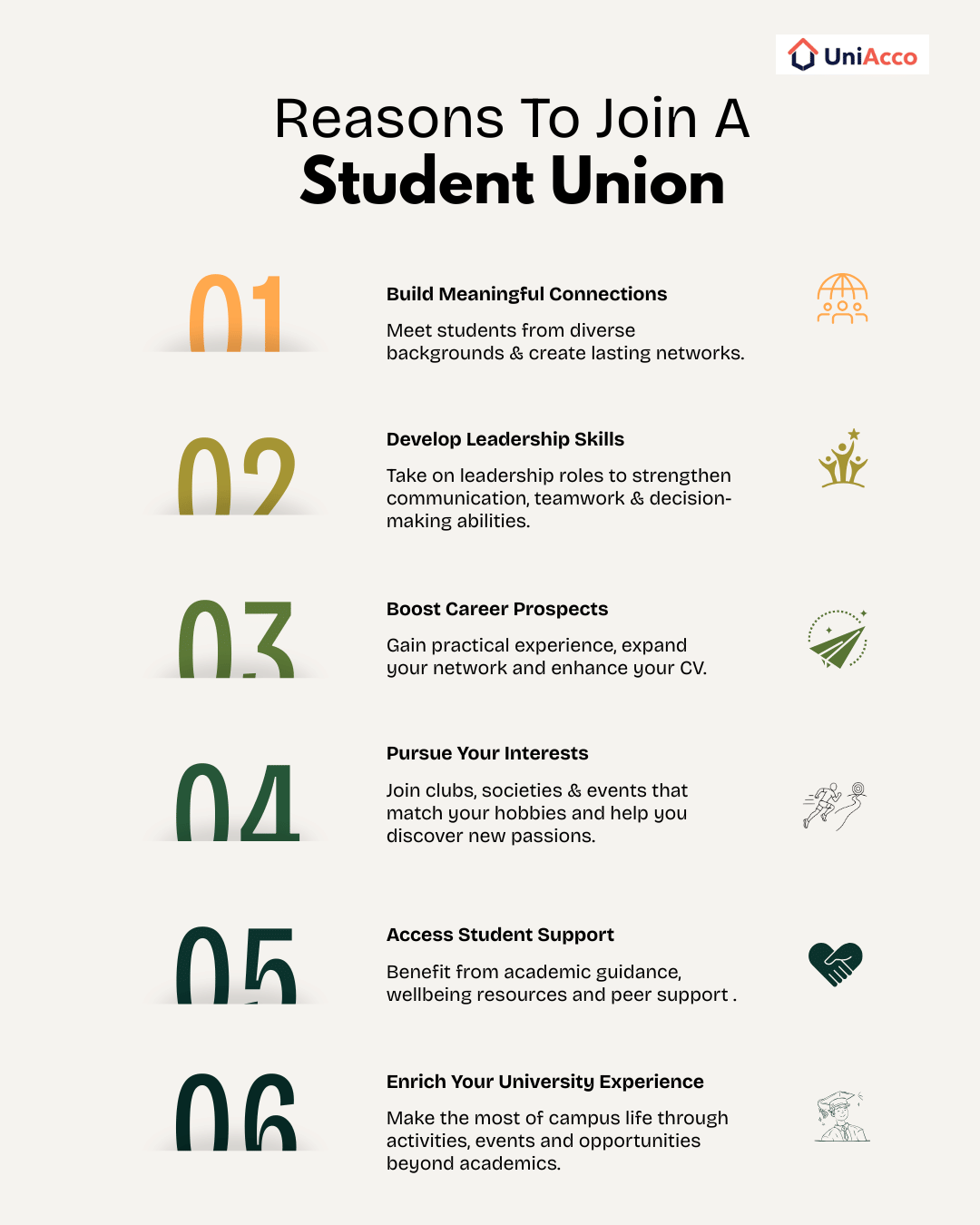
As an international student, one of the main reasons for you to be a part of the student union at the university is to find your tribe. The initial days of joining the campus can seem isolating and culturally shocking. When you become a part of the union groups, you are in a structured organisation where the chances of meeting like-minded students are high. Plus, it’s a great way of networking for future collaborative projects.
- Developing leadership skills
On the home ground, it’s easier to showcase one’s leadership skills, especially when you understand the human psyche, and of course, the language plays an important role. But on a foreign land, it may get overwhelming, although you may have it in you. But this is where you push yourself into the limelight and get spotted for showcasing your leadership skills, that would be the right kind of show off! And for the underconfident ones, this is a great platform to learn and absorb by simply observing your peers who are elected representatives. This is where theory ends, and practicality begins.
- Improving employability
When recruiters review your resume as an international student, they look for more than just your GPA. They want to know why you chose a specific country and the university, what you would aim to do if you were to go back to your home ground, and on top of that, if you have an experience that screams – I was the Student Union Leader or Treasurer, you have gained the extra grace for sure. Employers are looking for soft skills such as project management, financial accountability, and cross-functional leadership. This platform becomes your playground to grab a great offer.
- Exploring hobbies and interests
Look at student unions like your playground. Explore as much as you want until you find your voice, your calling. Chances of finding yourself lost in a foreign land are high; this is where you explore your hobbies and interests. In fact, it’s a great way to get out of your comfort zone because there’s nobody who really knows you, so there’s no added pressure, you see. There are immense opportunities that will surround you. From cultural events to academic events, you’ll have a wide spectrum to explore via student union events. Imagine ending up at a stand-up gig and realising that you had a hidden talent of cracking witty academic jokes!
- Accessing support services
Being an international student, it’s not so easy on the pocket. You know the cost of living with the tuition fees and the weekend getaways can get overwhelming. This is why student unions will help you with additional support services, like providing a safety net for academic or personal consultations. Or you can just walk up to the student representative to have a casual conversation about where to find a specific cuisine from your home; it could be a good way to break the ice, too!
- Enhancing your university experience
From late-night collaborations to performing at a music concert to political victories like becoming a student representative, university life is all about making the best memories. Being a part of the student union groups will give you all kinds of memories. When you go back to your home, you’ll have some incredible stories to share, and some of them can literally go up on your resume!
Common Student Union Activities
Student union activities are like the dramatic films of university life. This energy of youth is the sleaziest example of what a student union is all about. Here are some common activities you’ll find yourself in.
- Freshers’ Week events
This is one of the most awaited events for freshers and seniors. If you are on the receiving end, you are simply enjoying being in the front row seat of the show called Fresher’s Week. If you’re the organiser from the student union group, you get to see the entire event plan while enjoying it. From club fairs, food trucks, film screenings, and icebreakers, you’ll absolutely love this time of the year.
- Cultural celebrations
With students flocking from different parts of the world, there’ll be music, food, lifestyle, and language that you will be absorbing for the first time. And what better way to bring all the flags under one roof with a common theme: celebrations of diversity. From Diwali, New Year, Holi, Black History Month, to global food events, traditional music, and art, of course, the canvas is set.
- Sports tournaments
Whether you’ve loved playing sports or simply watching, you’ll get to hang around with some of the best athletes from around the world. And for those who run away from sports, you might just find a new sport you’ll probably fall in love with, just because you had a great player to play with.
- Workshops and training sessions
To get a breather from the usual lectures, which can be overwhelming, these workshops and training sessions arranged by student unions could help bring out your creative juices. From financial literacy workshops to hand painting to AI-based sessions, you’ll find a platter with mixed starters, choose one or one too many!
- Student campaigns
This is when the students are not in a very celebratory mood, probably because of some disturbing change in policies by the university administration. Collective movements where you channelise your issues through organising rallies, peaceful protests, social media campaigns, etc. Issues could be from a micro level, like a change in examination schedule, to a macro level, like climate change.
- Charity and fundraising events
These are the events that bring out the goodness in the students. Under several humanitarian causes, the student unions organise various fundraising events to raise thousands of dollars for global causes.
Is Student Union Membership Mandatory?
While discovering what is a student union, you might ask yourself whether you are officially forced to be a part of these groups. However, that’s not the case. You always have your freedom to choose.
In some countries, such as the UK, Australia, New Zealand, and Canada, the student union system is well structured, so you don’t have to fill out any extra forms. It all comes with the package. You automatically get rolled as a full member of the student union as soon as you complete your academic registration.
While automatic membership might seem like an enforcement, you always have an opt-out policy. Every university has its own set of constitutional laws regarding these opt-out policies. While doing so, be assured that it won’t affect your academic or personal life at the university in any way.
You might think you will be charged extra to be a part of these student unions. Or there might be some hidden cost. But that’s never the case. Mostly, you never have to pay a direct amount because the university has specially allocated funds to run these student unions.
Student Union vs Student Association: What’s the Difference?
Well, an obvious question might arise: what do student unions do that student associations don’t and vice versa? The table below clearly defines the roles and responsibilities of both bodies.
| Basis | Student Union | Student Association |
| Purpose | An independent body focused on campus-wide advocacy, political representation, and student welfare support. | Mostly a university-backed body focused on social events, club coordinations, and campus activities. |
| Structure | Led by independently elected student representatives with full legal, operational, and financial separation from the university administration. | Integrated with the university administration, led by students appointed by the administration. |
| Activities | Multiple focus across lobbying campaigns, legal advice, commercial enterprises, and welfare resources. | Concentrated mostly on campus entertainment, orientation programming, and basic support. |
| Representation | Represents the entire student body at the institutional, municipal, and national government levels, as in a political union. | Represents internal student feedback to specific faculty and local university departments. |
| Funding | Autonomous budgets set aside from independent university allocations, along with external commercial enterprises. | Directly funded by the dependent university administration’s annual budget approvals. |
Common Misconceptions About Student Unions
Student unions are only for social events
If you’ve reached this part of the blog, then you know that student unions are not merely about parties and protests alone. They are much more than that. But the daily work that goes into building a student union is more about understanding everyday gaps and building bridges so students can smoothly blend into university life. From writing legal policy briefs to managing large-scale events like mental health drives or election campaigns, there’s a lot more that goes on under the surface.
Only student leaders can participate
A student union is not a closed circle group, for sure. Nor is it an organisation that forces its students to join. The student union belongs to the entire union, which comprises students from different parts of the world. There is no special criterion required to become the leader of a student union, other than demonstrating your leadership skills.
Student unions are mandatory organisations
As we spoke earlier, the students at all times have the right to opt out of the union and to express their disagreements with any decision taken by the student union bodies. Not just that, you never have to pay a direct amount because the university has specially allocated funds to run these student unions.
International students don’t benefit from student unions
In fact, it’s the other way round. It’s the international students who benefit the most from these student unions. Think of it this way, international students are new to the country, and they have no real contacts or communities to rely on. At such times, these student unions can be a real saviour, helping students meet people from their countries or simply share similar interests that may lead to meaningful connections.
We’ve discussed all the important points about what do student unions do. Now let’s focus on some important tips to help you utilise these unions in your best interests.
Tips for Making the Most of Your Student Union
- Attend Freshers’ Week
When you’re attending a dealer’s week, don’t simply go there as a guest. Use it as your launchpad instead. Get out of your comfort zone and break the ice by talking to people who seem welcoming. Get in touch with the student representatives and leaders; they are literally waiting for you to walk up to them. Sign up for different mailing lists that may do the rounds around the place, which may invite you to professional inner circles.
- Join relevant societies
Sort yourself into different groups based on two broad ideas: professional and personal. Professional societies are the ones which will help you climb up the academic ladder. The personal societies are the ones you join for your soul, like a weekend hiking group.
- Participate in events and workshops
Don’t just spend your weekends at your rented apartment, no matter how comfortable it may seem. Keep an eye on the union’s digital bulletin and social media pages to know what’s happening, when and where. Get out of comfort or fear and try something new, like taking up a masterclass on a totally new subject.
- Use support services
This one is especially for international students. Don’t wait for things to hit the roof. Saying that you feel lost isn’t a sign of weakness but a sign of courage. So, walk up to the student rep responsible for support services and talk it out. Whether it’s something that happened in class or outside the university, anything at all, just reach out.
- Consider leadership roles
You know, at some point, the current student union leader must have gathered the courage to say — yes, I can do it. And so can you. So instead of sitting by the fence, break out of your fear and consider applying for the various opportunities. From a course representative to a treasurer, ask yourself which role fits you best. These roles could build your confidence, sharpen your leadership skills, expand your network, and leave you with experiences that stay with you long after graduation.
Also Read: University Essentials Guide 2026: The Complete Checklist for Students
Conclusion
A student union is a system with a powerful team by your side throughout your university journey. They are like your political ministers who look out for your needs and are constantly in the service of enhancing your life at the university by providing a platform for you. It’s almost like your home away from home, where you can drop in whenever you feel that things are falling apart in any walk of your life at the university. But make sure that you don’t become somebody who always knocks on the door for trivial issues that probably wouldn’t need the student union’s support. Be professional and yet human.











0 Comments