

Building your skill set over the years to land the perfect job is the route most graduates take. But some of them choose a degree that will land them that job once they graduate. These are the most employable degrees – the ones that are high in demand, that meet industry needs and evolve over the years. Surprisingly, these degrees are people degrees, meaning the hospitality industry, and leading towards interpersonal relationships.
This article will cover the most employable university degrees and the best degree for jobs students can go for – where they know their future is completely secured.
Top 20 Most Employable Degrees: An Overview
The most employable degrees are the ones that require a strong labour market, such as healthcare, law, business, computing, engineering, etc. These streams usually lead to clear career pathways and higher employment rates. As these degrees prepare these students for the real world out there, they are more likely to land a job immediately after graduation.
| Degree | Global Demand | Average Graduate Salary | Best Countries to Study |
| Pharmacy | High demand in healthcare and pharmaceutical sectors | US$45,000–80,000 | UK, Australia, Canada |
| Medicine | Very high, especially in healthcare systems worldwide | US$60,000–150,000+ | UK, Australia, Canada |
| Rehabilitation | High, driven by ageing populations and healthcare needs | US$40,000–70,000 | UK, Australia, Canada |
| Veterinary Science | Steady demand in animal health and food industries | US$50,000–90,000 | UK, Canada, New Zealand |
| Teacher Education | High in many countries with teacher shortages | US$30,000–60,000 | UK, Australia, Canada |
| Engineering | Very high across civil, mechanical, electrical, and other fields | US$55,000–100,000+ | Germany, UK, Canada |
| Nursing | Very high worldwide due to healthcare workforce shortages | US$45,000–85,000 | UK, Canada, Australia |
| Business and Management | High, especially in operations, finance, and consulting | US$45,000–90,000 | UK, USA, Singapore |
| Law and Paralegal studies | Moderate to high, depending on legal market and qualification route | US$40,000–120,000 | UK, USA, Australia |
| Dentistry | Very high, with strong earnings potential | US$70,000–150,000+ | UK, Australia, Canada |
| Agriculture and environmental studies | Rising demand due to sustainability and food security | US$35,000–70,000 | Australia, Netherlands, UK |
| Social work | Steady demand in public services and community care | US$30,000–55,000 | UK, Canada, Australia |
| Architecture and environmental studies | Moderate to high, especially in urban growth markets | US$40,000–80,000 | UK, Australia, Germany |
| Health sciences and support | Very high across allied health and public health roles | US$40,000–75,000 | UK, Canada, Australia |
| Computing and information system | Very high, driven by digital transformation and AI | US$60,000–120,000+ | USA, UK, Canada |
| Tourism & Hospitality | Variable, but strong in major tourism economies | US$30,000–60,000 | Switzerland, Australia, UAE |
| Psychology | Growing demand, especially with a mental health focus | US$35,000–70,000 | UK, Canada, Australia |
| Humanities, culture and social sciences | Moderate. Strongest when paired with transferable skills | US$30,000–60,000 | UK, USA, Netherlands |
| Science and mathematics | High, especially in research, analytics, and data roles | US$45,000–90,000 | UK, Germany, Canada |
| Communications | Moderate to high in media, PR, and digital content roles | US$35,000–75,000 | UK, USA, Australia |
What Makes a Degree Employable?
- Industry demand
When the outside world has a job for you, your skills upon graduation will lead you to employability. This is called the industry demand- it can be either for the skills you carry or the degree you graduate with.
- Graduate employment rates
Employability rates mean how many students from the lot who graduated find a job. A percentage of either 96% or 23% explains how much demand for the job is there in the world and the companies hiring them.
- Salary potential
Highly employable degrees will not always hold the most salary potential. In most cases, doctoral or medical positions do come with higher salaries based on their role and contribution to society. These degrees are, however, attractive as their base pay starts at the higher end as compared to many.
- Transferable skills
Communication, problem-solving, teamwork, data handling, and project management are skills that can be transferred to any role the graduate may take up further in the future.
- Global demand
Degrees with international recognition and demand, such as medicine, engineering, computing, and nursing, will offer jobs to graduates as roles like these are in demand everywhere in the world.
- AI resilience
Roles such as these are resilient to the introduction of AI. While robots or AI machines may be able to replicate, human intelligence combined with empathy, care, creativity, or ethical decision-making won’t be possible to transfer, needing humans to tackle issues like this.
- Career flexibility
The technical knowledge, skills learnt over the duration of your degree and human understanding will enable employability for students in any career they wish to take a change into.
Highest Paying Degrees vs Most Employable Degrees
| Aspect | Highest Paying Degree | Most Employable Degrees |
| Main focus | Maximising salary outcomes after graduation. | Maximising chances of getting hired and staying employed. |
| Typical subjects | Petroleum engineering, computer engineering, medicine, dentistry, finance, and some engineering fields. | Medicine, nursing, engineering, computing, education, and other shortage-area subjects. |
| What matters most | Salary potential, senior earning ceiling, and ROI. | Industry demand, graduate employment rates, and transferable skills. |
| Job certainty | Can be high, but depends on the role and market cycle. | Usually stronger because demand is broader and more stable. |
| Global mobility | Often strong in technical and regulated professions. | Strongest in internationally recognised fields like healthcare, IT, engineering, and teaching. |
| Best for students who want | The highest income possible. | A safer route into work with multiple career options. |
| Risk level | May require niche expertise or a longer training pathway. | Lower risk if the degree is aligned with persistent labour shortages. |
Planning a career-focused degree? Get your accommodation sorted with UniAcco. Find fully furnished student accommodation in the UK with all bills included, plus 24/7 student support to guide you from searching for your room to moving in.
🔍 Explore Student Accommodation in the UKTop 20 Most Employable Degrees in 2026
Pharmacy
Overview: Understanding medicines, patient care and prescribing OTC medicines to those in need is what pharmacists do. Individuals rely on pharmacists in hospitals, community medical stores, and for research purposes.
| Category | Details |
| Why it’s highly employable | Pharmacists are needed in hospitals, pharmacies and pharmaceutical companies. They can also work in research, regulation and pharmaceutical sales. |
| Top career paths | Community pharmacist, hospital pharmacist, clinical research associate, regulatory affairs specialist, medical science liaison |
| Average graduate salary | Around US$45,000–80,000 per year |
| Top recruiters & industries | Hospitals, pharmacy chains, pharmaceutical companies, healthcare providers, research organisations |
| Best countries to study | UK, Australia, Canada, USA |
| Top universities | University College London, King’s College London, University of Nottingham, Monash University, University of Toronto |
| Key skills you’ll develop | Knowledge of medicines, patient care, attention to detail, clinical judgement, ethics |
| Who should choose this degree? | Students who enjoy learning about medicines, healthcare and working with patients. |
Medicine
Overview: Studying medicine prepares students to undertake the role of a doctor and medical specialists. Medical professionals are constantly in demand because healthcare is constantly increasing, and with new inventions in the field, medical qualifications are the most in-demand degrees and are highly valued across the globe.
| Category | Details |
| Why it’s highly employable | Doctors are needed in almost every country. Medicine also offers clear career paths and good earning potential. |
| Top career paths | General practitioner, surgeon, paediatrician, psychiatrist, physician associate, medical researcher |
| Average graduate salary | Around US$60,000–150,000+ per year |
| Top recruiters & industries | Hospitals, public health systems, private clinics, research centres, government health services |
| Best countries to study | UK, Australia, Canada, Ireland |
| Top universities | University of Oxford, University of Cambridge, Harvard University, University of Melbourne, University of Toronto |
| Key skills you’ll develop | Clinical reasoning, diagnosis, communication, teamwork, resilience |
| Who should choose this degree? | Students who want to work in healthcare and are ready for a long period of study and training. |
Rehabilitation
Overview: A degree that enables people to find meaning, balance and mobility in life. Whether it is by undergoing rehab for recovering alcoholics or those who’ve met with personal accidents in life. This degree covers physiotherapy, occupational therapy, and related health fields. The demand for this specialisation is increasing due to age and chronic health problems faced by individuals today.
| Category | Details |
| Why it’s highly employable | Rehabilitation professionals are needed in hospitals, clinics, sports centres and community healthcare. |
| Top career paths | Physiotherapist, occupational therapist, rehabilitation specialist, sports therapist, neurorehabilitation therapist |
| Average graduate salary | Around US$40,000–70,000 per year |
| Top recruiters & industries | Hospitals, rehabilitation centres, sports clinics, aged care, private healthcare providers |
| Best countries to study | UK, Australia, Canada, New Zealand |
| Top universities | University of Sydney, University of Toronto, King’s College London, University of Queensland, University of Melbourne |
| Key skills you’ll develop | Patient care, movement assessment, treatment planning, communication, empathy |
| Who should choose this degree? | Students interested in healthcare, recovery and helping people improve their daily lives. |
Veterinary Science
Overview: With the number of animals in the world, treating them for diseases and injuries is an everyday occurrence. Veterinary science is one of the most in-demand degrees as it trains individuals to diagnose, treat and prevent life-threatening diseases in our loved ones. This degree is highly looked upon and respected. Roles can include companion animal care, livestock, research and public health.
| Category | Details |
| Why it’s highly employable | Vets are needed for animal healthcare, food safety and disease control. |
| Top career paths | Veterinary surgeon, livestock veterinarian, animal health consultant, veterinary pathologist, research vet |
| Average graduate salary | Around US$50,000–90,000 per year |
| Top recruiters & industries | Veterinary clinics, animal hospitals, agricultural businesses, government agencies, research labs |
| Best countries to study | UK, Australia, New Zealand, USA |
| Top universities | University of Cambridge, Royal Veterinary College, University of Edinburgh, University of Guelph, University of Melbourne |
| Key skills you’ll develop | Diagnosis, surgery, animal handling, communication, scientific analysis |
| Who should choose this degree? | Students who love animals and are interested in healthcare, science and animal treatment. |
Teacher Education
Overview: A degree for students who want to be trained to be teachers in the future. Teaching in schools and other educational settings. Many employable countries constantly deal with shortages in teachers – especially in STEM, early years and special education.
| Category | Details |
| Why it’s highly employable | Many countries have teacher shortages, especially in STEM, early education and special education. |
| Top career paths | Primary teacher, secondary teacher, special educational needs teacher, curriculum specialist, education consultant |
| Average graduate salary | Around US$30,000–60,000 per year |
| Top recruiters & industries | Schools, academies, education departments, tutoring organisations, training providers |
| Best countries to study | UK, Australia, Canada, New Zealand |
| Top universities | University of Oxford, University of Melbourne, University College London, University of Sydney, University of Toronto |
| Key skills you’ll develop | Classroom management, communication, lesson planning, leadership, adaptability |
| Who should choose this degree? | Students who enjoy teaching, mentoring and working with young people. |
Engineering
Overview: Engineers are required for technological performance, adding improvements and fixing machines. This field covers civil, mechanical, electrical, chemical, aerospace, and environmental specialisms. It constantly ranks among the most employable degrees in the world for this reason.
| Category | Details |
| Why it’s highly employable | Engineers are needed in construction, energy, transport, manufacturing and technology. |
| Top career paths | Civil engineer, mechanical engineer, electrical engineer, project engineer, design engineer |
| Average graduate salary | Around US$55,000–100,000+ per year |
| Top recruiters & industries | Construction firms, energy companies, technology firms, consulting companies, transport authorities |
| Best countries to study | Germany, UK, Canada, Australia |
| Top universities | MIT, University of Cambridge, Imperial College London, ETH Zurich, University of Melbourne |
| Key skills you’ll develop | Problem-solving, maths, design, technical analysis, project management |
| Who should choose this degree? | Students who enjoy maths, problem-solving and finding practical solutions. |
Nursing
Overview: A doctor will always need his nurse. Nurses are the backbone of any medical setup and huge hospitals. They maintain and follow checkup procedures, provide community care or are a hand to rely on for most patients without a supporter. It is especially attractive for students seeking clear work routes and international mobility.
| Category | Details |
| Why it’s highly employable | Nurses are needed in hospitals, clinics, community care and public health services around the world. |
| Top career paths | Staff nurse, ICU nurse, nurse practitioner, paediatric nurse, mental health nurse |
| Average graduate salary | Around US$45,000–85,000 per year |
| Top recruiters & industries | Hospitals, public healthcare systems, private healthcare, aged care providers, community health services |
| Best countries to study | UK, Canada, Australia, New Zealand |
| Top universities | King’s College London, University of Toronto, University of Sydney, University of Manchester, University of Melbourne |
| Key skills you’ll develop | Patient care, clinical observation, communication, teamwork, resilience |
| Who should choose this degree? | Students who enjoy helping people, can work under pressure and want a stable healthcare career. |
Business and Management
Overview: This is for students who look for careers in corporate. These come in a variety of positions ranging from operations, finance, marketing, strategy, and leadership. A degree in business and management opens up careers in various fields and can lead up the ladder quite quickly.
| Category | Details |
| Why it’s highly employable | Business graduates can work across many industries and help companies manage people, money, projects and growth. |
| Top career paths | Business analyst, project manager, operations manager, marketing executive, HR manager |
| Average graduate salary | Around US$45,000–90,000 per year |
| Top recruiters & industries | Consulting firms, banks, FMCG brands, startups, multinational companies |
| Best countries to study | UK, USA, Singapore, Canada |
| Top universities | London Business School, University of Oxford, University of Manchester, National University of Singapore, University of Toronto |
| Key skills you’ll develop | Leadership, communication, data analysis, strategy, teamwork |
| Who should choose this degree? | Students who are interested in business, leadership, entrepreneurship and different career options. |
Law and Paralegal Studies
Overview: Law and paralegal studies consist of the study of the law and dealing with conflicts using legal ways. Careers can lead into legal practice, compliance, policy and dispute resolution. Employability often depends on local qualification routes and professional licensing. This profession continues to be highly respected throughout the world.
| Category | Details |
| Why it’s highly employable | Legal skills are useful in law firms, companies, government and financial services. |
| Top career paths | Solicitor, barrister, paralegal, compliance officer, legal analyst |
| Average graduate salary | Around US$40,000–120,000 per year |
| Top recruiters & industries | Law firms, courts, government agencies, financial services, in-house legal teams |
| Best countries to study | UK, USA, Australia, Canada |
| Top universities | University of Oxford, University of Cambridge, Harvard University, University of Melbourne, University of Toronto |
| Key skills you’ll develop | Research, writing, critical thinking, argument building, attention to detail |
| Who should choose this degree? | Students interested in law, rules, evidence and solving complex problems. |
Dentistry
Overview: This is one of the healthcare degrees that requires a highly specialised focus on oral health, which covers the treatment, prevention and maintenance of the mouth. This is one of the strongest degrees in terms of employment and earning potential.
| Category | Details |
| Why it’s highly employable | Dentists are needed in private practices, hospitals, public health and specialist clinics. |
| Top career paths | General dentist, orthodontist, oral surgeon, public health dentist, dental researcher |
| Average graduate salary | Around US$70,000–150,000+ per year |
| Top recruiters & industries | Dental practices, hospitals, health systems, specialist clinics, research institutions |
| Best countries to study | UK, Australia, Canada, Ireland |
| Top universities | King’s College London, University of Manchester, University of Sydney, University of Toronto, University of Melbourne |
| Key skills you’ll develop | Clinical precision, patient care, diagnosis, manual dexterity, communication |
| Who should choose this degree? | Students who want a healthcare career with strong earning potential and an interest in oral health. |
Agriculture and Environmental Studies
Overview: Agriculture and environmental studies is understanding how sustainability, food systems, land management and environmental protection work. This degree imbues students with skills that they can use to preserve and work towards the greater good. This is becoming more important as issues such as climate change, food security and green transitions expand.
| Category | Details |
| Why it’s highly employable | Jobs are growing in sustainability, environmental consulting, farming, food production and resource management. |
| Top career paths | Agronomist, environmental consultant, farm manager, sustainability officer, conservation specialist |
| Average graduate salary | Around US$35,000–70,000 per year |
| Top recruiters & industries | Agribusinesses, environmental agencies, NGOs, research bodies, government departments |
| Best countries to study | Australia, Netherlands, UK, New Zealand |
| Top universities | Wageningen University, University of Reading, University of Melbourne, University of Guelph, University of Queensland |
| Key skills you’ll develop | Data analysis, sustainability planning, field research, problem-solving |
| Who should choose this degree? | Students interested in climate change, sustainability, food systems and protecting the environment. |
Social Work
Overview: Giving your life, providing for the betterment of individuals, families, and communities through welfare, advocacy and safeguarding. People volunteering their careers for public services are in huge demand, and care systems are constantly looking for people with newer and upgraded skills.
| Category | Details |
| Why it’s highly employable | Social workers are needed in healthcare, schools, local government, child protection and community services. |
| Top career paths | Social worker, family support worker, child protection officer, community services coordinator |
| Average graduate salary | Around US$30,000–55,000 per year |
| Top recruiters & industries | Local authorities, NGOs, hospitals, schools, social care organisations |
| Best countries to study | UK, Canada, Australia, New Zealand |
| Top universities | University of Toronto, University of Melbourne, University of Manchester, University of Sydney, London School of Economics |
| Key skills you’ll develop | Empathy, advocacy, communication, crisis support, case management |
| Who should choose this degree? | Students who enjoy helping people and want to support individuals, families and communities. |
Architecture and Built Environment
Overview: This is a degree that teaches construction, design, urban planning and the use of sustainable spaces. This degree requires creativity with technical knowledge and is in high demand in cities and many infrastructure-heavy markets.
| Category | Details |
| Why it’s highly employable | Cities need professionals who can design safe, useful and sustainable buildings and spaces. |
| Top career paths | Architect, urban planner, building surveyor, construction project manager, interior designer |
| Average graduate salary | Around US$40,000–80,000 per year |
| Top recruiters & industries | Architecture firms, construction companies, property developers, planning authorities |
| Best countries to study | UK, Australia, Germany, Netherlands |
| Top universities | University of Cambridge, University College London, University of Melbourne, ETH Zurich, Delft University of Technology |
| Key skills you’ll develop | Design, spatial thinking, technical drawing, project coordination, sustainability |
| Who should choose this degree? | Students who enjoy drawing, design, buildings and solving design problems. |
Health Science and Support
Overview: This degree is made to prepare students to face the medical world. Sectors such as allied health, public health, diagnostics, and healthcare operations come under the umbrella of health science and support. Health systems need both clinical and non-clinical help in the field.
| Category | Details |
| Why it’s highly employable | Healthcare workers are needed in hospitals, laboratories, public health services and care organisations. |
| Top career paths | Public health officer, laboratory technician, healthcare administrator, health information manager, allied health assistant |
| Average graduate salary | Around US$40,000–75,000 per year |
| Top recruiters & industries | Hospitals, health agencies, laboratories, NGOs, government health departments |
| Best countries to study | UK, Canada, Australia, USA |
| Top universities | University of Toronto, University of Sydney, Johns Hopkins University, University of Melbourne, King’s College London |
| Key skills you’ll develop | Health data, research, communication, service delivery, teamwork |
| Who should choose this degree? | Students interested in healthcare who do not necessarily want to become doctors or nurses. |
Computing and Information Systems
Overview: Today this is your world – on a phone. Computing and information systems covers your software, data systems, cybersecurity, and digital infrastructure. To say less, it is a field that is in high demand with the constantly growing digital world. The introduction of AI has made this an even more employable degree.
| Category | Details |
| Why it’s highly employable | Almost every industry needs people who can build, manage and protect digital systems. |
| Top career paths | Software developer, systems analyst, data analyst, cybersecurity analyst, cloud engineer |
| Average graduate salary | Around US$60,000–120,000+ per year |
| Top recruiters & industries | Tech firms, banks, startups, consulting firms, government departments |
| Best countries to study | USA, UK, Canada, Singapore |
| Top universities | MIT, Stanford University, University of Oxford, National University of Singapore, University of Toronto |
| Key skills you’ll develop | Programming, data analysis, cybersecurity, systems thinking, problem-solving |
| Who should choose this degree? | Students who enjoy technology, computers, data and logical problem-solving. |
Tourism, Hospitality, Personal Services, Sport and Recreation
Overview: The hospitality sector, the travel industry, along with Sports and recreation are the fastest-growing industries. Opening up various roles across each category. Hotels, restaurants, airlines, on-ground staff, trainers and more are always in demand. Countries with major tourism economies are always hiring newer talents.
| Category | Details |
| Why it’s highly employable | The industry has jobs across hotels, airlines, travel, events, sports and leisure. |
| Top career paths | Hotel manager, travel consultant, event coordinator, sports facility manager, guest services manager |
| Average graduate salary | Around US$30,000–60,000 per year |
| Top recruiters & industries | Hotels, resorts, airlines, event companies, tourism boards, gyms, sports organisations |
| Best countries to study | Switzerland, Australia, UAE, UK |
| Top universities | EHL Hospitality Business School, University of Surrey, Griffith University, The Hong Kong Polytechnic University, University of Queensland |
| Key skills you’ll develop | Customer service, communication, operations, teamwork, adaptability |
| Who should choose this degree? | Students who enjoy travel, hospitality, meeting people and working in a fast-moving industry. |
Psychology
Overview: The study of human behaviour, cognition and mental health is what the degree of Psychology entails. The relevancy of this degree isn’t only a human-to-human need, but now companies and businesses worldwide are recognising the need to tend to the mind. Making it one of the most employable degrees today.
| Category | Details |
| Why it’s highly employable | Psychology graduates can work in mental health, HR, research, user experience and support services. |
| Top career paths | Psychologist, counsellor, HR specialist, behavioural analyst, research assistant |
| Average graduate salary | Around US$35,000–70,000 per year |
| Top recruiters & industries | Health services, schools, HR teams, research centres, charities, technology companies |
| Best countries to study | UK, Canada, Australia, USA |
| Top universities | University of Oxford, University College London, University of Toronto, University of Melbourne, University of Cambridge |
| Key skills you’ll develop | Research, analysis, empathy, communication, critical thinking |
| Who should choose this degree? | Students who are curious about human behaviour, mental health and how people make decisions. |
Humanities, Culture and Social Services
Overview: Humanities, culture and social services is the study of human culture, history, sociology, and philosophy. These degrees remain valuable for their analytical and communication strengths.
| Category | Details |
| Why it’s highly employable | These degrees build skills that are useful in writing, research, policy, communication and cultural work. |
| Top career paths | Policy officer, researcher, editor, museum professional, community project coordinator |
| Average graduate salary | Around US$30,000–60,000 per year |
| Top recruiters & industries | Education, publishing, public sector, NGOs, cultural institutions, media |
| Best countries to study | UK, USA, Netherlands, Canada |
| Top universities | University of Oxford, University of Cambridge, University of Amsterdam, University College London, University of Toronto |
| Key skills you’ll develop | Writing, critical analysis, research, presentation, interpretation |
| Who should choose this degree? | Students who are curious about history, culture, society and how people think and express themselves. |
Science and Mathematics
Overview: Subjects in school that were always the vastest – degrees in Science and Mathematics cover physics, chemistry, biology, statistics and applied math. They are preferred for building a strong analytical foundation for research, finance, tech and technical industries.
| Category | Details |
| Why it’s highly employable | These degrees build strong skills in maths, problem-solving, research and data that can be used across many industries. |
| Top career paths | Data scientist, statistician, lab researcher, actuary, science analyst |
| Average graduate salary | Around US$45,000–90,000 per year |
| Top recruiters & industries | Universities, laboratories, fintech firms, pharmaceutical companies, government agencies |
| Best countries to study | UK, Germany, Canada, USA |
| Top universities | University of Cambridge, MIT, ETH Zurich, University of Toronto, University of Melbourne |
| Key skills you’ll develop | Quantitative analysis, research, modelling, logic, experimentation |
| Who should choose this degree? | Students who enjoy numbers, problem-solving, theories, research and logical thinking. |
Communications
Overview: The creative field of the lot. A communications degree focuses on media, public relations, digital content, corporate messaging and also audience engagement. The skills are highly sought after and can pay really well; however, this field is competitive.
| Category | Details |
| Why it’s highly employable | Companies need people who can write clearly, manage their public image and communicate with different audiences. |
| Top career paths | PR executive, content strategist, social media manager, corporate communications officer, journalist |
| Average graduate salary | Around US$35,000–75,000 per year |
| Top recruiters & industries | Media houses, PR agencies, brands, NGOs, startups, government departments |
| Best countries to study | UK, USA, Australia, Canada |
| Top universities | University of Leeds, University of Westminster, University of Sydney, University of Toronto, Northwestern University |
| Key skills you’ll develop | Writing, storytelling, media strategy, presentation, digital communication |
| Who should choose this degree? | Students who enjoy writing, storytelling, media, reporting and connecting with audiences. |
Wanna study in the UK but not sure which course to choose? Read this Reddit thread to find out which degrees could help you land a job even before finishing your course.
What’s a degree that will give you high chances of employment? – r/UKJobs
Top 10 Degrees with the Highest Employment Rates
| Degree | Graduate Employment Rate |
| Pharmacy | 98.4% |
| Medicine | 95.6% |
| Rehabilitation | 95.6% |
| Veterinary Science | 92.1% |
| Teacher Education | 89.6% |
| Engineering | 89.2% |
| Nursing | 86.8% |
| Business and management | 84.5% |
| Law and paralegal studies | 84.5% |
| Dentistry | 83.2% |
Best Degrees by Industry
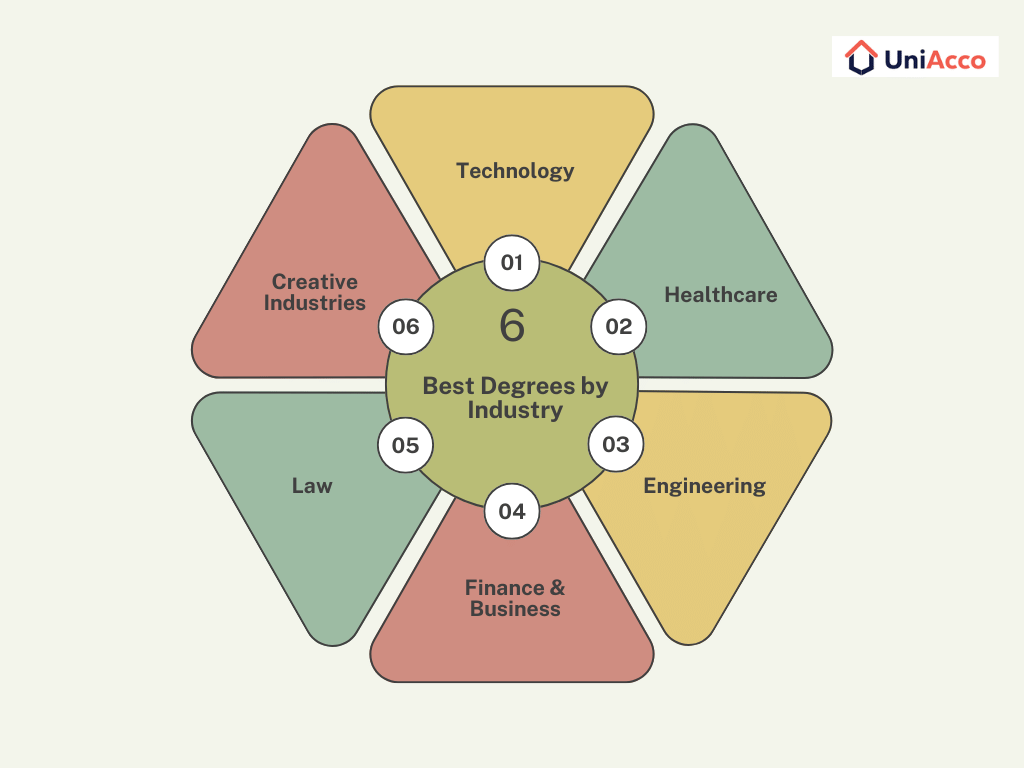
- Technology
- Computer Science
- AI
- Cybersecurity
- Software Engineering
- Healthcare
- Medicine
- Nursing
- Dentistry
- Pharmacy
- Engineering
- Mechanical
- Electrical
- Civil
- Chemical
- Finance & Business
- Accounting
- Economics
- Finance
- Business Analytics
- Law
- Law
- International Relations
- Criminology
- Creative Industries
- UX
- Animation
- Digital Marketing
- Graphic Design
Future-Proof Degrees in the Age of AI
| Industry | Expected Growth | Automation risk |
| AI | Growth is very high. Demand is increasing for AI engineers, machine-learning specialists, AI product managers, and responsible-AI experts. | Risk lies, but it’s not that much. Routine coding and analysis may be automated, but designing, auditing, and governing AI systems will continue to require skilled professionals. |
| Green Energy | Again high. The investment in renewable power, storage, grid infrastructure, and energy efficiency is expanding. | Can range between low to medium. Installation, engineering, maintenance, and site-based work are difficult to automate fully. |
| Climate Tech | Growth is currently high and will continue to be. Businesses and governments need solutions for emissions reduction, climate adaptation, and resource efficiency. | Low to medium. Research, regulation, fieldwork, and systems design require human expertise. |
| Cybersecurity | Very high due to expanding digital systems and increasingly sophisticated cyber threats are driving demand. | Depends. AI can support monitoring, but threat assessment, incident response, and security strategy still require human judgement. |
| Data | Very high. Organisations need data scientists, analysts, engineers, and specialists who can turn information into decisions. | Medium. Basic reporting may be automated, while advanced modelling, data governance, and interpretation remain more resilient. |
| Healthcare | Very high. Ageing populations, chronic conditions, and global healthcare shortages are supporting long-term demand. | Can be relatively lower. Diagnosis and administration may be AI-assisted, but patient care, accountability, and hands-on treatment remain highly human-centred. |
| Mental Health | Awareness of mental wellbeing and demand for counselling and psychological services continue to grow, and will always be in demand. | Empathy, trust, therapeutic relationships, and safeguarding are difficult to automate, hence lower. |
| Biotechnology | High. Growth is expected in pharmaceuticals, genomics, diagnostics, medical research, and agricultural biotechnology. | Low to medium. AI can accelerate research, but laboratory work, regulation, experimentation, and ethical decisions still need specialists. |
| Semiconductors | High. Demand is supported by AI, electric vehicles, consumer electronics, telecommunications, and advanced manufacturing. | Medium. Some manufacturing tasks may be automated, but chip design, materials science, engineering, and quality control require advanced expertise. |
| Robotics | Very high due to the changing landscape. Businesses are investing in automation, logistics, manufacturing, healthcare, and autonomous systems. | Medium. The industry creates demand for robotics engineers, but some routine operational roles may be replaced by the systems being developed. |
Choosing an employable degree in Australia? Get your accommodation sorted with UniAcco. Find fully furnished student accommodation with all bills included, plus 24/7 student support to guide you from your initial search right through to move-in day.
🔍 Explore Student Accommodation in AustraliaSkills Employers Seek in 2026 and Beyond
- Problem-solving
Organisations and employers will always prefer a candidate that knows how to identify a challenge, assess the options and work towards a solution – rather than leaving it up to the company to fix. This skill makes the employer value that employee even more in the long run.
- AI literacy
Using AI to its full potential while also following guidelines, being aware of the privacy policy and recognising incorrect data enables faster and smarter work – leading to efficiency.
- Data analysis
The ability to read the market and what the business needs. Understanding trends and evidence supports better decision-making in almost every industry.
- Communication
Clear writing, speaking and presentation skills help graduates explain ideas to colleagues, clients and the public. When you speak well, you go places, and that’s how most students land jobs, just because of their skills in pitching and selling their skills.
- Leadership
An employer would look for someone with leadership skills – someone who knows how to lead a team, take responsibility, motivate others and make crucial decisions. The skills of leadership are valuable in every aspect of life, as they make you independent and take steps confidently without the assurance of a third party.
- Critical thinking
Critical thinking is a skill that is valuable and incredibly beneficial not only in the corporate sector but when it comes to your personal life and maintaining inter-personal relationships. This is when you can assess information, challenge assumptions and make judgements based on evidence provided.
- Digital skills
In a world where everything is online, digital skills are essential. Understanding the workings of software, online platforms and how algorithms work is what will take a business forward.
- Adaptability
Learning the know-how of tools as and when required, learning skills or picking up responsibilities demanded by the job is appreciated by everyone.
- Emotional intelligence
Self-awareness, empathy and relationship-building support teamwork and are needed with the generation of individuals that work in corporate, even with the people you surround yourself with every day. This helps develop trust and encourages growth among everyone.
- Cross-cultural communication
International teams and diverse workplaces require graduates to communicate respectfully across cultures, lifestyles, and workplace regulations. languages and varied working styles.
Best Degrees for International Students
- UK
Most valuable degrees: Computing, engineering, medicine, nursing, pharmacy, data science, finance and education.
Average salaries: Graduates can expect salaries starting between £25,000 to £35,000. Although degrees such as technology, engineering, medicine and dentistry can offer higher starting pay due to the skills and effort required.
Graduate Visa opportunities: Eligible bachelor’s and master’s graduates can generally stay in the UK for two years if they apply for the Graduate visa on or before 31 December 2026. However, for applications made on or after 1 January 2027, the visa will be granted for 18 months. Doctoral graduates can stay for three years. Students planning to stay longer will have to issue a work visa, provided by their company.
- Australia
Most valuable degrees: Nursing, engineering, information technology, healthcare, accounting, teaching, construction and environmental science.
Average salaries: Technology, engineering and healthcare roles can earn much higher salaries. With starting pay for graduates being between AUD 55,000 to AUD 75,000.
Graduate Visa opportunities: The Temporary Graduate visa, subclass 485, usually provides two to three years, depending on the qualification. For eligible research and doctoral graduates, a visa granted for a longer period can be issued.
- USA
Most valuable degrees: Computer science, engineering, medicine, data science, business analytics, finance and biotechnology.
Average salaries: Graduate salaries commonly range from US$58,000 to US$82,000.
Graduate Visa opportunities: F-1 graduates may be eligible for up to 12 months of post-completion Optional Practical Training. Graduates of eligible STEM programmes may qualify for a further 24-month extension, subject to specific conditions.
- Canada
Most valuable degrees: Computing, engineering, nursing, healthcare, education, environmental science and skilled trades.
Average salaries: Students can expect a starting pay of CAD 50,000 to CAD 70,000, depending on the province, occupation and qualification.
Graduate Visa opportunities: Graduates of eligible institutions may qualify for a Post-Graduation Work Permit. Bachelor’s, master’s and doctoral graduates generally do not have a field-of-study requirement.
- Ireland
Most valuable degrees: Computing, data analytics, engineering, pharmaceuticals, business, finance and healthcare.
Average salaries: €30,000 to €45,000 is most graduates’ starting pay. Students graduating with technology, pharmaceuticals and financial services earn more.
Graduate Visa opportunities: Under the Third Level Graduate Programme, level 8 graduates can generally remain for 12 months, while level 9 graduates may remain for up to 24 months, subject to the scheme’s conditions.
- Germany
Most valuable degrees: Engineering, computer science, renewable energy, automotive technology, biotechnology and mathematics.
Average salaries: While factors such as region, sector and language ability may affect salaries, the starting pay for graduates can be between €38,000 and €52,000.
Graduate Visa opportunities: Graduates of German higher education institutions can generally apply for a residence permit of up to 18 months to look for qualified employment.
Which Degree Offers the Best Return on Investment?
| Degree | Cost of studying | Starting Salary | Break-even Time | ROI |
| Computing and information systems | US$20,000–55,000 per year in the USA | US$60,000–90,000 | Approximately 1–2 years | Very high |
| Engineering | US$20,000–55,000 per year in the USA. German universities may offer these courses at a lower fee. | US$55,000–80,000 | Approximately 1–3 years | High |
| Nursing | US$20,000–45,000 per year | US$45,000–70,000 | Approximately 2–4 years | High |
| Business and management | US$15,000–50,000 per year | US$45,000–70,000 | Approximately 2–4 years | Moderate to high |
| Medicine | US$30,000–90,000+ per year in some destinations | US$60,000–100,000+ after the relevant training stage | Approximately 4–8+ years | High long-term, but slower initial ROI |
| Pharmacy | US$20,000–60,000 per year | US$45,000–70,000 | Approximately 2–5 years | Moderate to high |
| Data science and mathematics | US$20,000–55,000 per year | US$60,000–90,000 | Approximately 1–3 years | Very high |
| Teaching and education | US$12,000–35,000 per year | US$30,000–50,000 | Approximately 2–4 years | Moderate |
| Communications | US$15,000–50,000 per year | US$35,000–55,000 | Approximately 3–6 years | Moderate |
| Humanities and social sciences | US$12,000–50,000 per year | US$30,000–50,000 | Approximately 3–7 years | Improves when combined with various skills |
How to Choose the Right Degree?
| If you | Choose this |
| Enjoy solving technical problems | Engineering, computer science, mathematics or data science |
| Prefer working with people | Nursing, medicine, psychology, teaching or social work |
| Want global mobility | Nursing, engineering, computing, medicine or business |
| Plan postgraduate study | Psychology, biological sciences, law, medicine or research-focused subjects |
| Love research | Biotechnology, science, mathematics, medicine or environmental studies |
| Need faster ROI | Computing, data science, engineering, nursing or a career-focused business degree |
| Have a creative outlook | Architecture, communications, design, media or marketing |
Common Mistakes When Choosing a Degree
- Choosing salary over interest
To study a degree you’re not really interested in, and even if you start working in that field just for the money, it is not really worth it. You might choose it for the time being, but the actual test is if you’re actually enjoying what you’re doing and want to continue doing that for the rest of your life.
- Ignoring industry demand
You might go for the degree because you really like it, but if the industry demand is zero – don’t expect jobs to be lined up once you graduate. You have to be smart and wise while selecting your degree.
- Following trends blindly
Popular developments in the field of technology such as AI may offer opportunities, but course quality, accreditation and long-term demand matter more than hype.
- Overlooking internship opportunities
Always start small and take up as many internships as you can while studying. This is what will eventually prepare you for corporate or full-time roles with the pay you deserve once you graduate.
- Ignoring employability statistics
Always check the graduate employability statistics, your career destinations and the salary your preferred degree will bring you. Ignoring these statistics will later put you in a fix, and you won’t know what to do next.
- Not researching visa opportunities
International students should check post-study work rules, sponsorship requirements and professional registration.
- Ignoring university reputation
The standing your university has in the world will depend on how and what opportunities you get. Check for accreditation, teaching quality, employer links and graduate support when you apply for one.
Emerging Careers to Watch
- AI Ethics Specialist
An AI ethics specialist assesses the fairness, transparency, safety and social impact that AI systems have, usually avoiding misuse or wrong use of power.
- Machine Learning Engineer
A machine learning engineer is skilled in designing, training, and deploy machine-learning models and various AI applications.
- Climate Risk Analyst
Climate change is a growing tension in the world. The job of a climate risk analyst is to analyse how this problem could affect businesses, infrastructure, investments and communities.
- Quantum Computing Researcher
This is the study of quantum algorithms, hardware and applications in security and scientific research.
- Digital Health Consultant
This is when healthcare and the digital world meet. A consultant enables healthcare organisations to use digital platforms, health data and technology effectively.
- AI Product Manager
The future is AI, this degree helps you understand user needs, technical development and commercial goals when creating AI products.
- AI Governance Specialist
The AI governance specialist develops policies and oversees the responsible use and development of AI.
- ML Operations Engineer
A machine learning operations engineer builds and maintains the systems used to deploy, monitor and update machine-learning models.
- Cyber Intelligence Analyst
Individuals passionate about cyber norms who investigate cyber threats and help organisations prevent and respond to attacks.
- Sustainability Consultant
They are responsible for organisations’ wise use of resources and ensuring they follow sustainability rules. Energy use, supply chains and environmental strategy are critical aspects of their job roles.
- Robotics Engineer
They are the minds behind the working, designing and maintaining of robots used in various fields. Running tests for optimum performance and efficiency is also one of their job roles.
- Bioinformatics Scientist
This degree requires the skill and understanding of biology, computing and statistics to analyse genetic, medical and pharmaceutical data.
The most employable degrees in 2026 are usually the ones that hold maximum earning, employment and growth opportunities. Students deciding on the right degree should look at every aspect of it, right from the career opportunities, placements, earning potential and the main thing, their passion for the subject. Universities around the globe offer these courses, but it is your duty to research and find the country and university that fits your budget and liking. In the end, it should all come down to you.
Starting your degree in Ireland? Find fully furnished student accommodation with all bills included through UniAcco. From choosing your room to moving in, our 24/7 student support team is there to help make your accommodation journey simple and stress-free.
🔍 Explore Student Accommodation in Ireland

 LinkedIn








0 Comments