

The world isn’t just moving, it’s reshaping itself around talent. Today, an estimated 304 million people live outside their home country, nearly double the number in 1990, as professionals chase higher salaries, global exposure, and career opportunities beyond borders. Acute talent shortages in tech, healthcare, engineering, finance, and skilled trades mean countries are competing fiercely for skilled workers, offering streamlined visas, PR-friendly pathways, and hybrid work models. Working abroad has evolved from a dream into a strategic career move.
This blog highlights the best countries to work abroad, detailing salaries, in-demand careers, visa options, PR routes, and key insights to plan your international move with confidence.
Top 10 Countries to Work Abroad: An Overview
| Country | Why It Stands Out | Avg Annual Salary Range | Top Job Sectors |
| Australia | – Strong economy- Hybrid work culture- High immigrant workforce | AUD 77,000 – 84,700 | – IT- Engineering- Healthcare- Construction |
| New Zealand | – High demand- Flexible residency pathways | NZD 72,800 – 103,300 | – Healthcare- IT- Engineering- Construction |
| Germany | – Skilled immigration reforms- Huge labour shortages | €50,000 – 90,000 | – Engineering- IT- Manufacturing- Trades |
| Netherlands | – Knowledge economy- Excellent quality of life | €39,000 – 70,000 | – IT- Healthcare- Engineering- Research |
| Switzerland | – Highest paid workforce globally- Advanced industries | CHF 79,980 – 90,000 | – Tech- Pharma- Finance- Healthcare |
| South Korea | – Rapid tech & manufacturing expansion- Talent shortage | ₩ 45,80,000 – 53,90,000 | – IT- R&D- Engineering- Manufacturing |
| Denmark | – Top work–life balance- Green-energy boom | DKK 450,000 – 700,000 | – Green Tech – IT- Engineering- Healthcare |
| Singapore | – Asia’s business capital- Lucrative salaries | SGD 60,000 – 85,000 | – FinTech- AI/Data- Engineering- Healthcare |
| Luxembourg | – High salaries- Finance and tech hub | €65,000 – 78,000 | – Finance- Cybersecurity- IT- Logistics |
| Finland | – Innovation-driven- Safe- High standard of living | €48,000 – 56,000 | – IT- Healthcare- Engineering- Research |
Secure a comfortable, verified home before you fly. Find your ideal student accommodation with UniAcco and get ready to focus on your studies.
Find Your Student AccommodationReasons to Work Abroad in 2026
1. Global Skill Shortages Open Doors for Skilled Talent
Countries worldwide are struggling to fill roles in tech, healthcare, engineering, and trades. For international students, this means more job opportunities, faster hiring, and a higher likelihood of landing roles that match their skills. Governments are actively seeking talent, creating a golden window for students to secure work abroad right after graduation.
2. Salaries Are Surging in High-Demand Sectors
Jobs in tech, healthcare, and engineering are paying significantly more than average. For instance, healthcare practitioners in the US earn around $80K/year, while AI specialists can make up to 67% more than standard software developers. For students, this means not just international experience but also a financially rewarding career start.
3. Remote-to-Relocation is the New Career Strategy
Companies now hire globally with flexible work models—remote-first roles often transition to relocation opportunities. Many employers offer up to 20% higher pay for in-office or hybrid positions, making it easier for international students to test the waters before fully relocating.
4. Visa and PR Pathways Are More Accessible Than Ever
Countries like Canada, Australia, and the UK are fast-tracking work visas and permanent residency for skilled professionals. International students with in-demand qualifications can navigate immigration processes faster, reducing uncertainty and providing a clearer path to long-term work abroad.
5. STEM and Skilled Trades Are in Skyrocketing Demand
AI, data analytics, and specialised trades are among the fastest-growing job areas globally, with some roles projected to grow by 40% year-on-year. Students in these fields are uniquely positioned to benefit from high demand, job security, and rapid career progression overseas.
6. Work-Life Balance and Quality of Life Improve Abroad
Countries like the Netherlands, Germany, and Australia offer strong healthcare, safety, and balanced work-life policies. For international students, this translates into a healthier, more productive lifestyle while gaining global exposure and experience in progressive work environments.
Factors Making a Country Great for Working Abroad
High Salary Potential: Countries like Canada, Australia, and the UK offer median wages in key sectors well above global averages, giving international students strong earning potential after graduation.
Skill-Shortage Priority: Nations such as Australia, Germany, and New Zealand maintain official skill shortage lists in healthcare, IT, engineering, and trades, making it easier for qualified students to secure visas and jobs.
Visa-Friendly Policies & PR Pathways: Countries like Canada and Australia provide post-study work visas and clear routes to permanent residency, offering international graduates stability and long-term career options.
Language & Expat-Friendly Culture: English-speaking and multicultural countries like Canada, the UK, and Germany make it easier for students to adapt, with support networks and English-taught programs for smoother integration.
Cost of Living vs Earnings: Scandinavian countries and the Netherlands offer high wages alongside financial stability, ensuring students’ earnings comfortably cover living costs without compromising lifestyle.
Strong Industry Growth & Job Security: Destinations with booming sectors, like Germany’s automotive industry and the U.S.’s manufacturing sector, offer international students long-term employment security in high-demand fields.
The best countries to work abroad in 2026 offer strong salary potential, clear visa pathways, and real demand across high-growth sectors, while supporting quality of life and long-term security. When these elements align, working abroad becomes a strategic move with lasting impact.
A List Of The 10 Best Countries To Work Abroad
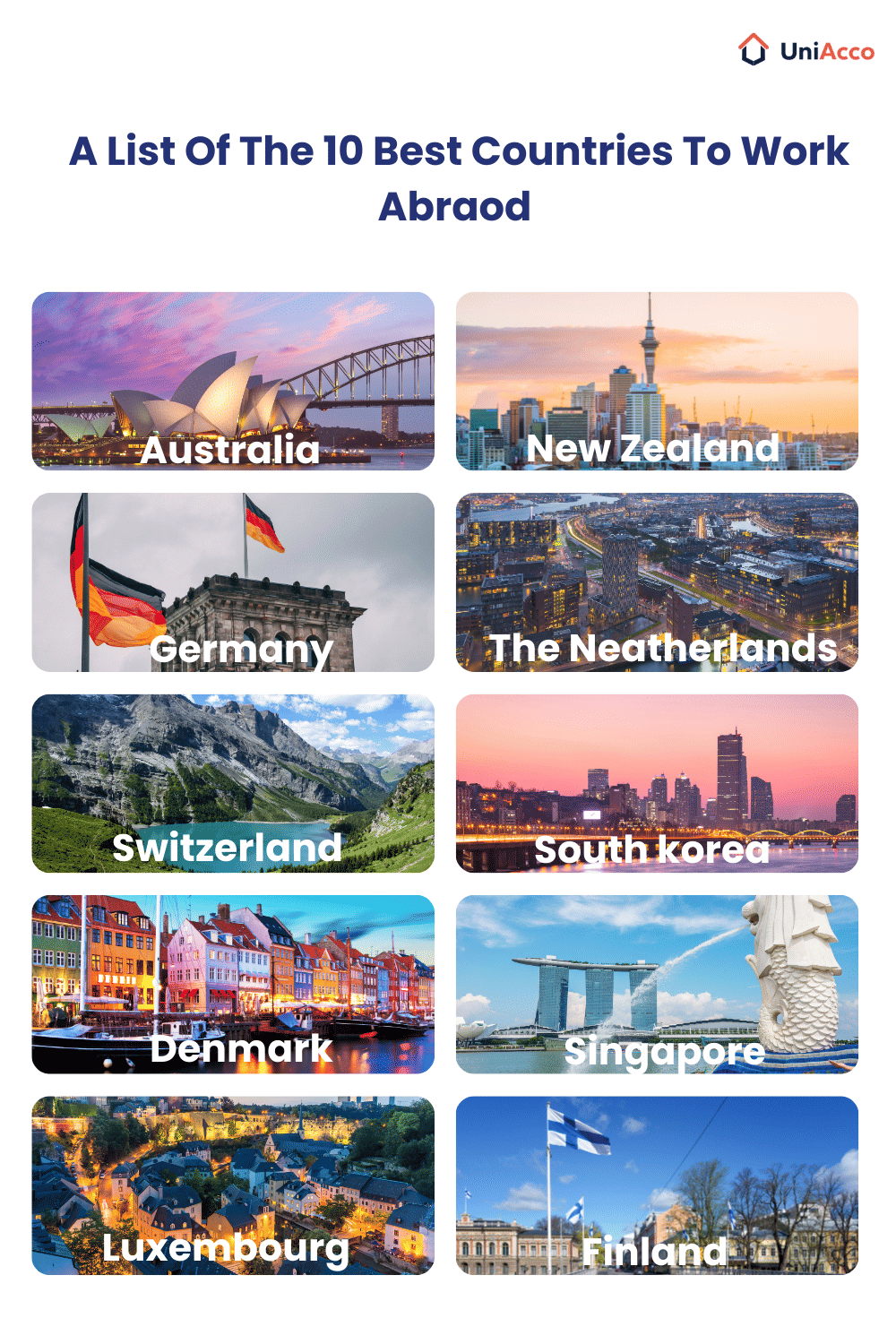
1. Australia
This country is one of the most attractive destinations for skilled professionals worldwide, known for its exceptional work culture and emphasis on work–life balance. As of June 2024, around 8.6 million people living in Australia were born overseas, accounting for 31.5% of the population, highlighting its strong global workforce representation.
Australia offers a stable economy, competitive salaries, and a diverse job market across sectors such as healthcare, engineering, IT, education, and construction. Many employers support hybrid work models, flexible schedules, and employee wellbeing programs, making it ideal for professionals seeking both career growth and personal fulfilment.
Working In Australia: Key Highlights
| Category | Details |
| Avg Annual Salary | Approximately AUD 77,000 to AUD 84,700 |
| In-Demand Jobs | IT / SoftwareEngineeringHealthcareEducationConstructionSkilled Trades |
| Cost of Living | AUD 1,500 – AUD 2,500 per month, depending on city and lifestyle |
International Work Visa Pathways in Australia
Many professionals begin their global careers by studying in Australia and transitioning to work through post-study visas. If you’re a student planning that journey, securing the right accommodation is step one.
Explore Student Accommodation in Australia2. New Zealand
In recent years, New Zealand has been increasingly recognised as a welcoming destination for skilled professionals, with a stable, high-income economy, demand across multiple sectors, and immigration pathways that offer the possibility of residence and long-term settlement. In fact, nearly 3 in 10 New Zealand residents (~29%) are foreign-born, highlighting the country’s openness to global talent.
New Zealand’s labour market currently has consistent demand for qualified workers in fields such as IT, healthcare, engineering, construction, and other skilled trades, especially roles listed on the official Immigration New Zealand (INZ) “Green List.”
Working In New Zealand: Key Highlights
| Category | Details |
| Avg Annual Salary | Approximately NZD 72,800 – NZD 103,300 |
| In-Demand Jobs | HealthcareEngineeringConstructionAgricultureITBusinessNurses and Specialist Physicians |
| Cost of Living | NZD $2,650 and $3,950/ Month |
International Work Visa Pathways in New Zealand
| Visa Type | Key Features | Ideal For |
| Skilled Migrant Category Resident Visa (SMC) | Points-based residence visa allows you to live and work permanently in New Zealand if you meet the criteria. | Skilled professionals whose occupation is in demand (or on the Green List), with job/offer and meet pay/qualification standards |
| Accredited Employer Work Visa (AEWV) | Temporary (initially) work visas let you work, and potentially transition to residence via skilled-job pathways if conditions are met. | Skilled foreign workers with job offers from accredited NZ employers.Good for those exploring or entering the workforce first time |
| Green List / Work-to-Residence Pathways | If your job is on the Green List (high-demand occupations), you may qualify for faster or direct residence applications under Work-to-Residence or Straight-to-Residence visa options. | Professionals in trust-listed fields (IT, healthcare, engineering, trades).Ideal for long-term plans or PR focus |
3. Germany
For skilled professionals seeking a stable long-term career pathway in Europe, Germany presents one of the strongest opportunities today. It is a major destination for skilled professionals worldwide, with a strong economy, advanced industries, and a growing need for a qualified workforce, especially in engineering, IT, healthcare, manufacturing, and skilled trades.
Through the recently strengthened immigration framework (including the Skilled Immigration Act (FEG)), Germany offers structured and accessible visa and residency pathways for non-EU professionals, making it an attractive long-term destination.
Working in Germany: Key Highlights
| Category | Details |
| Avg Annual Salary | $52,368 – $157,824 |
| In-Demand Jobs | EngineeringIT/SoftwareHealthcareSkilled Trades & Vocational ProfessionsResearch & SciencesManufacturing & Skilled Labour |
| Cost of Living | Between €900 – €1,500/ Month, depending on city and lifestyle |
International Work Visa Pathways in Germany
| Visa Type | Key Features | Ideal For |
| EU Blue Card | Residence permit for highly qualified work enables non-EU citizens with a recognised degree + a valid job offer to live and work in GermanyAllows long-term stay and family reunification under certain conditions. | Degree holders or equivalent with job offers in qualified employment, especially professionals in shortage / high-skilled fields |
| Residence Permit for Qualified Professionals (via Labour Migration rules) | For professionals with vocational training or recognised qualifications allows qualified employment in Germany under the Residence Act (AufenthG) if the job and qualification match. | Skilled workers (with a degree or recognised vocational qualification) across a wide range of non-academic and academic roles |
| Job-Search Visa / Permit (for Highly-Qualified Workers) | Allows degree-holders to come to Germany and search for qualified employment for up to 6 months. | Graduates from abroad seeking to find appropriate employment in Germany |
| Opportunity Card (under the Skilled Immigration Act) | New route for non-EU skilled workers (with vocational training or a degree) or in-demand workers to enter Germany even without an immediate job contract.Intended to simplify labour immigration under the updated Act. | Applicants with vocational backgrounds or degrees, especially those entering from countries outside the EU, seeking to find jobs locally |
If you are an Indian student exploring the study-abroad journey, this Quora thread features honest, real-world experiences and practical insights from people who’ve been there.

4. The Netherlands
The Netherlands is emerging as a top destination for global talent, driven by its strong knowledge economy, dynamic industries, and progressive immigration policies geared toward skilled workers from outside the EU/EEA.
With demand across sectors such as IT, engineering, research, healthcare, and specialised technical fields, the country offers attractive opportunities for professionals seeking both excellent career growth and long-term settlement.
Working in the Netherlands: Key Highlights
| Category | Details |
| Avg Annual Salary | Appromately €39,000 – €70,000 |
| In-Demand Jobs | Healthcare professionalsIT specialists: software developers, data scientists, cybersecurity expertsEngineers: civil, mechanical, electrical, chemicalBusiness services and retail rolesTechnicians and associate professionals |
| Cost of Living | €1,200–€1,600 per month, excluding rent |
International Work Visa Pathways in the Netherlands
| Visa Type | Key Features | Ideal For |
| Highly Skilled Migrant Permit (Kennismigrant) | Residence + work permit combined. Employer (recognised sponsor) applies, allows you to live and work legally in NLAlso permits self-employment or a side business under certain conditions. | Non-EU/EEA professionals with a job offer from a recognised employer and a salary meeting thresholds (age-based). |
| EU Blue Card (Netherlands variant) | For highly qualified workers with a degree + employment offer, enables legal residence and work.Mobility across the EU, a route to long-term stay/residency. | Degree-holders seeking skilled employment; particularly useful if you plan EU-wide mobility/long-term European career. |
| Orientation Year / Recent Graduate Route, Highly-Skilled Permit | If you completed higher education (master’s/PhD or designated degree) in NL or an eligible institution, you can apply for an orientation-year stay to seek work, then convert to a skilled-migrant permit if a job is found. | International graduates looking to transition into employment in NL after their studies. |
| Other Work / Residence Permits (TWV / GVVA / Employment Permit) | For roles outside the “highly-skilled” threshold but still requiring a permitThe employer must apply for a work permit.Valid for employment as per Dutch labour laws. | Workers whose jobs or pay do not meet “highly-skilled” criteria but still require legal authorisation.Often suited for shorter-term or sectoral jobs. |
5. Switzerland
Switzerland attracts skilled professionals globally with its high-income economy, strong labour demand in specialised sectors, and a structured immigration + work-permit system.
Given its stable economy, advanced industries (especially in finance, engineering, healthcare, pharmaceuticals, and technology), and relatively high standard of living, Switzerland remains a compelling destination for international workers wanting both career growth and long-term residence.
Working in Switzerland: Key Highlights
| Category | Details |
| Avg Annual Salary | Approximately CHF 79,980 – CHF 84,300 |
| In-Demand Jobs | Engineering IT / SoftwareHealthcarePharmaceuticalsResearch & SciencesSkilled Trades & Specialist Roles |
| Cost of Living | CHF 2,360 to CHF 2,590/Month |
International Work Visa Pathways in Switzerland
| Visa Type | Key Features | Ideal For |
| Swiss Work Permit / Residence Permit for Employment | Allows non-EU/EFTA foreign nationals to live and work legally in SwitzerlandValid only if the employer sponsors the permit and the quota is available. | Skilled workers with a confirmed job offer + recognised qualification, willing to relocate under employer sponsorship. |
| L Permit | Short-term residence/ work permit typically for employment contracts up to 12 months (or initially short-term assignments). | Professionals accepting temporary or short-contract jobs. |
| B Permit | For longer-term employment contracts renewable annually. Standard permit for longer-stay workers. | Skilled workers employed on longer contracts and intending to stay. |
| EU/EFTA Nationals (or nationals from countries with bilateral agreements) | Under free-movement or bilateral agreements, they can obtain permits once they register locally.Generally, easier access without strict quotas or labour-market tests. | Professionals from the EU/EFTA region are looking for easier access to the Swiss job market. |
6. South Korea
South Korea is rapidly emerging as a top destination for global talent, fuelled by strong growth in technology, manufacturing, and high-tech industries, and a significant shortage of skilled professionals. As of 2024, the number of foreign workers in the country recently crossed the 1.01 million mark, reflecting its expanding reliance on international talent.
Through visas like the E-7 Work Visa, the government is actively attracting experts in fields such as IT, engineering, R&D, and healthcare to address critical workforce gaps. This makes South Korea an appealing choice for skilled professionals seeking strong career opportunities and flexible immigration pathways in Asia.
Working in South Korea: Key Highlights
| Category | Details |
| Avg Annual Salary | ₩4580000 to 5390000 |
| In-Demand Jobs | IT / Software, Engineering, Research & DevelopmentEducation & Language TeachingTechnical & Skilled TradesHealthcare & Specialist ProfessionsManufacturing |
| Cost of Living | ₩120000 and ₩250000 |
International Work Visa Pathways in South Korea
| Visa Type | Key Features | Ideal For |
| E-7 (Foreign National of Special Ability / Skilled Worker Visa) | For foreign professionals hired for specified skilled occupations.Allows work and residence for 1–3 years (renewable). | Skilled professionals in IT, engineering, technical fields, or other qualified occupations. |
| E-1 / E-2 / E-3 / E-4 / E-5 (Professor, Language Instructor, Researcher, Technician, Licensed Professional) | Allows foreigners to work in teaching, research, technical or licensed-profession roles at institutions/companies in Korea.Typically issued for 1 year and renewable. | Academics, teachers, researchers, and qualified professionals in licensed occupations. |
| D-10 (Job-Search / Job-Seeker Visa) | Short-term visa permitting stay (without immediate job offer) to search for suitable employment in Korea valid for a limited period. | Degree-holders or qualified job seekers planning to find employment in Korea before converting to a work visa. |
| E-9 / Other Non-Professional Visas (under Employment Permit System, EPS) | For non-professional or semi-skilled jobs (manufacturing, labour-intensive roles) under regulated sectorsTypically employer-sponsored. | Foreign workers for labour/manufacturing / semi-skilled roles (when eligible under quota/permit terms). |
7. Denmark
Denmark is becoming an increasingly attractive destination for skilled professionals, thanks to its strong economy, world-leading work–life balance, and growing reliance on international talent. As of 2023, foreign-born residents made up around 11.8% of the population, and 1 in every 8 full-time workers in Denmark is now a foreigner, reflecting a major rise in international hiring across key sectors.
With high demand in fields such as IT, engineering, healthcare, green energy, and skilled trades, and streamlined work-permit routes like the Positive List and Pay Limit Scheme, Denmark offers a compelling opportunity for professionals seeking rewarding careers and a high quality of life.
Working in Denmark: Key Highlights
| Category | Details |
| Avg Annual Salary | DKK 450,000 to DKK 700,000 |
| In-Demand Jobs | Renewable Energy & Green-techLogistics & Supply ChainFinance & Business ServicesIT/SoftwareEngineeringHealthcare (medical, nursing) |
| Cost of Living | 5,800 to 12,100 DKK, depending on the city and lifestyle |
International Work Visa Pathways in Denmark
| Visa Type | Key Features | Ideal For |
| Positive List Scheme | Work & residence permit for non-EU professionals hired for jobs on Denmark’s official shortage-occupation list. | Skilled workers whose profession is listed among shortage occupations are quickly eligible if other requirements are met. |
| Pay Limit Scheme | Work & residence permit for high-salary roles (above salary threshold), regardless of job-type or shortage list. | Professionals offered high-paying jobs by a Danish employer, even if the occupation is not on the shortage list. |
| Fast-Track / Standard Skilled-Worker Permits | For recognised sponsors/employers hiring skilled foreign workersFollow standard salary & contract compliance rules. | Skilled foreign workers with employer sponsorship and a contract meeting Danish employment standards. |
8. Singapore
Singapore is one of Asia’s most powerful talent hubs, known for its innovation-driven economy, high salaries, and business-friendly environment. The country attracts skilled professionals globally due to its stable economic growth, world-class infrastructure, and strong demand across technology, finance, healthcare, engineering, and advanced manufacturing. As of 2024, Singapore is home to over 1.47 million foreign workers, reflecting its deep reliance on international talent and a globally connected workforce.
Alongside strong career prospects, Singapore delivers an exceptional living experience a safe, diverse, and highly efficient city with world-leading healthcare and public transport. It’s a place where professionals can grow their careers without compromising on quality of life.
Working in Singapore: Key Highlights
| Category | Details |
| Avg Annual Salary | Approximately SGD 60,000 – SGD 85,000 |
| In-Demand Jobs | Tech & Software EngineeringBanking & FinanceCybersecurityHealthcareData & AIEngineeringBiotech |
| Cost of Living | SGD 1,800 – SGD 3,200/month (excluding rent) depending on lifestyle & location |
International Work Visa Pathways in Singapore
| Visa Type | Key Features | Ideal For |
| Employment Pass (EP) | Allows professionals, managers & executives to work in SingaporeRenewable and can support PR eligibility | Skilled professionals with relevant qualifications and competitive salary offers |
| S Pass | Mid-level skilled workers; quota-regulated and renewable | Technicians & mid-skilled professionals within approved industries |
| ONE Pass (Overseas Networks & Expertise Pass) | 5-year pass for top global talentAllows flexibility to work with multiple employers | High-earning professionals with established achievements in business, research, or tech |
| Tech.Pass | Designed to attract leading global tech experts and foundersFlexible employment options | Senior tech specialists, founders, and innovators in deep tech fields |
9. Luxembourg
Luxembourg is one of Europe’s strongest and wealthiest economies, known for high living standards, excellent salaries, and a multicultural workforce.
The country has a thriving job market driven by finance, banking, technology, engineering, research, and logistics, supported by a stable economy, strong labour protection laws, and a high quality of life. For skilled workers seeking European exposure and long-term residence opportunities, Luxembourg remains a highly competitive and attractive option.
Working in Luxembourg: Key Highlights
| Category | Details |
| Avg Annual Salary | Approximately €65,000 – €78,000 |
| In-Demand Jobs | Finance & BankingIT & SoftwareEngineeringCybersecurityData & CloudHealthcareResearch & PhD rolesLogistics & Supply Chain |
| Cost of Living | Around €2,000 – €2,800/month depending on location & lifestyle |
International Work Visa Pathways in Luxembourg
| Visa Type | Key Features | Ideal For |
| EU Blue Card | Residence & work permit for highly-skilled professionals with a recognised degree + job offer meeting salary threshold | Professionals in high-demand sectors such as IT, finance, engineering, scientific R&D |
| Salaried Worker Permit | Standard work visa for non-EU nationals holding an employment contract; renewable | Skilled workers across general occupations |
| Highly-Qualified Worker Permit | Fast-track for high-skilled profiles meeting salary and qualification requirements | Professionals with specialised expertise and senior-level roles |
10. Finland
Finland is increasingly becoming a go-to destination for global talent, thanks to its strong economy, high quality of life, and growing demand across sectors like IT, engineering, healthcare, research and technology. In 2025, the median gross monthly earnings for a full-time employee in Finland stood at €3,611, meaning many skilled workers can expect competitive income while benefiting from Finland’s excellent public services and social safety net.
Working in Finland: Key Highlights
| Category | Details |
| Avg Annual Salary | Starting from €48,000 to €56,000 |
| In-Demand Jobs | IT / SoftwareEngineering & Technical RolesHealthcareResearch & SciencesSkilled TradesSpecialists in high-qualification fields |
| Cost of Living | €1,700 to €1,730/ Month |
International Work Visa Pathways in Finland
| Visa Type | Key Features | Ideal For |
| Residence Permit for Employed Person | Standard permit for non-EU/EEA nationals with a valid job contractAllows legal work + residencePermit is employer-linked. | Skilled workers with a confirmed employment offer across various sectors. |
| Residence Permit for Specialists / Highly-Qualified Workers | For professionals with higher education/specialist qualificationsOften paired with better job offersAllows residence & workMay lead to renewal and residency eligibility. | Degree-holders, experienced professionals in technical/engineering/IT/healthcare/research fields. |
| EU Blue Card (Finland variant) | For non-EU high-skilled workers with a recognised degree + employment meeting salary/contract criteriaEnables workResidenceand (after tenure) option for long-term EU residence. | Highly qualified specialists, senior professionals, experts across demand sectors. |
| Residence Permit for Job-Seekers / Recent Graduates (limited cases) | For those who have completed education/research or a qualification in FinlandA temporary stay to search for employment or start registration of residence/permit. | International graduates, researchers, and those looking for suitable employment after studies. |
Having explored the best countries for global opportunities, it is also essential to know about the in-demand careers shaping the future job market and driving success worldwide.
Most In-Demand Careers Abroad
The fastest-growing global job opportunities are concentrated in fields where talent shortages are the most urgent and where countries are actively competing to attract skilled professionals. Across nearly every top work-abroad destination, the same pattern emerges: if your skills solve real workforce gaps, the world wants you.
1. Technology (IT & AI)
Software engineers, data scientists, and cybersecurity experts are in massive demand globally, with AI specialists earning ~67% more than traditional IT roles. Salaries often exceed $100,000 annually in countries like the US, Canada, Germany, the UK, and Australia, making this sector highly attractive for international students.
2. Healthcare
Global shortages of nurses, doctors, and therapists create strong opportunities abroad. Registered nurses alone earn upwards of $80,000 annually in the US, Canada, the UK, Australia, and Ireland, offering stable, high-paying careers for students with healthcare qualifications.
3. Engineering
Civil, mechanical, electrical, and mining engineers are sought after worldwide. With salaries ranging from $80,000–$120,000 and strong demand in Canada, Australia, Germany, and the UAE, international students in engineering fields can secure rewarding roles soon after graduation.
4. Finance & Accounting
Corporate finance, audit, and fintech professionals remain consistently in demand. Median salaries start around $70,000 in the US, UK, Australia, and Singapore, offering international students pathways to globally recognised, high-growth careers.
5. Skilled Trades
Electricians, welders, plumbers, and mechanics are facing shortages in countries like Germany, Canada, Australia, and New Zealand. Median earnings start at $60,000, offering practical, hands-on career opportunities that often lead to permanent residency.
6. Hospitality & Tourism
Hotel management, culinary, and tourism roles are rebounding post-pandemic, especially in the UK, Spain, Australia, and the UAE. Pay varies widely, but benefits and growth opportunities make this sector appealing for international students seeking flexible or entry-level work abroad.
7. Education / Teaching
High demand exists for STEM, ESL, and special education teachers in countries such as Canada, Australia, the UAE, and Singapore. Salaries can reach up to $70,000, offering international students a meaningful career path with options for long-term relocation.
Many students use the UK as a stepping stone to global careers, staying back for work opportunities through post-study visas. Secure the perfect student accommodation with UniAcco.
Explore Student Accommodation in the UKHere’s a short video that offers a quick overview of the best countries to work and live abroad:
Conclusion
Today’s global job market isn’t just expanding, it’s actively competing for skilled talent. Countries like Australia, New Zealand, Germany, and emerging destinations such as the Netherlands, Denmark, and Finland are rolling out priority visa pathways, high-growth roles in tech, healthcare, engineering, and finance, and clear routes to long-term residency.
But moving abroad isn’t just about securing the right job; it’s about building the right life. Where you live determines how smoothly you settle in, how quickly you adapt, and how confidently you begin your new chapter. And if you’re an international student preparing to study abroad, your stay is the last thing you should worry about. With UniAcco, you get access to some of the best verified student accommodations across major global cities.










This was a pretty informative article, it has been a great help.
This is so informative and helpful, would love to read more such blogs.
Superr informative and helpful blog💯!! This is usually a bigg confusion but thanks to this awesome blog it is sorted and much more clear now. Thanks a ton for this. Looking forward for more of ur blogs!
Laundry job